
实验进化过程中必需的细胞内细菌的基因组动态和温度适应。
Genome Dynamics and Temperature Adaptation During Experimental Evolution of Obligate Intracellular Bacteria.
机构信息
Centre for Microbiology and Environmental Systems Science, University of Vienna, Vienna, Austria.
出版信息
Genome Biol Evol. 2023 Aug 1;15(8). doi: 10.1093/gbe/evad139.
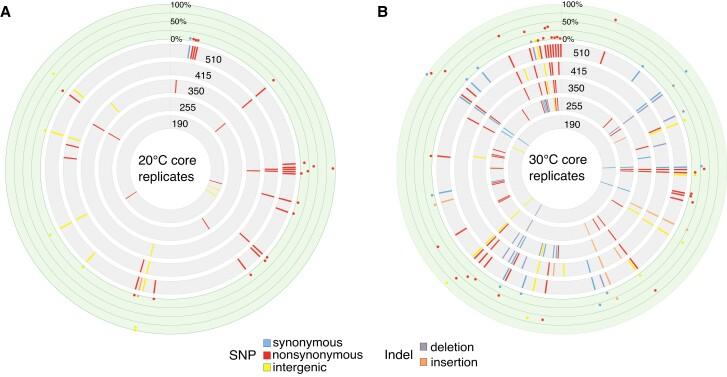
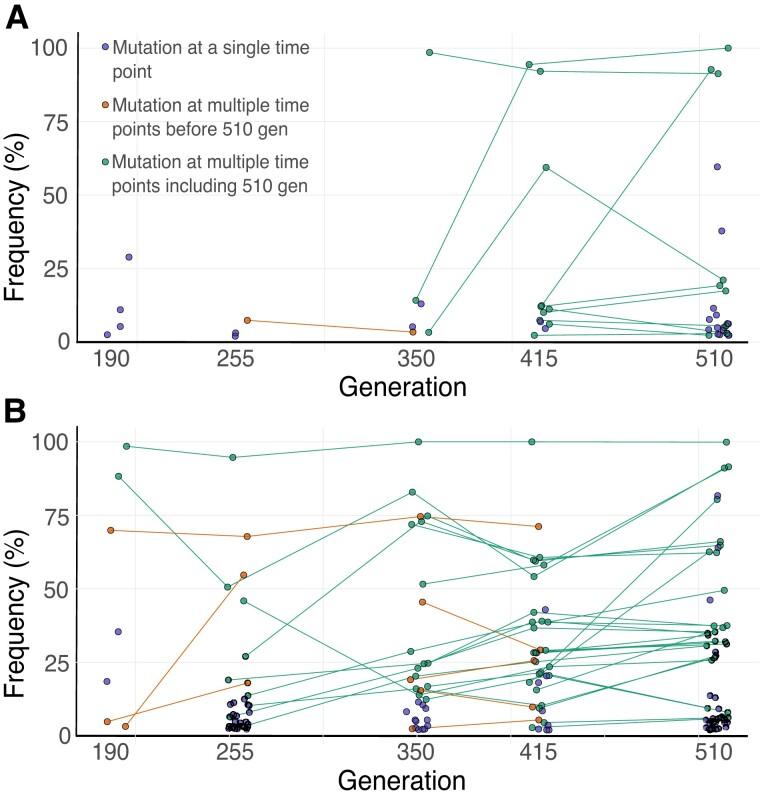
Evolution experiments with free-living microbes have radically improved our understanding of genome evolution and how microorganisms adapt. Yet there is a paucity of such research focusing on strictly host-associated bacteria, even though they are widespread in nature. Here, we used the Acanthamoeba symbiont Protochlamydia amoebophila, a distant relative of the human pathogen Chlamydia trachomatis and representative of a large group of protist-associated environmental chlamydiae, as a model to study how obligate intracellular symbionts evolve and adapt to elevated temperature, a prerequisite for the pivotal evolutionary leap from protist to endothermic animal hosts. We established 12 replicate populations under two temperatures (20 °C, 30 °C) for 510 bacterial generations (38 months). We then used infectivity assays and pooled whole-genome resequencing to identify any evolved phenotypes and the molecular basis of adaptation in these bacteria. We observed an overall reduction in infectivity of the symbionts evolved at 30 °C, and we identified numerous nonsynonymous mutations and small indels in these symbiont populations, with several variants persisting throughout multiple time points and reaching high frequencies. This suggests that many mutations may have been beneficial and played an adaptive role. Mutated genes within the same temperature regime were more similar than those between temperature regimes. Our results provide insights into the molecular evolution of intracellular bacteria under the constraints of strict host dependance and highly structured populations and suggest that for chlamydial symbionts of protists, temperature adaptation was facilitated through attenuation of symbiont infectivity as a tradeoff to reduce host cell burden.
自由生活的微生物进化实验极大地提高了我们对基因组进化以及微生物如何适应环境的理解。然而,针对严格依赖宿主的细菌的此类研究却很少,尽管它们在自然界中广泛存在。在这里,我们使用变形虫共生体原生质体Protochlamydia amoebophila 作为模型,研究专性细胞内共生体如何进化和适应高温,这是从原生动物到恒温动物宿主这一关键进化飞跃的前提。我们在两种温度(20°C 和 30°C)下建立了 12 个重复种群,共进行了 510 代细菌培养(38 个月)。然后,我们使用感染性测定和全基因组重测序的组合来鉴定这些细菌中出现的任何进化表型和适应的分子基础。我们观察到在 30°C 下进化的共生体的整体感染性降低,并且在这些共生体群体中鉴定出许多非同义突变和小的插入缺失,其中一些变体在多个时间点持续存在并达到较高频率。这表明许多突变可能是有益的,并发挥了适应性作用。同一温度下的突变基因比不同温度下的基因更为相似。我们的研究结果为在严格的宿主依赖性和高度结构化的种群限制下,细胞内细菌的分子进化提供了新的见解,并表明对于原生动物的衣原体共生体,通过降低共生体的感染性来适应温度,是减少宿主细胞负担的一种权衡。


 Zotero 插件