
2015 - 2021年中国北京市人类札如病毒引起的急性胃肠炎暴发的基因型多样性
Genotypes Diversity of Acute Gastroenteritis Outbreaks Caused by Human Sapovirus - Beijing Municipality, China, 2015-2021.
作者信息
Jiao Yang, Han Taoli, Qi Xiao, Gao Yan, Zhao Jianhong, Zhang Yue, Li Beibei, Zhang Zheng, Du Jialiang, Sun Lingli
机构信息
Beijing Chaoyang District Center for Disease Control and Prevention, Beijing, China.
National Institutes for Food and Drug Control, Beijing, China.
出版信息
China CDC Wkly. 2023 Jul 14;5(28):625-631. doi: 10.46234/ccdcw2023.119.
INTRODUCTION
Human sapovirus (HuSaV) is an enteric virus responsible for sporadic cases and outbreaks of acute gastroenteritis (AGE) globally. A seven-year active surveillance study was conducted to investigate the molecular epidemiology of HuSaVs associated with AGE outbreaks in Chaoyang District of Beijing Municipality, China from January 2015 to December 2021.
METHODS
Fecal and anal swab samples were obtained from patients experiencing AGE outbreaks. HuSaVs were identified through reverse transcription polymerase chain reaction (RT-PCR), and partial viral protein 1 (VP1) sequences (approximately 434 base pairs) were utilized for genotyping, single nucleotide polymorphism (SNP) analysis, and phylogenetic examination.
RESULTS
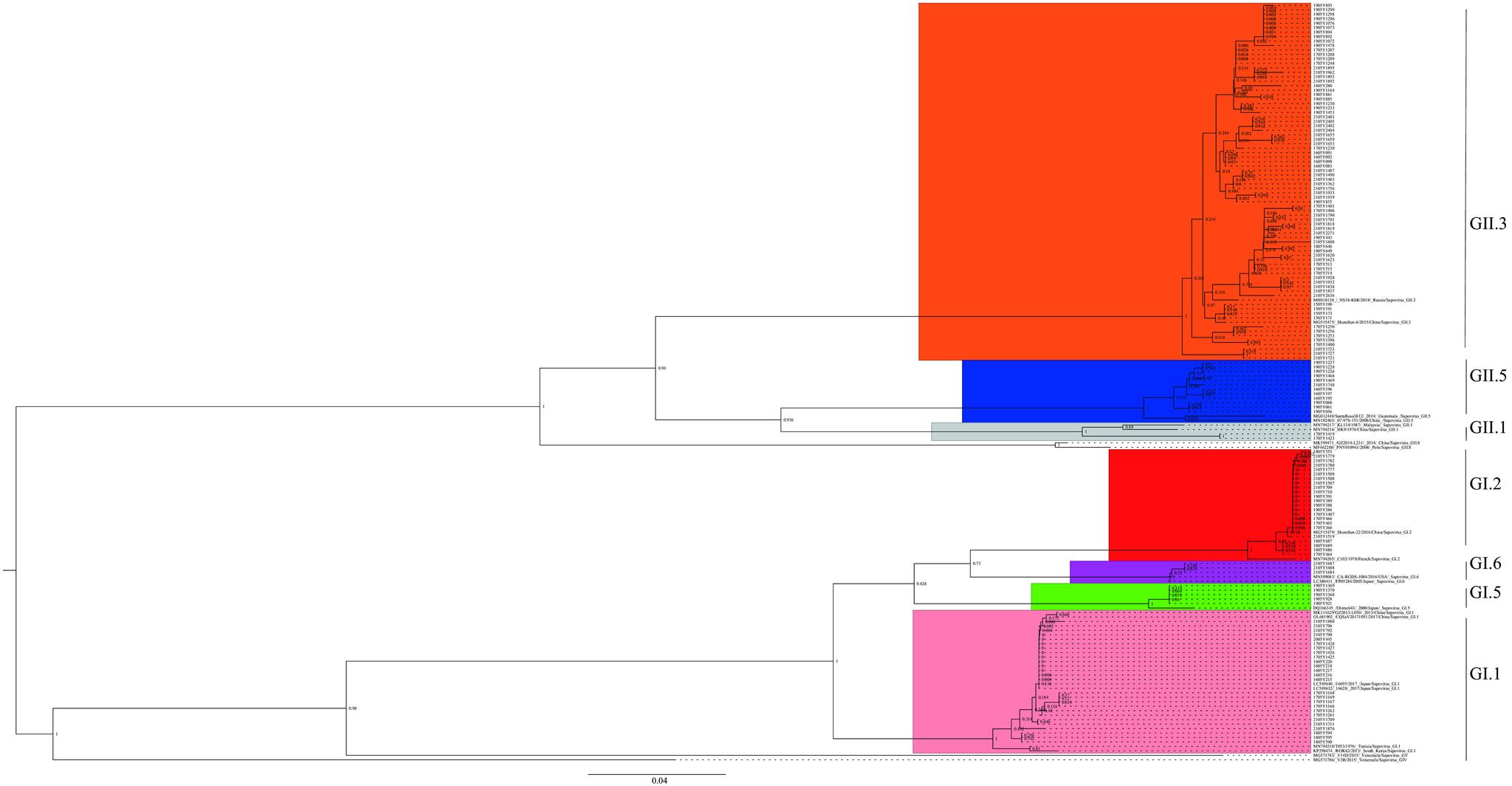
HuSaVs were identified in 71 AGE outbreaks, demonstrating a detection rate of 10.5%, second only to norovirus. The primary demographic affected by HuSaV were children under the age of 5 in kindergarten settings. Infection rates tended to peak during two distinct periods: May to June and September to December. Upon genotyping, seven distinct genotypes emerged. GII.3 was the most prevalent, accounting for 54.9% of cases, followed by GI.1 (12.7%), GI.2 (9.9%), GII.5 (7.0%), GI.5 (2.8%), GI.6 (1.4%), GII.1 (1.4%), and untyped cases (9.9%). A phylogenetic analysis of GII.3 identified three distinct groups, with 15 notable SNPs observed.
CONCLUSIONS
This study offers a comprehensive analysis of the persistent prevalence of HuSaV outbreaks in Chaoyang District, Beijing Municipality, China. Over time, the diversity of HuSaV subtypes has shifted, and it is now recognized as the second leading viral agent responsible for AGE outbreaks. This highlights the importance of ongoing surveillance in the future.
引言
人札如病毒(HuSaV)是一种肠道病毒,在全球范围内导致散发病例和急性胃肠炎(AGE)暴发。2015年1月至2021年12月,在中国北京市朝阳区开展了一项为期七年的主动监测研究,以调查与AGE暴发相关的HuSaV的分子流行病学。
方法
从经历AGE暴发的患者中采集粪便和肛拭子样本。通过逆转录聚合酶链反应(RT-PCR)鉴定HuSaV,并利用部分病毒蛋白1(VP1)序列(约434个碱基对)进行基因分型、单核苷酸多态性(SNP)分析和系统发育研究。
结果
在71起AGE暴发中鉴定出HuSaV,检出率为10.5%,仅次于诺如病毒。受HuSaV影响的主要人群是幼儿园环境中5岁以下的儿童。感染率在两个不同时期趋于峰值:5月至6月和9月至12月。基因分型后出现了七种不同的基因型。GII.3最为常见,占病例的54.9%,其次是GI.1(12.7%)、GI.2(9.9%)、GII.5(7.0%)、GI.5(2.8%)、GI.6(1.4%)、GII.1(1.4%)和未分型病例(9.9%)。对GII.3的系统发育分析确定了三个不同的组,观察到15个显著的SNP。
结论
本研究对中国北京市朝阳区HuSaV暴发的持续流行情况进行了全面分析。随着时间的推移,HuSaV亚型的多样性发生了变化,现在它被认为是导致AGE暴发的第二大主要病毒病原体。这凸显了未来持续监测的重要性。

 Zotero 插件