
使用加标和自然感染的牛粪便样本比较 Mini-FLOTAC、Flukefinder 和沉淀技术检测和定量肝片吸虫和双腔吸虫卵。
Comparison of Mini-FLOTAC, Flukefinder and sedimentation techniques for detection and quantification of Fasciola hepatica and Calicophoron daubneyi eggs using spiked and naturally infected bovine faecal samples.
机构信息
Department of Veterinary Medicine and Animal Production, University of Naples Federico II, Regional Center for Monitoring Parasitic infections (CREMOPAR), Naples, Italy.
School of Veterinary Medicine, Faculty of Health and Medical Sciences, University of Surrey, Guilford, UK.
出版信息
Parasit Vectors. 2023 Aug 2;16(1):260. doi: 10.1186/s13071-023-05890-2.
BACKGROUND
Fasciolosis (Fasciola hepatica) and paramphistomosis (Calicophoron daubneyi) are two important infections of livestock. Calicophoron daubneyi is the predominant Paramphistomidae species in Europe, and its prevalence has increased in the last 10-15 years. In Italy, evidence suggests that the prevalence of F. hepatica in ruminants is low in the southern part, but C. daubneyi has been recently reported at high prevalence in the same area. Given the importance of reliable tools for liver and rumen fluke diagnosis in ruminants, this study evaluated the diagnostic performance of the Mini-FLOTAC (MF), Flukefinder (FF) and sedimentation (SED) techniques to detect and quantify F. hepatica and C. daubneyi eggs using spiked and naturally infected cattle faecal samples.
METHODS
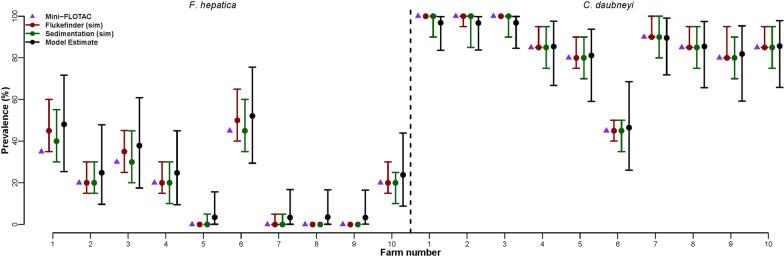
Briefly, negative bovine faecal samples were artificially spiked with either F. hepatica or C. daubneyi eggs to achieve different egg count levels: 10, 50 and 100 eggs per gram (EPG) of faeces. Moreover, ten naturally infected cattle farms from southern Italy with either F. hepatica and/or C. daubneyi were selected. For each farm, the samples were analysed individually only with MF technique and as pools using MF, FF and SED techniques. Bayesian latent class analysis (LCA) was used to estimate sensitivity and accuracy of the predicted intensity of infection as well as the infection rate in the naturally infected farms.
RESULTS
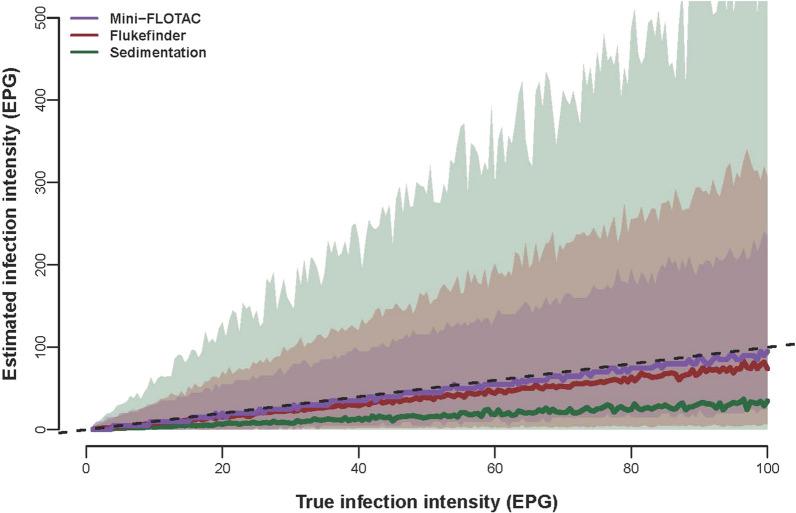
The outcome of this study showed that the highest number of eggs (F. hepatica and C. daubneyi) recovered was obtained with MF, followed by FF and SED in spiked infected samples at 50 and 100 EPG, while at lower infection levels of 10 EPG, FF gave the best results. Moreover, the sensitivity for all the techniques included in the study was estimated at > 90% at infection levels > 20 EPG for both F. hepatica and C. daubneyi eggs. However, MF was the most accurate of the three techniques evaluated to estimate fluke infection intensity. Nevertheless, all three techniques can potentially estimate infection rate at farm level accurately.
CONCLUSIONS
Optimization and standardization of techniques are needed to improve the FEC of fluke eggs.
背景
片形吸虫病(Fasciola hepatica)和双腔吸虫病(Calicophoron daubneyi)是两种重要的家畜感染病。在欧洲,双腔属吸虫主要是指棘口吸虫属,其流行率在过去 10-15 年有所增加。在意大利,有证据表明,在南部地区反刍动物的肝片吸虫感染率较低,但最近在同一地区报道棘口吸虫属的流行率较高。鉴于在反刍动物中,可靠的肝吸虫和瘤胃吸虫诊断工具的重要性,本研究评估了 Mini-FLOTAC(MF)、Flukefinder(FF)和沉淀(SED)技术检测和定量检测肝片吸虫和棘口吸虫属虫卵的诊断性能,使用了人工添加肝片吸虫或棘口吸虫属虫卵的牛粪便样本。
方法
简要地说,从意大利南部选择了 10 个自然感染肝片吸虫和/或棘口吸虫属的牛场,对每个牛场,仅使用 MF 技术对样本进行了个体分析,并使用 MF、FF 和 SED 技术对样本进行了混合分析。采用贝叶斯潜在类别分析(LCA)来估计感染强度的预测灵敏度和准确性,以及自然感染牛场的感染率。
结果
本研究的结果表明,在 50 和 100 EPG 的人工感染样本中,MF 技术回收的虫卵数量(肝片吸虫和棘口吸虫属)最高,其次是 FF 和 SED,而在 10 EPG 的较低感染水平下,FF 技术的效果最佳。此外,研究中包括的所有技术的灵敏度估计在 90%以上,对于 F. hepatica 和 C. daubneyi 虫卵的感染水平>20 EPG。然而,MF 是评估的三种技术中最准确的一种,可用于估计吸虫感染强度。尽管如此,所有三种技术都可以潜在地准确估计农场层面的感染率。
结论
需要优化和标准化技术,以提高吸虫卵的粪检计数(FEC)。


 Zotero 插件