
脊髓麻醉后孤立性展神经麻痹
Isolated Abducens Nerve Palsy Following Spinal Anesthesia.
作者信息
Siau Tiak Hing, Zahari Mimiwati
机构信息
Ophthalmology, University Malaya Eye Research Centre, Kuala Lumpur, MYS.
出版信息
Cureus. 2023 Jul 3;15(7):e41298. doi: 10.7759/cureus.41298. eCollection 2023 Jul.
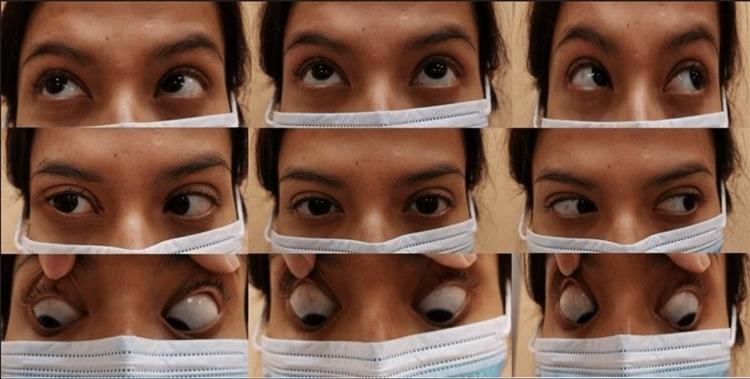
A healthy 28-year-old lady, para 1, presented to the emergency department with persistent frontal headache, nausea, and vomiting following an emergency cesarean section four days ago. She experienced difficulties with six failed attempts of spinal anesthesia intrapartum before conversion to general anesthesia. A 25-gauge Whitacre needle was utilized for administering spinal anesthesia under a sitting position. The anesthetist noticed a loss of resistance upon needle insertion, but only a negligible amount of cerebrospinal fluid was obtained upon removing the stylet. The patient underwent an emergency cesarean section due to fetal distress, and she was not in labor during the attempts of spinal anesthesia. Otherwise, the cesarean section lasted for an hour and was uneventful. No intrapartum eclampsia or pre-eclampsia. She was diagnosed with post-dural puncture headache, and her symptoms improved after receiving intravenous hydration, oral caffeine, and non-steroidal anti-inflammatory drug (NSAIDs). However, on the sixth day after the spinal anesthesia, she suddenly developed double vision. Examination showed bilateral visual acuity was measured at 6/7.5. No proptosis or ptosis was noted. The relative afferent pupillary defect was negative with no anisocoria. Both eyes were orthophoria with normal head posture. Extraocular muscles revealed a right abduction restriction of -1 with the patient complaining of binocular horizontal diplopia at the right gaze, consistent with right abducens nerve palsy. Systemic neurological findings were normal, and imaging results were unremarkable. Diagnosis of right abducens nerve palsy post-dural puncture was made clinically. The patient was keen on conservative management instead of blood patch therapy. Hence, she was treated supportively via uni-ocular patching to relieve diplopia. Spontaneous complete recovery of the right abducens nerve palsy was observed after three weeks. Cranial nerve palsy is a rare complication reported following spinal anesthesia, with the abducens nerve being the commonest nerve involved. Although it is not always benign, the presented case showed spontaneous complete recovery of the right abducens nerve palsy after three weeks. Awareness of this uncommon complication will avoid unnecessary distress and investigative burden to both the patient and the doctor.
一位28岁、经产1次的健康女性,在4天前紧急剖宫产术后出现持续性额部头痛、恶心和呕吐,到急诊科就诊。她在产时进行脊髓麻醉时经历了6次失败尝试,之后改为全身麻醉。使用25号Whitacre针在坐位下进行脊髓麻醉。麻醉师在进针时感觉到阻力消失,但拔出针芯后仅获得极少量脑脊液。患者因胎儿窘迫接受了紧急剖宫产,在进行脊髓麻醉尝试时未处于产程。此外,剖宫产持续了1小时,过程顺利。未发生产时子痫或先兆子痫。她被诊断为硬膜穿刺后头痛,在接受静脉补液、口服咖啡因和非甾体抗炎药(NSAIDs)后症状有所改善。然而,在脊髓麻醉后的第6天,她突然出现复视。检查显示双侧视力为6/7.5。未发现眼球突出或上睑下垂。相对性传入瞳孔障碍为阴性,无瞳孔不等大。双眼眼位正常,头部姿势正常。眼外肌检查显示右眼外展受限-1,患者在右侧注视时主诉双眼水平复视,符合右侧展神经麻痹。全身神经系统检查结果正常,影像学检查结果无异常。临床上诊断为硬膜穿刺后右侧展神经麻痹。患者倾向于保守治疗而非血液补片治疗。因此,通过单眼眼罩治疗以缓解复视。3周后观察到右侧展神经麻痹自发完全恢复。颅神经麻痹是脊髓麻醉后报道的一种罕见并发症,展神经是最常受累的神经。虽然并非总是良性,但本病例显示右侧展神经麻痹在3周后自发完全恢复。认识到这种罕见并发症将避免给患者和医生带来不必要的困扰和检查负担。
 Zotero 插件