
乳腺癌筛查对40-49岁加拿大女性10年净生存率的影响。
Impact of Breast Cancer Screening on 10-Year Net Survival in Canadian Women Age 40-49 Years.
作者信息
Wilkinson Anna N, Ellison Larry F, Billette Jean-Michel, Seely Jean M
机构信息
Department of Family Medicine, University of Ottawa.
Centre for Population Health Data at Statistics Canada, Government of Canada, Ottawa, Canada.
出版信息
J Clin Oncol. 2023 Oct 10;41(29):4669-4677. doi: 10.1200/JCO.23.00348. Epub 2023 Aug 4.
PURPOSE
In Canada, some provincial/territorial mammography screening programs include women age 40-49 years, whereas others do not. This study examines the impact of this dichotomy on the 10-year breast cancer (BC) net survival (NS) among women age 40-49 years and 50-59 years at diagnosis.
METHODS
Using the Canadian Cancer Registry data record linked to death information, we evaluated the cohort of Canadian women age 40-49 years and 50-59 years diagnosed with BC from 2002 to 2007. We compared 10-year NS estimates in the jurisdictions with organized screening programs that included women age 40-49 years, designated as screeners (Northwest Territories, British Columbia, Alberta, Nova Scotia, and Prince Edward Island), with comparator programs that did not (Yukon, Manitoba, Saskatchewan, Ontario, Quebec, New Brunswick, and Newfoundland and Labrador).
RESULTS
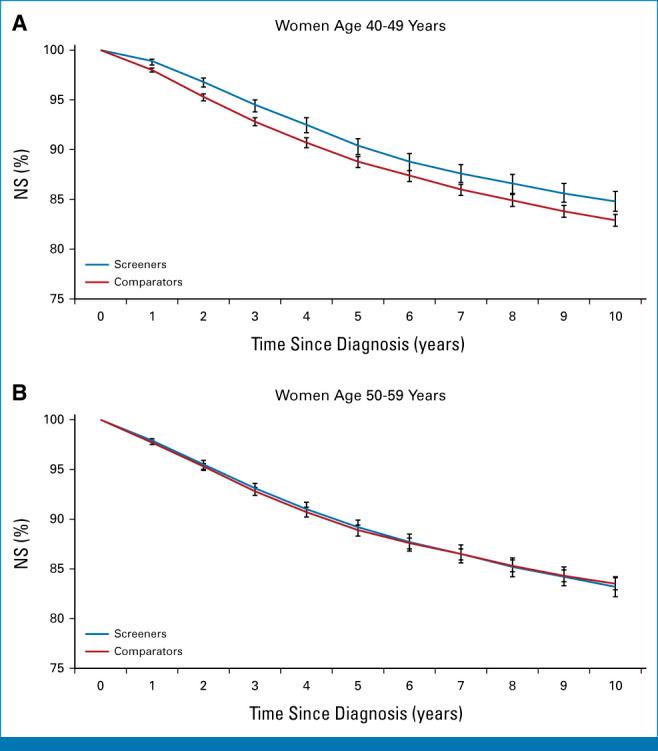
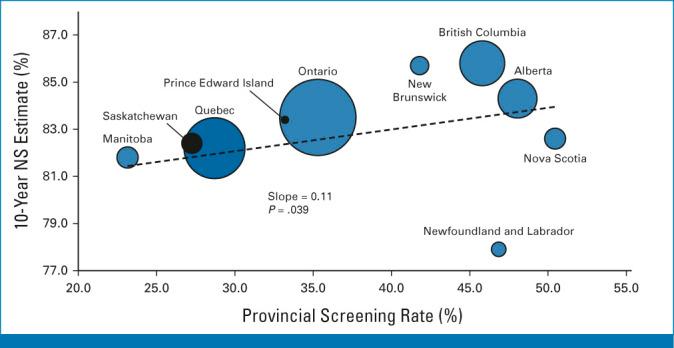
BC was the primary cause of 10-year mortality in women age 40-49 years diagnosed with BC (90.7% of deaths). Among these women, the 10-year NS for screeners (84.8%; 95% CI, 83.8 to 85.8) was 1.9 percentage points (pp) higher than that for comparators (82.9%; 95% CI, 82.3 to 83.5; = .001). The difference in favor of screeners was significant among women age 45-49 years (2.6 pp; = .001) but not among women age 40-44 years (0.9 pp; = .328). Similarly, the incidence-based BC mortality rate was significantly lower in screener jurisdictions among women age 40-49 years and 45-49 years, but not for 40-44 years. Provincial/territorial NS increased significantly with higher mammography screening participation ( = .003). The BC incidence rate was virtually identical in screener and comparator jurisdictions among women age 40-49 years ( = .976) but was significantly higher for comparators among women age 50-59 years ( < .001).
CONCLUSION
Screening programs that included women in their 40s were associated with a significantly higher BC 10-year NS in women age 40-49 years, but not an increased rate of BC diagnosis. These results may inform screening guidelines for women age 40-49 years.
目的
在加拿大,一些省级/地区性的乳房X光筛查项目涵盖40至49岁的女性,而其他项目则不包括。本研究探讨了这种差异对诊断时年龄在40至49岁以及50至59岁的女性10年乳腺癌净生存率的影响。
方法
利用与死亡信息相链接的加拿大癌症登记数据记录,我们评估了2002年至2007年期间被诊断为乳腺癌的40至49岁以及50至59岁的加拿大女性队列。我们将设有涵盖40至49岁女性的有组织筛查项目的辖区(指定为筛查地区,包括西北地区、不列颠哥伦比亚省、艾伯塔省、新斯科舍省和爱德华王子岛)的10年净生存率估计值,与未设此类项目的对照辖区(育空地区、马尼托巴省、萨斯喀彻温省、安大略省、魁北克省、新不伦瑞克省以及纽芬兰和拉布拉多省)进行了比较。
结果
乳腺癌是被诊断为乳腺癌的40至49岁女性10年死亡的主要原因(占死亡人数的90.7%)。在这些女性中,筛查地区的10年净生存率为84.8%(95%置信区间,83.8至85.8),比对照地区(82.9%;95%置信区间,82.3至83.5;P = 0.001)高1.9个百分点。在45至49岁的女性中,筛查地区的优势差异显著(2.6个百分点;P = 0.001),但在40至44岁的女性中不显著(0.9个百分点;P = 0.328)。同样,在40至49岁以及45至49岁的女性中,基于发病率的乳腺癌死亡率在筛查地区显著较低,但在40至44岁的女性中并非如此。省级/地区性净生存率随着乳房X光筛查参与率的提高而显著增加(P = 0.003)。在40至49岁的女性中,筛查地区和对照辖区的乳腺癌发病率几乎相同(P = 0.976),但在50至59岁的女性中,对照地区的发病率显著更高(P < 0.001)。
结论
将40多岁女性纳入其中的筛查项目与40至49岁女性显著更高的10年乳腺癌净生存率相关,但并未导致乳腺癌诊断率增加。这些结果可能为40至49岁女性的筛查指南提供参考。


 Zotero 插件