
诱导性缺血性心肌梗死犬的微小RNA谱分析:一项实验研究。
MicroRNA profiling in dogs undergoing induced ischemic heart infarction: An experimental study.
作者信息
Raffee Liqaa A, Alawneh Khaled Z, Alshehabat Musa Ahmed Mohammed, Haddad Hazem, Jaradat Saied A
机构信息
Department of Accident and Emergency Medicine, Faculty of Medicine, Jordan University of Science and Technology, Irbid, Jordan.
Department of Diagnostic Radiology and Nuclear Medicine, Faculty of Medicine, Jordan University of Science and Technology, Irbid, Jordan.
出版信息
Vet World. 2023 Jun;16(6):1319-1324. doi: 10.14202/vetworld.2023.1319-1324. Epub 2023 Jun 13.
BACKGROUND AND AIM
MicroRNAs (miRNAs) play an important role in various biological functions. According to many studies, miRNA expression is tissue-specific, strongly controlled throughout embryogenesis, and over- or under-expressed in numerous disorders, including cardiovascular pathologies. This study aimed to screen, characterize, and profile many induced biomarkers (miRNAs) in dog serum before and after experimentally inducing a regional myocardial infarction (MI) by occluding the coronary arteries under general anesthesia.
MATERIALS AND METHODS
A preclinical experimental animal study recruited 12 healthy canine dogs. The selected canine dogs were anesthetized with 1 mg/kg xylazine and 15 mg/kg ketamine before undergoing femoral arterial catheterization under fluoroscopic supervision. Commercial assay kits were used to purify total RNA and miRNA before the occlusion and 2 h after the occlusion according to the manufacturer's guidelines, and the samples were stored in RNase/DNase-free water at -80°C. Data were analyzed by GraphPad Prism 5.0 software (GraphPad Prism, San Diego, CA) SPSS, and GenEx software (www.multid.se) or (REST V3).
RESULTS
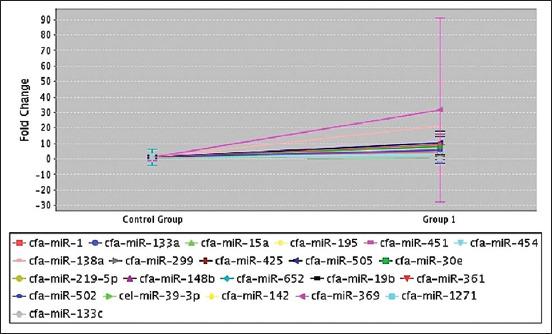
Among 325 transcribed genes, 20 were identified in 2 h. After MI, 14 biomarkers were negative, indicating downregulation, and 6 (3-F08, 3-B10, 4-A11, 1-A06, 2-E01, 3-F10) were positive, indicating upregulation. Polymerase chain reaction assay results showed a normalized fold-change in gene expression in the test sample. Fold values >1 represented a biologically significant change.
CONCLUSION
Profiling of miRNAs before and after MI in a dog model revealed upregulation of six previously unidentified biomarkers (3-F08, 3-B10, 4-A11, 1-A06, 2-E01, and 3-F10), indicating various miRNA regulatory patterns.
背景与目的
微小RNA(miRNA)在多种生物学功能中发挥重要作用。根据多项研究,miRNA表达具有组织特异性,在整个胚胎发育过程中受到严格调控,并且在包括心血管疾病在内的众多疾病中表达上调或下调。本研究旨在筛选、鉴定和分析在全身麻醉下通过闭塞冠状动脉实验性诱导局部心肌梗死(MI)前后犬血清中多种诱导生物标志物(miRNA)。
材料与方法
一项临床前实验动物研究招募了12只健康犬。所选犬在透视监测下进行股动脉插管前,用1mg/kg甲苯噻嗪和15mg/kg氯胺酮麻醉。根据制造商的指南,使用商业检测试剂盒在闭塞前和闭塞后2小时纯化总RNA和miRNA,样本保存在-80°C的无RNase/DNase水中。数据用GraphPad Prism 5.0软件(GraphPad Prism,圣地亚哥,加利福尼亚州)、SPSS和GenEx软件(www.multid.se)或(REST V3)进行分析。
结果
在325个转录基因中,2小时内鉴定出20个。MI后,14种生物标志物呈阴性,表明下调,6种(3-F08、3-B10、4-A11、1-A06、2-E01、3-F10)呈阳性,表明上调。聚合酶链反应检测结果显示测试样本中基因表达的标准化倍数变化。倍数>1表示具有生物学意义的变化。
结论
在犬模型中对MI前后的miRNA进行分析,发现6种先前未鉴定的生物标志物(3-F08、3-B10、4-A11、1-A06、2-E01和3-F10)上调,表明存在多种miRNA调控模式。


 Zotero 插件