
一种新型近红外荧光探针 THK-565 可用于活体检测阿尔茨海默病小鼠模型中的淀粉样沉积。
A Novel Near-Infrared Fluorescence Probe THK-565 Enables In Vivo Detection of Amyloid Deposits in Alzheimer's Disease Mouse Model.
机构信息
Division of Pharmacology, Faculty of Medicine, Tohoku Medical and Pharmaceutical University, 1-15-1 Fukumuro, Miyagino-Ku, Sendai, Miyagi, 983-8536, Japan.
Department of Pharmacology, Tohoku University Graduate School of Medicine, 2-1 Seiryo-Machi, Aoba-Ku, Sendai, Miyagi, 980-8575, Japan.
出版信息
Mol Imaging Biol. 2023 Dec;25(6):1115-1124. doi: 10.1007/s11307-023-01843-4. Epub 2023 Aug 14.
PURPOSE
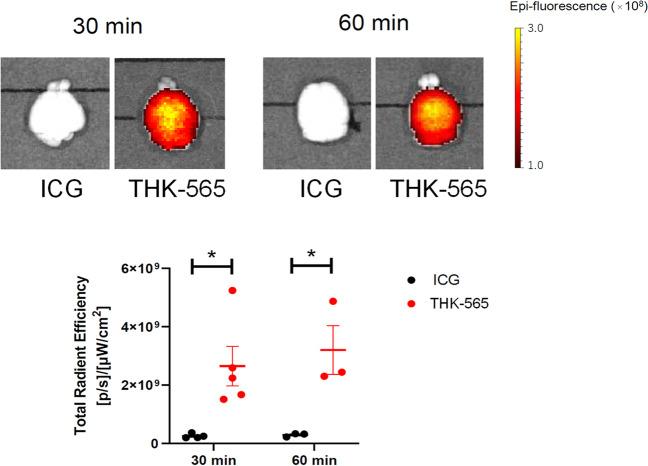
Noninvasive imaging of protein aggregates in the brain is critical for the early diagnosis, disease monitoring, and evaluation of the effectiveness of novel therapies for Alzheimer's disease (AD). Near-infrared fluorescence (NIRF) imaging with specific probes is a promising technique for the in vivo detection of protein deposits without radiation exposure. Comprehensive screening of fluorescent compounds identified a novel compound, THK-565, for the in vivo imaging of amyloid-β (Aβ) deposits in the mouse brain. This study assessed whether THK-565 could detect amyloid-β deposits in vivo in the AD mouse model.
PROCEDURES
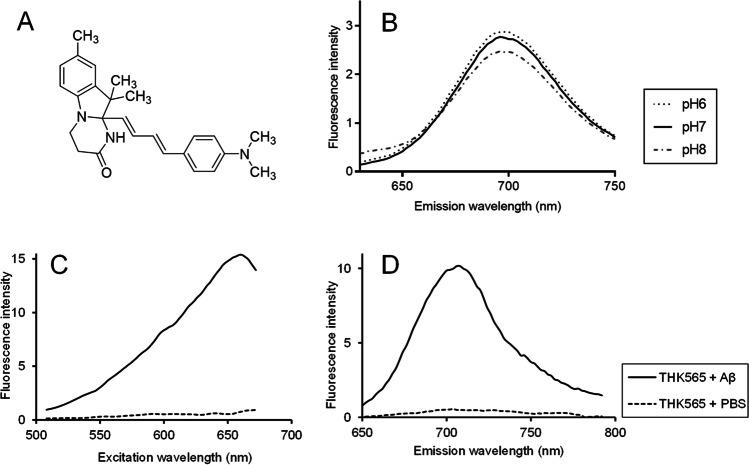
The fluorescent properties of THK-565 were evaluated in the presence and absence of Aβ fibrils. APP knock-in (APP-KI) mice were used as an animal model of AD. In vivo NIRF images were acquired after the intravenous administration of THK-565 and THK-265 in mice. The binding selectivity of THK-565 to Aβ was evaluated using brain slices obtained from these mouse models.
RESULTS
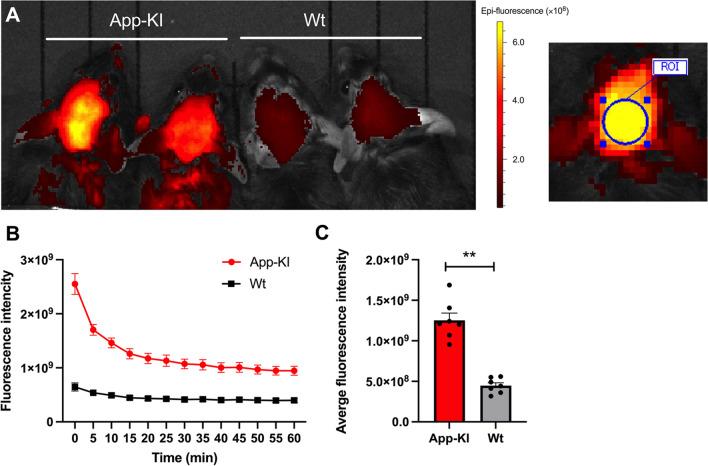
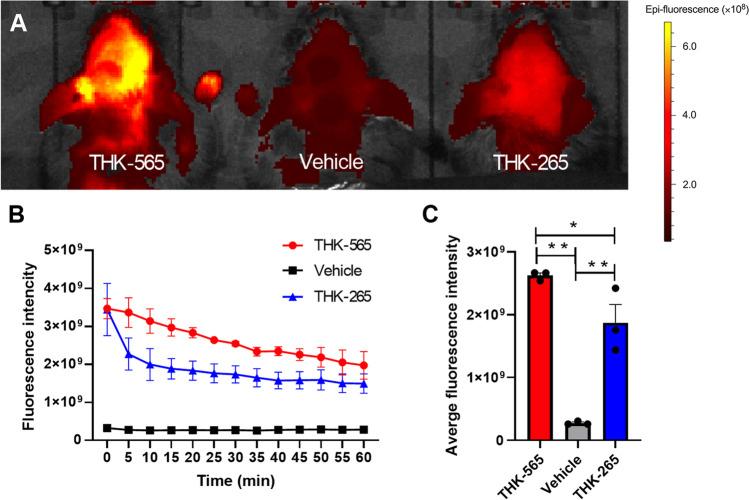
The fluorescence intensity of the THK-565 solution substantially increased by mixing with Aβ fibrils. The maximum emission wavelength of the complex of THK-565 and Aβ fibrils was 704 nm, which was within the optical window range. THK-565 selectively bound to amyloid deposits in brain sections of APP-KI mice After the intravenous administration of THK-565, the fluorescence signal in the head of APP-KI mice was significantly higher than that of wild-type mice and higher than that after administration of THK-265. Ex vivo analysis confirmed that the THK-565 signal corresponded to Aβ immunostaining in the brain sections of these mice.
CONCLUSIONS
A novel NIRF probe, THK-565, enabled the in vivo detection of Aβ deposits in the brains of the AD mouse model, suggesting that NIRF imaging with THK-565 could non-invasively assess disease-specific pathology in AD.
目的
对大脑中的蛋白质聚集体进行非侵入性成像,对于阿尔茨海默病(AD)的早期诊断、疾病监测以及新型治疗方法的效果评估至关重要。使用特定探针的近红外荧光(NIRF)成像技术是一种很有前途的技术,无需辐射暴露即可在体内检测蛋白质沉积物。对荧光化合物进行全面筛选,发现了一种新型化合物 THK-565,可用于活体成像小鼠大脑中的淀粉样β(Aβ)沉积物。本研究评估了 THK-565 是否可以在 AD 小鼠模型中体内检测到 Aβ 沉积物。
过程
评估了 THK-565 在存在和不存在 Aβ 纤维的情况下的荧光特性。使用 APP 敲入(APP-KI)小鼠作为 AD 的动物模型。在 THK-565 和 THK-265 静脉注射后,在小鼠体内采集近红外荧光图像。使用从这些小鼠模型获得的脑切片评估 THK-565 对 Aβ 的结合选择性。
结果
THK-565 溶液的荧光强度通过与 Aβ 纤维混合而显著增加。THK-565 与 Aβ 纤维复合物的最大发射波长为 704nm,在光学窗口范围内。THK-565 选择性结合 APP-KI 小鼠脑切片中的淀粉样沉积物。静脉注射 THK-565 后,APP-KI 小鼠头部的荧光信号明显高于野生型小鼠,高于 THK-265 给药后。离体分析证实,这些小鼠脑切片中 THK-565 信号与 Aβ 免疫染色相对应。
结论
一种新型的 NIRF 探针 THK-565 能够在 AD 小鼠模型的大脑中体内检测到 Aβ 沉积物,表明使用 THK-565 的 NIRF 成像可以非侵入性地评估 AD 中的疾病特异性病理学。



 Zotero 插件