
游离核酸作为实体器官移植受者的生物标志物。
Free-Circulating Nucleic Acids as Biomarkers in Patients After Solid Organ Transplantation.
机构信息
Department of Hepatology, Transplantology, and Internal Medicine, Medical University of Warsaw, Warsaw, Poland.
Department of General, Vascular, and Transplant Surgery, Medical University of Warsaw, Warsaw, Poland.
出版信息
Ann Transplant. 2023 Aug 15;28:e939750. doi: 10.12659/AOT.939750.
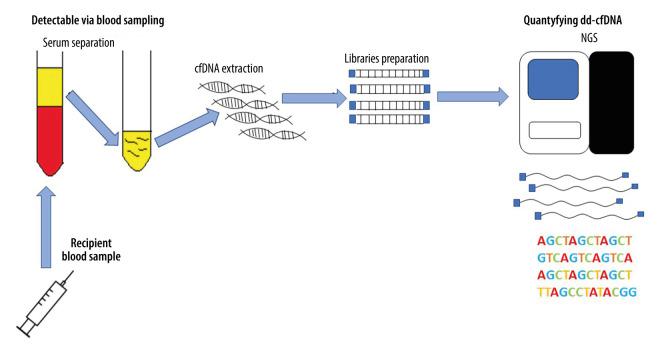
A number types of extracellular DNA (eg, cell-free, cfDNA) circulate in human blood, including mitochondrial, transcriptome, and regulatory DNA, usually at low concentrations. Larger amounts of cfDNA appear in any inflammatory condition, including organ damage due to a variety of reasons. The role of cfDNA in solid organ transplantation is discussed in this review as a valuable additional tool in the standard of care of transplant patients. Post-transplant monitoring requires the use of high-quality biomarkers for early detection of graft damage or rejection to be able to apply early therapeutic intervention. CfDNA complements the traditional monitoring strategies, being a risk stratification tool and an important prognostic marker. However, improving the sensitivity and specificity of cfDNA detection is necessary to facilitate personalized patient management, warranting further research in terms of measurement, test standardization, and storage, processing, and shipping. A diagnostic test (Allosure, CareDx, Inc., Brisbane, CA) for kidney, heart and lung transplant patients is now commercially available, and validation for other organs (eg, liver) is pending. To date, donor-derived cfDNA in combination with other biomarkers appears to be a promising tool in graft rejection as it is minimally invasive, time-sensitive, and cost-effective. However, improvement of sensitivity and specificity is required to facilitate personalized patient management. Whether it could be an alternate to graft biopsy remains unclear.
许多类型的细胞外 DNA(如无细胞游离 DNA,cfDNA)在人体血液中循环,包括线粒体、转录组和调控 DNA,通常浓度较低。在任何炎症情况下,cfDNA 的含量都会增加,包括由于各种原因导致的器官损伤。本文综述了 cfDNA 在实体器官移植中的作用,将其作为移植患者标准护理的有价值的附加工具。移植后监测需要使用高质量的生物标志物,以便能够早期检测移植物损伤或排斥反应,从而进行早期治疗干预。cfDNA 是传统监测策略的补充,可作为风险分层工具和重要的预后标志物。然而,需要提高 cfDNA 检测的灵敏度和特异性,以促进个体化患者管理,这需要进一步研究测量、测试标准化以及存储、处理和运输。目前,一种用于肾、心和肺移植患者的诊断测试(Allosure,CareDx,Inc.,Brisbane,CA)已商业化,其他器官(如肝)的验证正在进行中。迄今为止,供体来源的 cfDNA 与其他生物标志物联合应用于移植物排斥反应似乎是一种很有前途的工具,因为它微创、时间敏感且具有成本效益。然而,需要提高灵敏度和特异性以促进个体化患者管理。它是否可以替代移植活检仍不清楚。

 Zotero 插件