
人类谷氨酰胺环化酶抑制剂(QCIs)的开发与演变:一种用于阿尔茨海默病疾病修饰治疗的颇具前景的替代方法。
Development and evolution of human glutaminyl cyclase inhibitors (QCIs): an alternative promising approach for disease-modifying treatment of Alzheimer's disease.
作者信息
Chen Daoyuan, Chen Qingxiu, Qin Xiaofei, Tong Peipei, Peng Liping, Zhang Tao, Xia Chunli
机构信息
School of Bioengineering, Zunyi Medical University, Zhuhai, China.
Fujian Key Laboratory of Translational Research in Cancer and Neurodegenerative Diseases, School of Basic Medical Sciences, Institute of Basic Medicine, Fujian Medical University, Fuzhou, China.
出版信息
Front Aging Neurosci. 2023 Aug 3;15:1209863. doi: 10.3389/fnagi.2023.1209863. eCollection 2023.
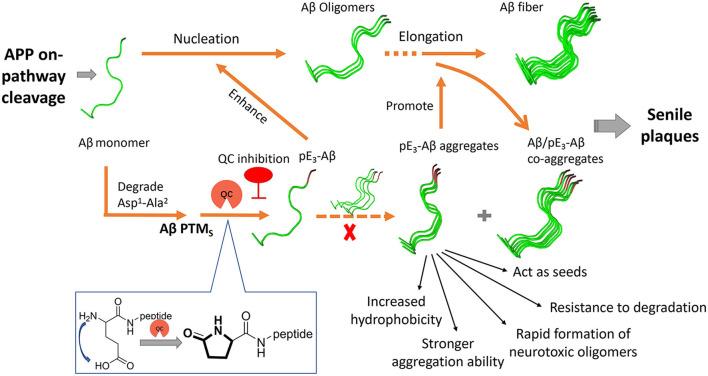
Human glutaminyl cyclase (hQC) is drawing considerable attention and emerging as a potential druggable target for Alzheimer's disease (AD) due to its close involvement in the pathology of AD via the post-translational pyroglutamate modification of amyloid-β. A recent phase 2a study has shown promising early evidence of efficacy for AD with a competitive benzimidazole-based QC inhibitor, PQ912, which also demonstrated favorable safety profiles. This finding has sparked new hope for the treatment of AD. In this review, we briefly summarize the discovery and evolution of hQC inhibitors, with a particular interest in classic Zinc binding group (ZBG)-containing chemicals reported in recent years. Additionally, we highlight several high-potency inhibitors and discuss new trends and challenges in the development of QC inhibitors as an alternative and promising disease-modifying therapy for AD.
人谷氨酰胺环化酶(hQC)正受到广泛关注,并因其通过淀粉样β蛋白的翻译后焦谷氨酸修饰密切参与阿尔茨海默病(AD)的病理过程而成为AD潜在的可成药靶点。最近的一项2a期研究显示,基于苯并咪唑的竞争性QC抑制剂PQ912对AD有早期疗效的良好证据,且其安全性也良好。这一发现为AD的治疗带来了新希望。在本综述中,我们简要总结了hQC抑制剂的发现和发展,特别关注近年来报道的含经典锌结合基团(ZBG)的化合物。此外,我们重点介绍了几种高效抑制剂,并讨论了QC抑制剂作为AD替代且有前景的疾病修饰疗法开发中的新趋势和挑战。

 Zotero 插件