
研究利福平耐药性和危险因素对人工关节感染患者 DAIR 术后恢复率的影响。
Investigation of the effect of rifampicin resistance and risk factors on recovery rates after DAIR procedure in patients with prosthetic joint infection.
机构信息
Department of Orthopaedics, Semmelweis University, Budapest, Hungary.
Department of Biophysics and Radiation Biology, Semmelweis University, Budapest, Hungary.
出版信息
J Orthop Surg Res. 2023 Aug 21;18(1):611. doi: 10.1186/s13018-023-04091-y.
BACKGROUND
Rifampicin plays a key role in the management of prosthetic joint infections (PJIs), however, the emergence of rifampicin resistance is associated with less favourable clinical outcomes. The purpose of this study was to investigate the impact of rifampicin resistance and other patient-related factors on recovery rates among patients with PJI undergoing debridement, antibiotics and implant retention (DAIR).
METHODS
We reviewed medical records and microbiology reports of 67 patients (37 males and 30 females) undergoing DAIR due to PJI between 2014 and 2021. Patient-related factors, co-morbidities and microbiological reports were collected and reviewed. Forty-four patients had hip, 21 had knee, 1 had shoulder and 1 had elbow joint infection. Obtained data were statistically analysed with a logistic regression model.
RESULTS
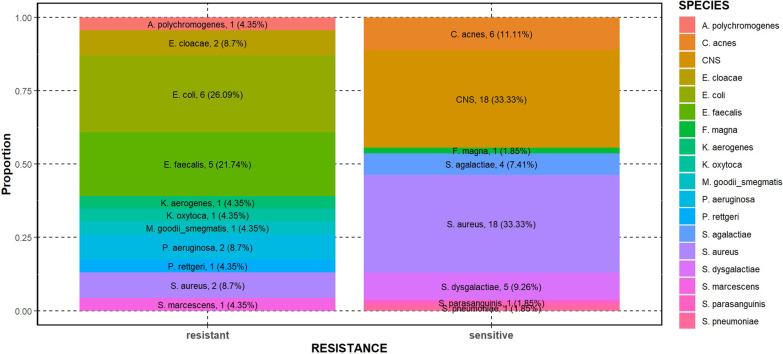
Rifampicin-sensitive organism was isolated in 47 cases. Recovery rate was 72.3% in the sensitive and 76.9% in the resistant group. We found no significant effect of rifampicin resistance on the probability of recovery. Age and diabetes mellitus showed negative clinical impact on recovery. Staphylococcus aureus and coagulase-negative Staphylococci were predominant in the rifampicin-sensitive (66.6% of the isolates) and Gram-negative rods in the resistant group (65.2%).
CONCLUSIONS
Based on our results, higher age and diabetes mellitus may have a clinically relevant negative impact on clinical outcome, however, this effect was not statistically significant. This may be due to the limited number of patients included in this study. We observed no clinically relevant effect of rifampicin-resistance, sex and body mass index (BMI) on recovery rates among patients undergoing DAIR due to PJI.
背景
利福平在治疗人工关节感染(PJI)中起着关键作用,然而,利福平耐药的出现与较差的临床结果相关。本研究的目的是探讨利福平耐药和其他与患者相关的因素对接受清创术、抗生素和保留植入物(DAIR)治疗的 PJI 患者的恢复率的影响。
方法
我们回顾了 2014 年至 2021 年间因 PJI 接受 DAIR 的 67 名患者(37 名男性和 30 名女性)的病历和微生物学报告。收集并回顾了患者相关因素、合并症和微生物学报告。44 例为髋关节,21 例为膝关节,1 例为肩关节,1 例为肘关节感染。使用逻辑回归模型对获得的数据进行统计学分析。
结果
在 47 例中分离出利福平敏感菌。敏感组的恢复率为 72.3%,耐药组为 76.9%。我们没有发现利福平耐药对恢复概率有显著影响。年龄和糖尿病对恢复有负面影响。在利福平敏感组(分离物的 66.6%)中,金黄色葡萄球菌和凝固酶阴性葡萄球菌占主导地位,而在耐药组中革兰氏阴性杆菌占主导地位(占 65.2%)。
结论
根据我们的结果,较高的年龄和糖尿病可能对临床结果有临床相关的负面影响,但这一影响没有统计学意义。这可能是由于本研究纳入的患者数量有限。我们观察到,在因 PJI 接受 DAIR 的患者中,利福平耐药、性别和体重指数(BMI)对恢复率没有临床相关影响。

 Zotero 插件