
雷公藤多苷治疗特发性膜性肾病的疗效与安全性:一项基于贝叶斯Meta分析的系统评价
Efficacy and safety of Tripterygium wilfordii multiglucoside for idiopathic membranous nephropathy: a systematic review with bayesian meta-analysis.
作者信息
Wang Hongyun, Liu Hongyan, Xue Xue, Wang Qiong, Yuan Jun
机构信息
Hubei University of Chinese Medicine, Wuhan, China.
Department of Nephrology, Renmin Hospital of Wuhan University, Wuhan, China.
出版信息
Front Pharmacol. 2023 Aug 2;14:1183499. doi: 10.3389/fphar.2023.1183499. eCollection 2023.
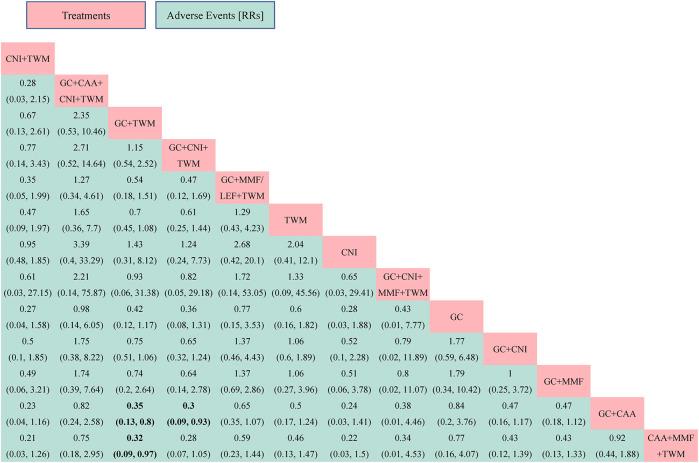
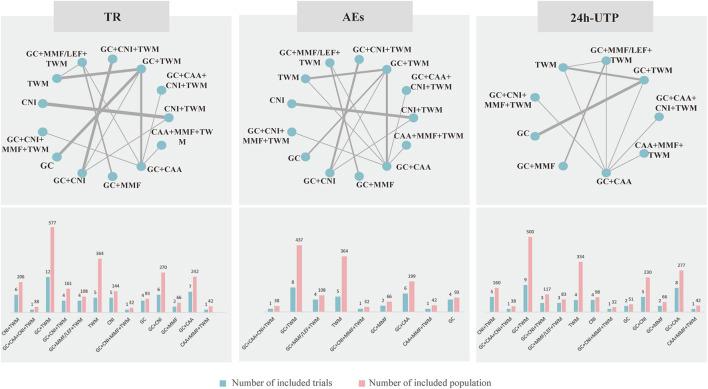
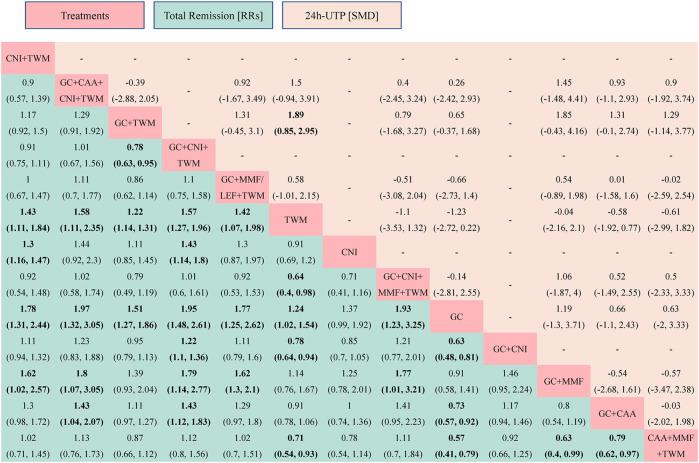
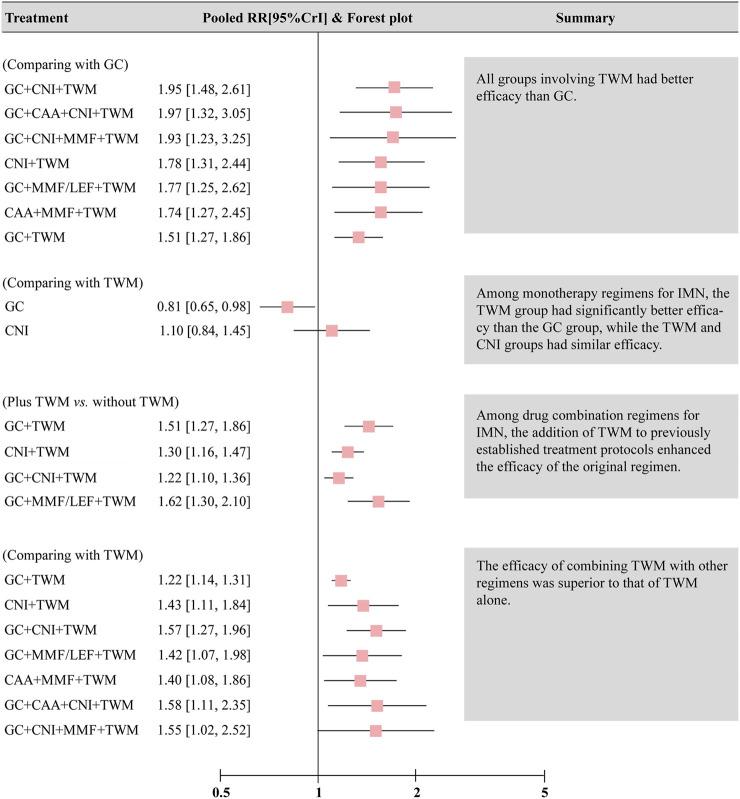
Currently, the optimal therapy plan for idiopathic membranous nephropathy (IMN) remains controversial as there has been no comprehensive and systematic comparison of therapy plans for IMN. Therefore, in this study, a Bayesian meta-analysis was used to systematically evaluate the clinical efficacy and safety of various intervention plans involving traditional Chinese medicine TWM in the treatment of IMN. An electronic search in 7 databases was conducted from their inception to August 2022 for all published randomized controlled trials (RCTs) of various intervention plans for IMN. Network meta-analysis (NMA) was performed by using software R, and the surface under the cumulative ranking area (SUCRA) probability curve was plotted for each outcome indicator to rank the efficacy and safety of different intervention plans. A total of 30 RCTs were included, involving 13 interventions. The results showed that (1) in terms of total remission (TR), ① GC + CNI + TWM was the best effective among all plans, and the addition and subtraction plan of CNI + TWM was the best effective for IMN; ② All plans involving TWM were more effective than GG; ③ Among monotherapy plans for IMN, TWM was more effective distinctly than GC, while TWM and CNI were similarly effective; ④ Among multidrug therapy plans for IMN, the addition of TWM to previously established therapy plans made the original plans more effective; ⑤The efficacy of combining TWM with other plans was superior to that of TWM alone. (2) In terms of lowering 24 h-UTP, GC + TWM was the best effective and more effective than TWM. (3) In terms of safety, there was no statistically significant difference between all groups. However, CNI + TWM was the safest. No serious adverse events (AEs) occurred in all the included studies. The addition of TWM may be beneficial to patients with IMN. It may enhance the efficacy of previously established treatment protocols without leading to additional safety risks. In particular, GC + CNI + TWM, GC + TWM, and CNI + TWM with better efficacy and higher safety can be preferred in clinical decision-making as the therapy plans for IMN.
目前,特发性膜性肾病(IMN)的最佳治疗方案仍存在争议,因为尚未对IMN的治疗方案进行全面系统的比较。因此,在本研究中,采用贝叶斯荟萃分析系统评价了包括中医药(TWM)在内的各种干预方案治疗IMN的临床疗效和安全性。从各数据库建库至2022年8月,在7个数据库中进行电子检索,查找所有已发表的关于IMN各种干预方案的随机对照试验(RCT)。使用R软件进行网状荟萃分析(NMA),并为每个结局指标绘制累积排序曲线下面积(SUCRA)概率曲线,以对不同干预方案的疗效和安全性进行排序。共纳入30项RCT,涉及13种干预措施。结果显示:(1)在完全缓解(TR)方面,①GC + CNI + TWM在所有方案中疗效最佳,CNI + TWM的加减方案对IMN疗效最佳;②所有涉及TWM的方案比糖皮质激素(GG)更有效;③在IMN的单药治疗方案中,TWM明显比GC更有效,而TWM和CNI疗效相似;④在IMN的多药治疗方案中,在既定治疗方案中加用TWM可使原方案更有效;⑤TWM与其他方案联合的疗效优于单独使用TWM。(2)在降低24小时尿蛋白(24 h-UTP)方面,GC + TWM疗效最佳且比TWM更有效。(3)在安全性方面,所有组间无统计学显著差异。然而,CNI + TWM最安全。所有纳入研究中均未发生严重不良事件(AE)。加用TWM可能对IMN患者有益。它可能增强既定治疗方案的疗效,而不会导致额外的安全风险。特别是,GC + CNI + TWM、GC + TWM和CNI + TWM疗效较好且安全性较高,在临床决策中可优先作为IMN的治疗方案。

 Zotero 插件