
提高人类蜱传疾病风险监测能力:利用多模态数据库进行空间分析。
Improving Surveillance of Human Tick-Borne Disease Risks: Spatial Analysis Using Multimodal Databases.
机构信息
School of Economic, Political and Policy Sciences, University of Texas at Dallas, Richardson, TX, United States.
Laboratory for Human Neurobiology, Boston University School of Medicine, Boston, MA, United States.
出版信息
JMIR Public Health Surveill. 2023 Aug 23;9:e43790. doi: 10.2196/43790.
BACKGROUND
The extent of tick-borne disease (TBD) risk in the United States is generally unknown. Active surveillance using entomological measures, such as presence and density of infected nymphal Ixodes scapularis ticks, have served as indicators for assessing human risk, but results have been inconsistent and passive surveillance via public health systems suggests TBDs are underreported.
OBJECTIVE
Research using various data sources and collection methods (eg, Google Trends, apps, and tick bite encounters [TBEs] reports) has shown promise for assessing human TBD risk. In that vein, and engaging a One Health perspective, this study used multimodal databases, geographically overlaying patient survey data on TBEs and concomitant reports of TBDs with data drawn from other sources, such as canine serological reports, to glean insights and to determine and assess the use of various indicators as proxies for human TBD risk.
METHODS
This study used a mixed methods research strategy, relying on triangulation techniques and drawing on multiple data sources to provide insights into various aspects of human disease risk from TBEs and TBDs in the United States. A web-based survey was conducted over a 15-month period beginning in December 2020 to collect data on TBEs. To maximize the value of the covariate data, related analyses included TBE reports that occurred in the United States between January 1, 2000, and March 31, 2021. TBEs among patients diagnosed with Lyme disease were analyzed at the county level and compared to I scapularis and I pacificus tick presence, human cases identified by the Centers for Disease Control and Prevention (CDC), and canine serological data. Spatial analyses employed multilayer thematic mapping and other techniques.
RESULTS
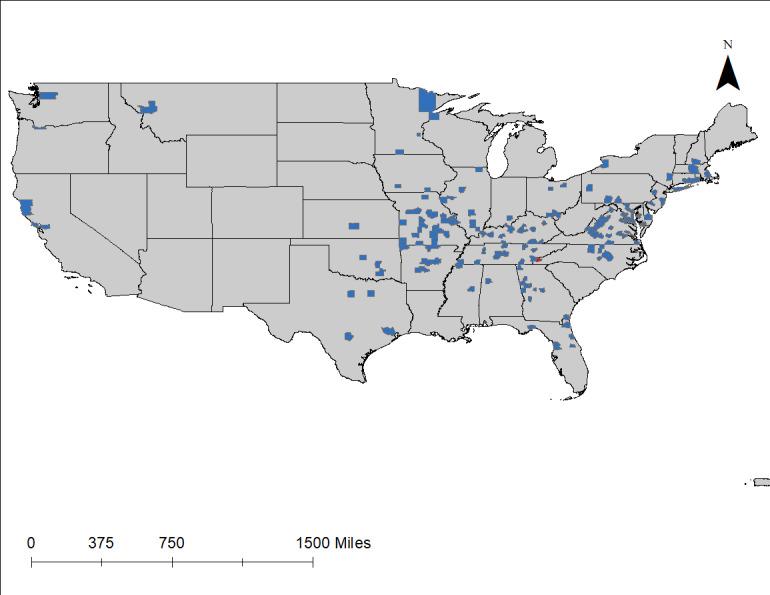
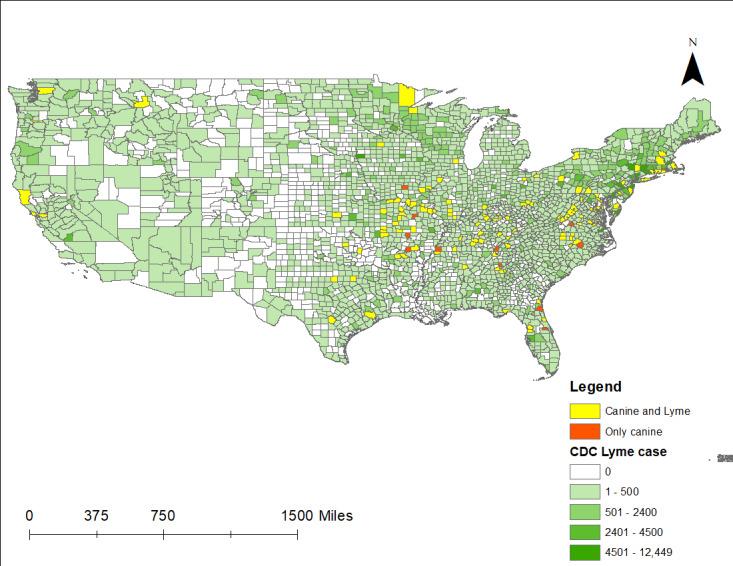
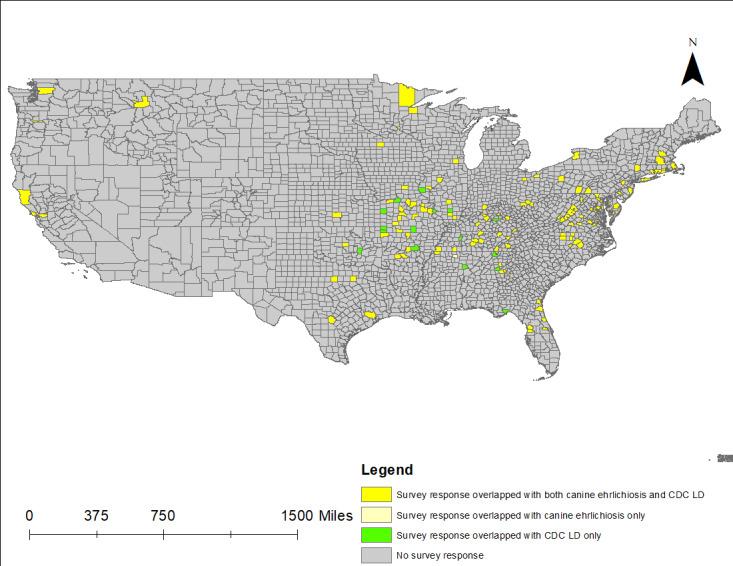
After cleaning, survey results showed a total of 249 (75.7%) TBEs spread across 148 respondents (61.9% of all respondents, 81.7% of TBE-positive respondents); 144 (4.7%) counties in 30 states (60%) remained eligible for analysis, with an average of 1.68 (SD 1.00) and median of 1 (IQR 1) TBEs per respondent. Analysis revealed significant spatial matching at the county level among patient survey reports of TBEs and disease risk indicators from the CDC and other official sources. Thematic mapping results included one-for-one county-level matching of reported TBEs with at least 1 designated source of human disease risk (ie, positive canine serological tests, CDC-reported Lyme disease, or known tick presence).
CONCLUSIONS
Use of triangulation methods to integrate patient data on TBE recall with established canine serological reports, tick presence, and official human TBD information offers more granular, county-level information regarding TBD risk to inform clinicians and public health officials. Such data may supplement public health sources to offer improved surveillance and provide bases for developing robust proxies for TBD risk among humans.
背景
美国蜱传疾病(TBD)的风险程度通常不为人知。使用昆虫学措施(如受感染的幼若虫伊氏革蜱的存在和密度)进行主动监测,已被用作评估人类风险的指标,但结果不一致,而通过公共卫生系统进行的被动监测表明 TBD 报告不足。
目的
使用各种数据源和收集方法(例如谷歌趋势、应用程序和蜱虫叮咬报告)进行的研究表明,评估人类 TBD 风险具有一定的潜力。本着这种精神,并采用一种“同一健康”的视角,本研究使用多模态数据库,将 TBE 患者调查数据与从其他来源(如犬血清学报告)获取的数据进行地理叠加,以获取有关 TBD 的伴随报告,从而深入了解和确定并评估各种指标作为人类 TBD 风险的替代指标。
方法
本研究采用混合方法研究策略,依靠三角测量技术,并利用多种数据源,从美国 TBE 和 TBD 角度提供有关人类疾病风险的各种见解。从 2020 年 12 月开始,进行了为期 15 个月的网络调查,以收集有关 TBE 的数据。为了最大限度地利用协变量数据,相关分析包括 2000 年 1 月 1 日至 2021 年 3 月 31 日期间在美国发生的 TBE 报告。对诊断为莱姆病的患者中的 TBE 进行了县级分析,并与伊氏革蜱和伊氏太平洋革蜱的存在、疾病控制和预防中心(CDC)确定的人类病例以及犬血清学数据进行了比较。空间分析采用多层专题制图和其他技术。
结果
经过清理,调查结果显示共有 249 例(75.7%)TBE 分布在 148 名受访者中(所有受访者的 61.9%,TBE 阳性受访者的 81.7%);在 30 个州的 144 个(4.7%)县中仍有符合分析条件的,平均每位受访者有 1.68(SD 1.00)和中位数为 1(IQR 1)例 TBE。分析表明,在县级层面上,患者 TBE 报告与来自疾病控制与预防中心和其他官方来源的疾病风险指标之间存在显著的空间匹配。专题制图结果包括报告的 TBE 与至少 1 个指定的人类疾病风险来源(即阳性犬血清学检测、CDC 报告的莱姆病或已知的蜱虫存在)之间的一对一县级匹配。
结论
使用三角测量方法将 TBE 回忆患者数据与已建立的犬血清学报告、蜱虫存在和官方人类 TBD 信息相结合,为 TBD 风险提供了更详细的县级信息,以告知临床医生和公共卫生官员。此类数据可能补充公共卫生来源,以提供更好的监测,并为人类 TBD 风险开发可靠的替代指标提供依据。


 Zotero 插件