
多塔利单抗对比化疗治疗铂类治疗后复发/晚期子宫内膜癌患者的结局:来自 GARNET 试验和英国国家癌症登记服务的数据。
Outcomes of dostarlimab versus chemotherapy in post-platinum patients with recurrent/advanced endometrial cancer: data from the GARNET trial and the National Cancer Registration Service in England.
机构信息
GSK, Brentford, UK.
GSK, Brentford, UK
出版信息
Int J Gynecol Cancer. 2023 Nov 6;33(11):1715-1723. doi: 10.1136/ijgc-2022-004178.
OBJECTIVES
Immune checkpoint inhibitors have emerged as novel treatment options in patients with endometrial cancer. In this study we aimed to compare the survival outcomes of patients with recurrent or advanced endometrial cancer. These patients had received dostarlimab after platinum-based chemotherapy in the single-arm, Phase I GARNET trial. We compared them with a matched indirect real-world cohort.
METHODS
The real-world cohort was established using National Cancer Registration and Analysis Service data, with five treatment-specific real-world sub-cohorts identified. To compare clinical outcomes between the GARNET trial and real-world cohorts, we performed matching-adjusted indirect comparisons. We used prognostic variables to create matching scenarios, including scenario 1 that incorporated grade, histology, and platinum-based chemotherapy number; scenario 2 that considered histology and platinum-based chemotherapy number; and scenario 3 that included race/ethnicity, stage at diagnosis, histology, and prior surgery. Overall survival was defined as the time between the first dostarlimab dose or second-line real-world treatment and death. Adjusted hazard ratios for matching-adjusted indirect comparisons were estimated via weighted Cox proportional-hazards models. Progression-free survival, using time-to-next treatment as a proxy for real-world cohorts, was summarized descriptively.
RESULTS
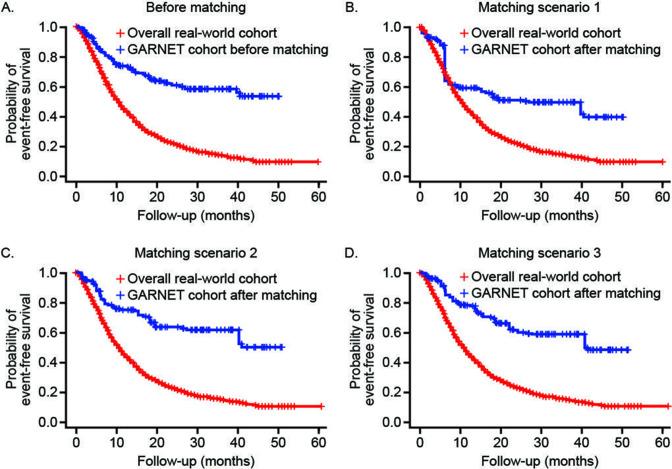
Distribution of baseline characteristics that were matched was similar between the GARNET cohort (n=153) and the real-world cohort (n=999). The most common International Federation of Gynecology and Obstetrics (FIGO) stage in both cohorts was stage III/IV (n=88; 57.5% and n=778; 77.9%, respectively), with endometroid histology predominating in the GARNET cohort (n=121; 79.1%) and non-endometrioid the predominant form in the real-world cohort (n=575; 57.6%). The median overall survival for dostarlimab was longer (range 27.1-40.5 months [95% confidence interval (CI) 6.4-non-estimable and 19.4-non-estimable]) both before and after matching for all scenarios compared with the real-world cohort (10.3 months). Across all matching scenarios, patients in the GARNET cohort had a decreased risk of death, with a HR for overall survival of 0.32 (p<0.0001) before matching, as compared with the overall real-world cohort and most treatment-specific real-world cohorts. For all three scenarios, progression-free survival rates at 12 and 18 months were higher for patients on dostarlimab compared with the real-world cohort (0.48 and 0.43 respectively before matching in the GARNET cohort vs 0.28 and 0.16 respectively in the real-world cohort; using time to next treatment as proxy). The effective sample size for scenario 1 was low when compared with the other scenarios (scenario 1: n=18; scenario 2: n=62; scenario 3: n=67).
CONCLUSION
In this adjusted indirect dataset, patients with recurrent/advanced mismatch repair deficient/microsatellite instability-high endometrial cancer post-platinum-based chemotherapy who received dostarlimab in the GARNET trial had significantly improved overall survival compared with patients receiving current second-line treatment in England.
目的
免疫检查点抑制剂已成为子宫内膜癌患者的新型治疗选择。本研究旨在比较接受铂类化疗后接受 dostarlimab 治疗的复发性或晚期子宫内膜癌患者的生存结局。这些患者在 GARNET 单臂 I 期试验中接受了 dostarlimab 治疗。我们将其与匹配的间接真实世界队列进行了比较。
方法
真实世界队列是使用国家癌症登记和分析服务数据建立的,确定了五个特定于治疗的真实世界亚队列。为了比较 GARNET 试验和真实世界队列之间的临床结局,我们进行了调整后的间接比较。我们使用预后变量创建匹配场景,包括纳入分级、组织学和铂类化疗次数的场景 1;考虑组织学和铂类化疗次数的场景 2;以及包括种族/民族、诊断时的分期、组织学和先前手术的场景 3。总生存期定义为首次 dostarlimab 剂量或二线真实世界治疗与死亡之间的时间。通过加权 Cox 比例风险模型估计匹配调整间接比较的调整后危险比。使用下一次治疗的时间作为真实世界队列的替代指标,描述性总结无进展生存期。
结果
GARNET 队列(n=153)和真实世界队列(n=999)中匹配的基线特征分布相似。两个队列中最常见的国际妇产科联合会(FIGO)分期均为 III/IV 期(n=88;57.5%和 n=778;77.9%),GARNET 队列中以子宫内膜样组织学为主(n=121;79.1%),而真实世界队列中以非子宫内膜样组织学为主(n=575;57.6%)。与真实世界队列相比,dostarlimab 的中位总生存期更长(范围为 27.1-40.5 个月[95%置信区间(CI)为 6.4-不可估计和 19.4-不可估计]),所有场景均在匹配前后(在匹配前,GARNET 队列的 HR 为 0.32,p<0.0001)。在所有匹配场景中,GARNET 队列的患者死亡风险降低,与总体真实世界队列和大多数特定于治疗的真实世界队列相比,总生存期的 HR 为 0.32(p<0.0001)。对于所有三个场景,与真实世界队列相比,接受 dostarlimab 治疗的患者在 12 个月和 18 个月时的无进展生存率更高(在 GARNET 队列中,在匹配前分别为 0.48 和 0.43,而在真实世界队列中分别为 0.28 和 0.16;使用下一次治疗作为代理)。与其他场景相比,方案 1 的有效样本量较低(方案 1:n=18;方案 2:n=62;方案 3:n=67)。
结论
在这项调整后的间接数据集研究中,接受铂类化疗后复发/晚期错配修复缺陷/微卫星不稳定高的子宫内膜癌患者接受 dostarlimab 治疗与接受英国当前二线治疗的患者相比,总生存期显著改善。
 Zotero 插件