
成人 COVID-19 患者住院期间死亡率的临床特征和预测因素:立陶宛维尔纽斯的一项回顾性单中心队列研究。
Clinical characteristics and predictors for in-hospital mortality in adult COVID-19 patients: A retrospective single center cohort study in Vilnius, Lithuania.
机构信息
Clinic of Infectious Diseases and Dermatovenerology, Institute of Clinical Medicine, Faculty of Medicine, Vilnius University, Vilnius, Lithuania.
Faculty of Medicine, Vilnius University, Vilnius, Lithuania.
出版信息
PLoS One. 2023 Aug 25;18(8):e0290656. doi: 10.1371/journal.pone.0290656. eCollection 2023.
BACKGROUND
The COVID-19 infection had spread worldwide causing many deaths. Mortality rates and patients' characteristics varied within and between countries, making it important to understand the peculiarities of different populations. The aim of this study was to identify the main predictors associated with in-hospital mortality due to COVID-19 in Vilnius, Lithuania.
MATERIALS AND METHODS
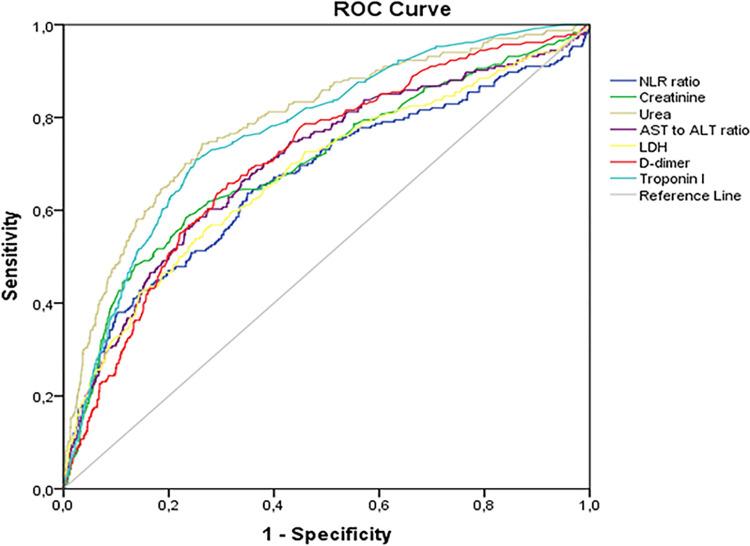
This was a retrospective observational cohort study conducted at Vilnius University Hospital Santaros Clinics, Lithuania. The study included SARS-CoV-2 positive patients aged over 18 years and hospitalized between March 2020 and May 2021. Depersonalized data were retrieved from electronic medical records. The predictive values of laboratory parameters were evaluated using ROC analysis. Multivariable binary logistic regression was performed to reveal predictors of in-hospital mortality due to COVID-19.
RESULTS
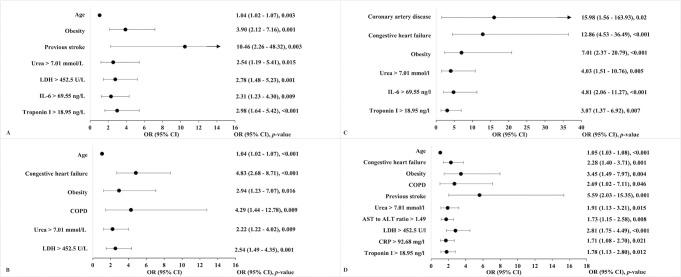
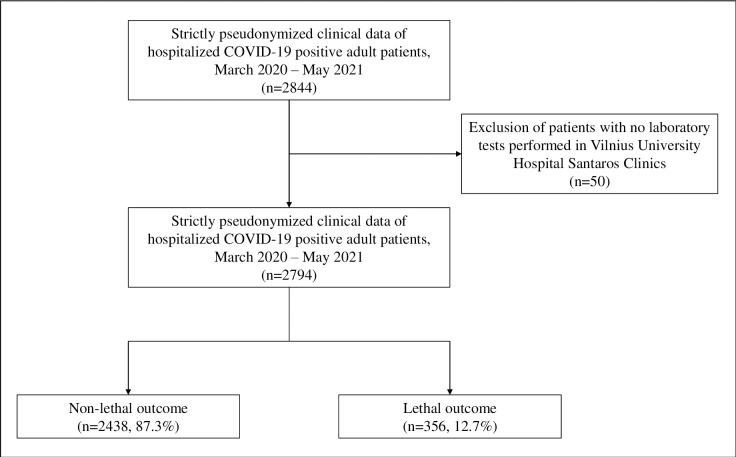
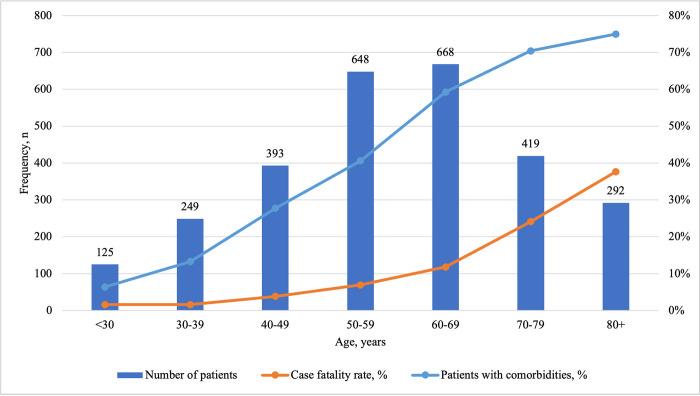
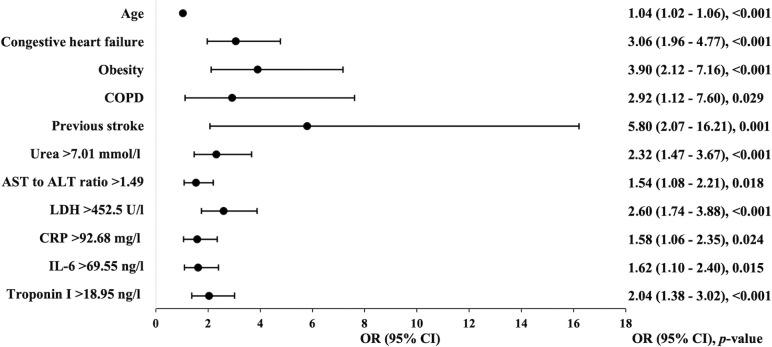
Among 2794 patients, 54.4% were male, the age median was 59 years (IQR 48-70), 47.4% had at least one comorbidity. The most common comorbidities were arterial hypertension (36.9%) and diabetes mellitus (13.7%). Overall, 12.7% of patients died. Multivariable regression revealed that age (OR 1.04, 95%CI 1.02-1.06), congestive heart failure (OR 3.06, 95%CI 1.96-4.77), obesity (OR 3.90, 95%CI 2.12-7.16), COPD (OR 2.92, 95%CI 1.12-7.60), previous stroke (OR 5.80, 95%CI 2.07-16.21), urea >7.01 mmol/l (OR 2.32, 95%CI 1.47-3.67), AST/ALT >1.49 (OR 1.54, 95%CI 1.08-2.21), LDH >452.5 U/l (OR 2.60, 95%CI 1.74-3.88), CRP >92.68 mg/l (OR 1.58, 95%CI 1.06-2.35), IL-6 >69.55 ng/l (OR 1.62, 95%CI 1.10-2.40), and troponin I >18.95 ng/l (OR 2.04, 95%CI 1.38-3.02), were associated with increased risk for in-hospital mortality in COVID-19 patients.
CONCLUSIONS
Age, congestive heart failure, obesity, COPD, prior stroke, and increased concentration of urea, LDH, CRP, IL-6, troponin I, ALT to AST ratio were identified to be the predictors for in-hospital mortality of COVID-19 patients.
背景
COVID-19 感染已在全球范围内传播,导致许多人死亡。死亡率和患者特征在国家内部和国家之间存在差异,因此了解不同人群的特点很重要。本研究的目的是确定与立陶宛维尔纽斯 COVID-19 住院患者死亡相关的主要预测因素。
材料和方法
这是一项在立陶宛维尔纽斯大学桑塔罗斯诊所进行的回顾性观察队列研究。该研究纳入了年龄在 18 岁以上且于 2020 年 3 月至 2021 年 5 月期间住院的 SARS-CoV-2 阳性患者。从电子病历中检索去识别数据。使用 ROC 分析评估实验室参数的预测值。采用多变量二项逻辑回归分析揭示 COVID-19 住院患者死亡的预测因素。
结果
在 2794 名患者中,54.4%为男性,年龄中位数为 59 岁(IQR 48-70),47.4%至少有一种合并症。最常见的合并症是动脉高血压(36.9%)和糖尿病(13.7%)。总体而言,12.7%的患者死亡。多变量回归显示年龄(OR 1.04,95%CI 1.02-1.06)、充血性心力衰竭(OR 3.06,95%CI 1.96-4.77)、肥胖(OR 3.90,95%CI 2.12-7.16)、COPD(OR 2.92,95%CI 1.12-7.60)、既往中风(OR 5.80,95%CI 2.07-16.21)、尿素>7.01mmol/l(OR 2.32,95%CI 1.47-3.67)、AST/ALT>1.49(OR 1.54,95%CI 1.08-2.21)、LDH>452.5U/l(OR 2.60,95%CI 1.74-3.88)、CRP>92.68mg/l(OR 1.58,95%CI 1.06-2.35)、IL-6>69.55ng/l(OR 1.62,95%CI 1.10-2.40)和肌钙蛋白 I>18.95ng/l(OR 2.04,95%CI 1.38-3.02)与 COVID-19 患者住院死亡率增加相关。
结论
年龄、充血性心力衰竭、肥胖、COPD、既往中风以及尿素、LDH、CRP、IL-6、肌钙蛋白 I、ALT 与 AST 比值升高被确定为 COVID-19 患者住院死亡率的预测因素。
 Zotero 插件