
自杀前一年的五条医疗轨迹及其为预防提供的启示:一项基于人群的病例系列研究
Five healthcare trajectories in the year before suicide and what they tell us about opportunities for prevention: a population-level case series study.
作者信息
Chitty Kate M, Sperandei Sandro, Carter Gregory L, Ali Zein, Raubenheimer Jacques E, Schaffer Andrea L, Page Andrew, Buckley Nicholas A
机构信息
Discipline of Biomedical Informatics and Digital Health, Faculty of Medicine and Health, University of Sydney, NSW, Australia.
School of Population and Global Health, Faculty of Health and Medicine, University of Western Australia, WA, Australia.
出版信息
EClinicalMedicine. 2023 Aug 18;63:102165. doi: 10.1016/j.eclinm.2023.102165. eCollection 2023 Sep.
BACKGROUND
Suicide prevention requires a shift from relying on an at-risk individual to engage with the healthcare system. Understanding patterns of healthcare engagement by people who have died by suicide may provide alternative directions for suicide prevention.
METHODS
This is a population-based case-series study of all suicide decedents (n = 3895) in New South Wales (NSW), Australia (2013-2019), with linked coronial, health services and medicine dispensing data. Healthcare trajectories were identified using a k-means longitudinal 3d analysis, based on the number and type of healthcare contacts in the year before death. Characteristics of each trajectory were described.
FINDINGS
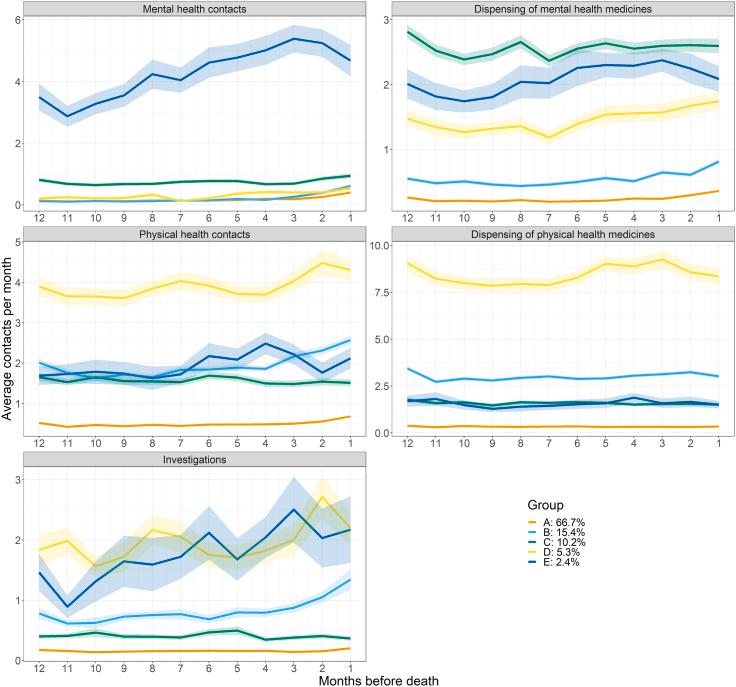
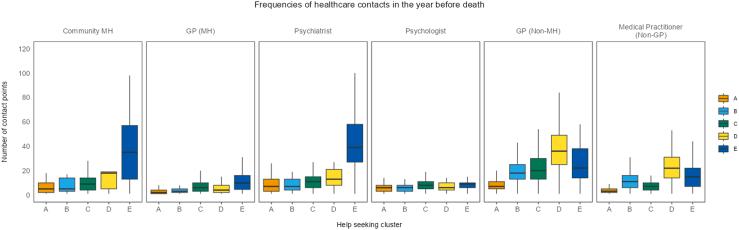
Five trajectories of healthcare utilisation were identified: (A) none or low (n = 2598, 66.7%), (B) moderate, predominantly for physical health (n = 601, 15.4%), (C) moderate, with high mental health medicine use (n = 397, 10.2%), (D) high, predominantly for physical health (n = 206, 5.3%) and E) high, predominantly for mental health (n = 93, 2.4%). Given that most decedents belonged to Trajectory A this suggests a great need for suicide preventive interventions delivered in the community, workplace, schools or online. Trajectories B and D might benefit from opioid dispensing limits and access to psychological pain management. Trajectory C had high mental health medicine use, indicating that the time that medicines are prescribed or dispensed are important touchpoints. Trajectory E had high mental health service predominantly delivered by psychiatrists and community mental health, but limited psychologist use.
INTERPRETATION
Although most suicide decedents made at least one healthcare contact in the year before death, contact frequency was overall very low. Given the characteristics of this group, useful access points for such intervention could be delivered through schools and workplaces, with a focus on alcohol and drug intervention alongide suicide awareness.
FUNDING
Australia's National Health and Medical Research Council.
背景
预防自杀需要从依赖高危个体与医疗保健系统接触转变。了解自杀死亡者的医疗保健接触模式可能为预防自杀提供其他方向。
方法
这是一项基于人群的病例系列研究,研究对象为澳大利亚新南威尔士州(2013 - 2019年)所有自杀死亡者(n = 3895),并关联了死因裁判、医疗服务和药品配给数据。基于死亡前一年医疗保健接触的数量和类型,使用k均值纵向三维分析确定医疗保健轨迹。描述了每条轨迹的特征。
结果
确定了五种医疗保健利用轨迹:(A)无或低(n = 2598,66.7%),(B)中等,主要用于身体健康(n = 601,15.4%),(C)中等,心理健康药物使用量高(n = 397,10.2%),(D)高,主要用于身体健康(n = 206,5.3%),以及(E)高,主要用于心理健康(n = 93,2.4%)。鉴于大多数死亡者属于轨迹A,这表明在社区、工作场所、学校或在线提供自杀预防干预措施有很大需求。轨迹B和D可能受益于阿片类药物配给限制和获得心理疼痛管理服务。轨迹C心理健康药物使用量高,表明开药或配药时间是重要的接触点。轨迹E主要由精神科医生和社区心理健康服务提供高心理健康服务,但心理学家的使用有限。
解读
尽管大多数自杀死亡者在死亡前一年至少有一次医疗保健接触,但总体接触频率非常低。鉴于该群体的特征,此类干预的有用切入点可以通过学校和工作场所提供,重点是酒精和药物干预以及自杀意识。
资金来源
澳大利亚国家卫生与医学研究委员会。
 Zotero 插件