
实时阻抗生物传感器监测生物膜的生长和分散。
Monitoring biofilm growth and dispersal in real-time with impedance biosensors.
机构信息
Center for Biofilm Engineering, Montana State University, Bozeman, MT 59717, USA.
Mechanical and Industrial Engineering, Montana State University, Bozeman, MT 59717, USA.
出版信息
J Ind Microbiol Biotechnol. 2023 Feb 17;50(1). doi: 10.1093/jimb/kuad022.
UNLABELLED
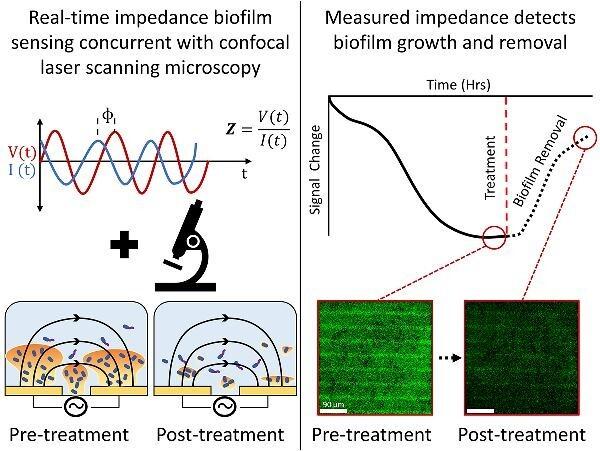
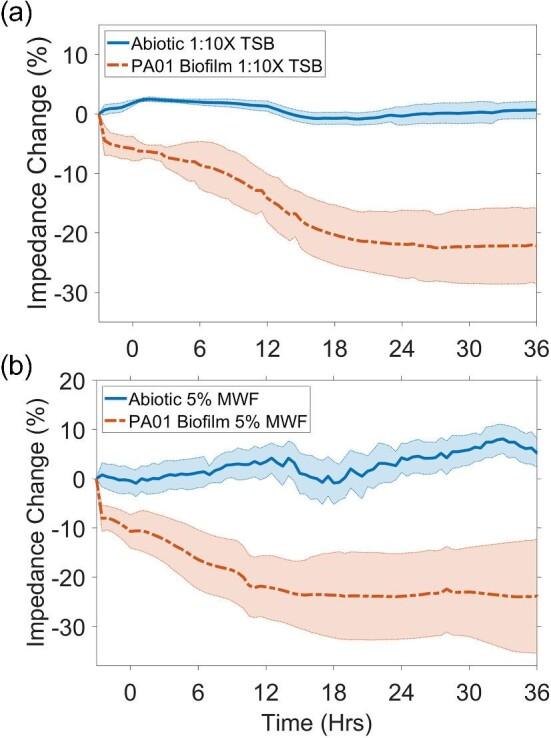
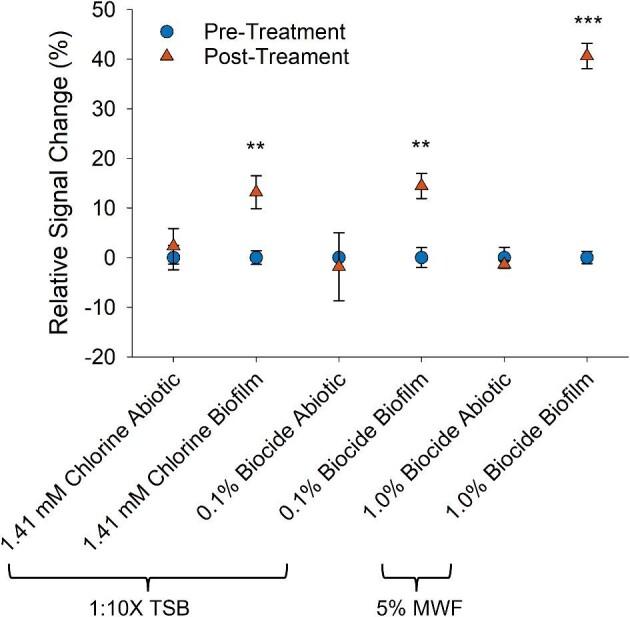
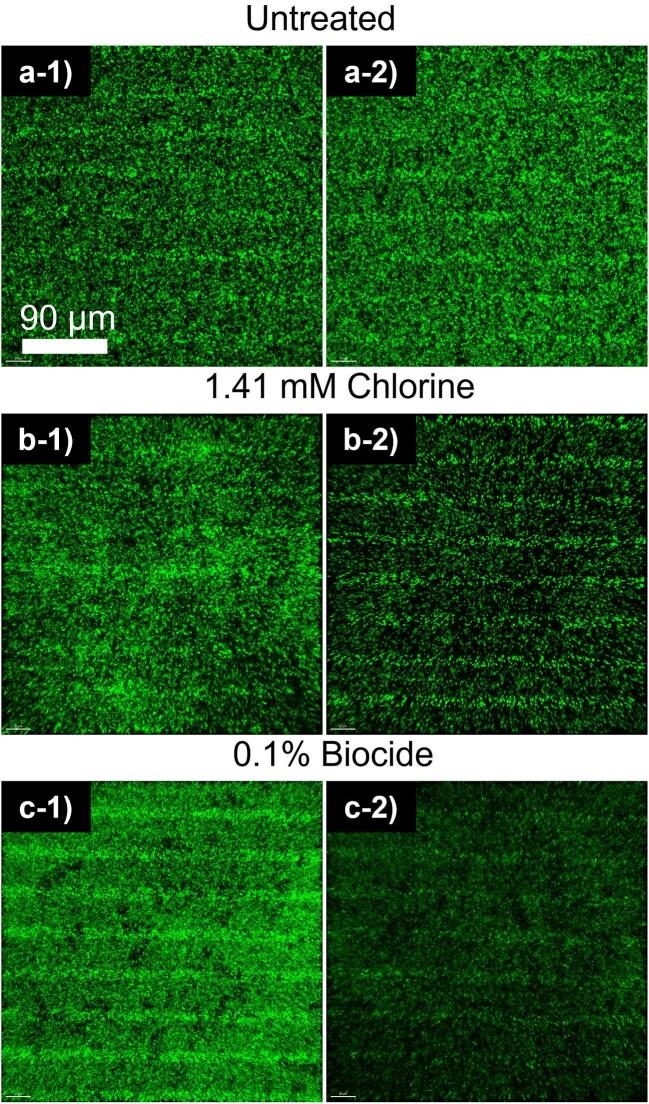
Microbial biofilm contamination is a widespread problem that requires precise and prompt detection techniques to effectively control its growth. Microfabricated electrochemical impedance spectroscopy (EIS) biosensors offer promise as a tool for early biofilm detection and monitoring of elimination. This study utilized a custom flow cell system with integrated sensors to make real-time impedance measurements of biofilm growth under flow conditions, which were correlated with confocal laser scanning microscopy (CLSM) imaging. Biofilm growth on EIS biosensors in basic aqueous growth media (tryptic soy broth, TSB) and an oil-water emulsion (metalworking fluid, MWF) attenuated in a sigmoidal decay pattern, which lead to an ∼22-25% decrease in impedance after 24 Hrs. Subsequent treatment of established biofilms increased the impedance by ∼14% and ∼41% in TSB and MWF, respectively. In the presence of furanone C-30, a quorum-sensing inhibitor (QSI), impedance remained unchanged from the initial time point for 18 Hrs in TSB and 72 Hrs in MWF. Biofilm changes enumerated from CLSM imaging corroborated impedance measurements, with treatment significantly reducing biofilm. Overall, these results support the application of microfabricated EIS biosensors for evaluating the growth and dispersal of biofilm in situ and demonstrate potential for use in industrial settings.
ONE-SENTENCE SUMMARY: This study demonstrates the use of microfabricated electrochemical impedance spectroscopy (EIS) biosensors for real-time monitoring and treatment evaluation of biofilm growth, offering valuable insights for biofilm control in industrial settings.
未加标签
微生物生物膜污染是一个普遍存在的问题,需要精确和及时的检测技术来有效控制其生长。微制造电化学阻抗谱(EIS)生物传感器作为一种早期生物膜检测和消除监测的工具具有很大的应用潜力。本研究利用带有集成传感器的定制流动池系统对流动条件下的生物膜生长进行实时阻抗测量,并与共聚焦激光扫描显微镜(CLSM)成像相关联。EIS 生物传感器在基本水培生长介质(胰蛋白酶大豆肉汤,TSB)和油水乳液(金属加工液,MWF)中的生物膜生长呈指数衰减模式衰减,导致 24 小时后阻抗降低约 22-25%。随后对已建立的生物膜进行处理,在 TSB 和 MWF 中分别使阻抗增加约 14%和 41%。在群体感应抑制剂(QSI)呋喃酮 C-30 的存在下,TSB 中阻抗在 18 小时内和 MWF 中在 72 小时内从初始时间点保持不变。从 CLSM 成像中计数的生物膜变化与阻抗测量结果相符,处理显著减少了生物膜。总的来说,这些结果支持微制造的电化学阻抗谱生物传感器用于原位评估生物膜的生长和扩散,并展示了在工业环境中应用的潜力。
简明摘要
本研究展示了微制造电化学阻抗谱(EIS)生物传感器在实时监测和处理生物膜生长方面的应用,为工业环境中的生物膜控制提供了有价值的见解。



 Zotero 插件