
研究造血犬癌细胞系中的DNA损伤反应途径,这是寻找靶点以开发治疗犬类癌症新疗法的必要步骤。
Studying the DNA damage response pathway in hematopoietic canine cancer cell lines, a necessary step for finding targets to generate new therapies to treat cancer in dogs.
作者信息
Hernández-Suárez Beatriz, Gillespie David A, Dejnaka Ewa, Kupczyk Piotr, Obmińska-Mrukowicz Bożena, Pawlak Aleksandra
机构信息
Department of Pharmacology and Toxicology, Faculty of Veterinary Medicine, Wroclaw University of Environmental and Life Sciences, Wrocław, Poland.
Facultad de Medicina, Instituto de Tecnologías Biomédicas, Universidad de La Laguna, Tenerife, Spain.
出版信息
Front Vet Sci. 2023 Aug 16;10:1227683. doi: 10.3389/fvets.2023.1227683. eCollection 2023.
BACKGROUND
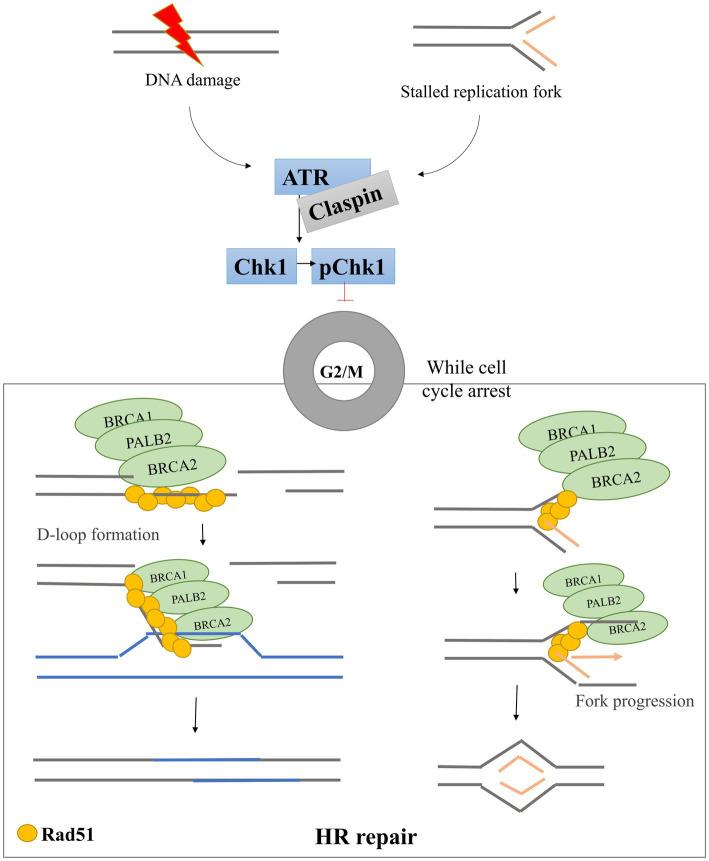
Dogs present a significant opportunity for studies in comparative oncology. However, the study of cancer biology phenomena in canine cells is currently limited by restricted availability of validated antibody reagents and techniques. Here, we provide an initial characterization of the expression and activity of key components of the DNA Damage Response (DDR) in a panel of hematopoietic canine cancer cell lines, with the use of commercially available antibody reagents.
MATERIALS AND METHODS
The techniques used for this validation analysis were western blot, qPCR, and DNA combing assay.
RESULTS
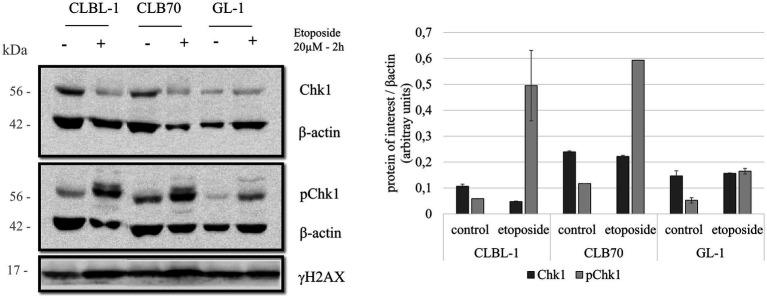
Substantial variations in both the basal expression (ATR, Claspin, Chk1, and Rad51) and agonist-induced activation (p-Chk1) of DDR components were observed in canine cancer cell lines. The expression was stronger in the CLBL-1 (B-cell lymphoma) and CLB70 (B-cell chronic lymphocytic leukemia) cell lines than in the GL-1 (B-cell leukemia) cell line, but the biological significance of these differences requires further investigation. We also validated methodologies for quantifying DNA replication dynamics in hematopoietic canine cancer cell lines, and found that the GL-1 cell line presented a higher replication fork speed than the CLBL-1 cell line, but that both showed a tendency to replication fork asymmetry.
CONCLUSION
These findings will inform future studies on cancer biology, which will facilitate progress in developing novel anticancer therapies for canine patients. They can also provide new knowledge in human oncology.
背景
狗为比较肿瘤学研究提供了重要契机。然而,目前犬类细胞中癌症生物学现象的研究受到有效抗体试剂和技术可用性有限的限制。在此,我们利用市售抗体试剂,对一组造血犬癌细胞系中DNA损伤反应(DDR)关键成分的表达和活性进行了初步表征。
材料与方法
用于该验证分析的技术有蛋白质免疫印迹法、定量聚合酶链反应和DNA梳理分析。
结果
在犬癌细胞系中观察到DDR成分的基础表达(ATR、Claspin、Chk1和Rad51)和激动剂诱导的激活(磷酸化Chk1)均存在显著差异。CLBL-1(B细胞淋巴瘤)和CLB70(B细胞慢性淋巴细胞白血病)细胞系中的表达强于GL-1(B细胞白血病)细胞系,但这些差异的生物学意义需要进一步研究。我们还验证了定量造血犬癌细胞系中DNA复制动力学的方法,发现GL-1细胞系的复制叉速度高于CLBL-1细胞系,但两者均表现出复制叉不对称的趋势。
结论
这些发现将为未来的癌症生物学研究提供信息,有助于为犬类患者开发新型抗癌疗法取得进展。它们也可为人类肿瘤学提供新知识。




 Zotero 插件