
通过测序技术绘制表观遗传修饰图谱。
Mapping epigenetic modifications by sequencing technologies.
作者信息
Chen Xiufei, Xu Haiqi, Shu Xiao, Song Chun-Xiao
机构信息
Ludwig Institute for Cancer Research, Nuffield Department of Medicine, University of Oxford, Oxford, OX3 7FZ, UK.
Target Discovery Institute, Nuffield Department of Medicine, University of Oxford, Oxford, OX3 7FZ, UK.
出版信息
Cell Death Differ. 2025 Jan;32(1):56-65. doi: 10.1038/s41418-023-01213-1. Epub 2023 Sep 1.
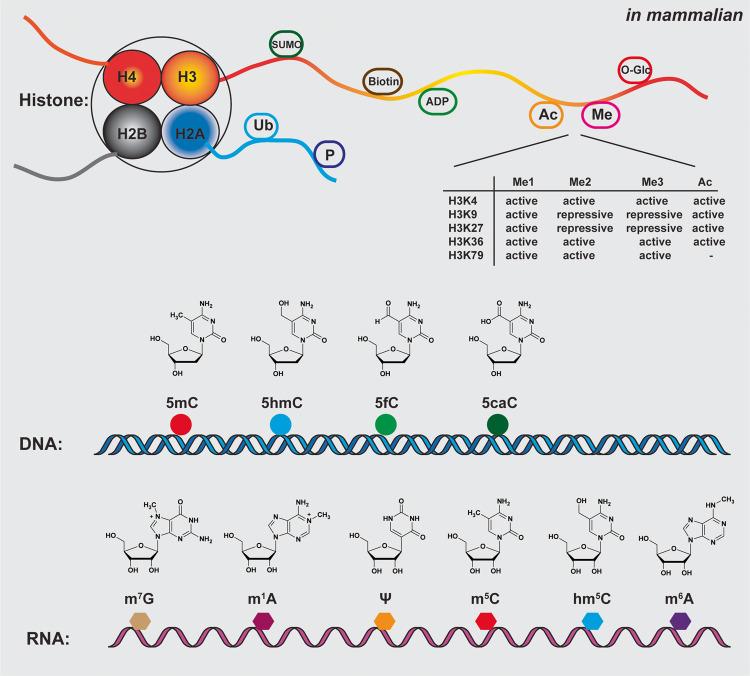
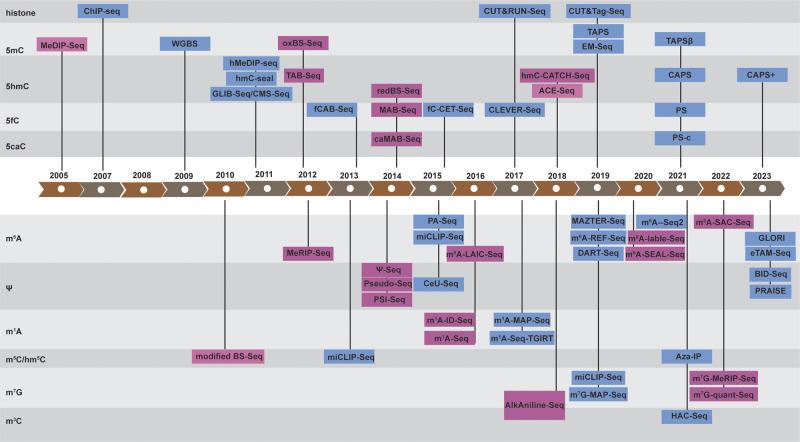
The "epigenetics" concept was first described in 1942. Thus far, chemical modifications on histones, DNA, and RNA have emerged as three important building blocks of epigenetic modifications. Many epigenetic modifications have been intensively studied and found to be involved in most essential biological processes as well as human diseases, including cancer. Precisely and quantitatively mapping over 100 [1], 17 [2], and 160 [3] different known types of epigenetic modifications in histone, DNA, and RNA is the key to understanding the role of epigenetic modifications in gene regulation in diverse biological processes. With the rapid development of sequencing technologies, scientists are able to detect specific epigenetic modifications with various quantitative, high-resolution, whole-genome/transcriptome approaches. Here, we summarize recent advances in epigenetic modification sequencing technologies, focusing on major histone, DNA, and RNA modifications in mammalian cells.
“表观遗传学”概念于1942年首次被描述。迄今为止,组蛋白、DNA和RNA上的化学修饰已成为表观遗传修饰的三个重要组成部分。许多表观遗传修饰已得到深入研究,并被发现参与了大多数基本生物过程以及包括癌症在内的人类疾病。精确且定量地绘制出组蛋白、DNA和RNA中超过100种[1]、17种[2]和160种[3]不同的已知表观遗传修饰类型,是理解表观遗传修饰在多种生物过程中的基因调控作用的关键。随着测序技术的迅速发展,科学家们能够通过各种定量、高分辨率的全基因组/转录组方法检测特定的表观遗传修饰。在此,我们总结了表观遗传修饰测序技术的最新进展,重点关注哺乳动物细胞中的主要组蛋白、DNA和RNA修饰。

 Zotero 插件