
粪便微生物群移植治疗溃疡性结肠炎的疗效和安全性:系统评价和荟萃分析。
Efficacy and safety of fecal microbiota transplantation in the treatment of ulcerative colitis: a systematic review and meta-analysis.
机构信息
Department of Gastroenterology, Shanxi Provincial People's Hospital, The Fifth Hospital of Shanxi Medical University, Taiyuan, 030012, China.
School of Pharmacy, Fujian University of Traditional Chinese Medicine, Fuzhou, 350122, China.
出版信息
Sci Rep. 2023 Sep 3;13(1):14494. doi: 10.1038/s41598-023-41182-6.
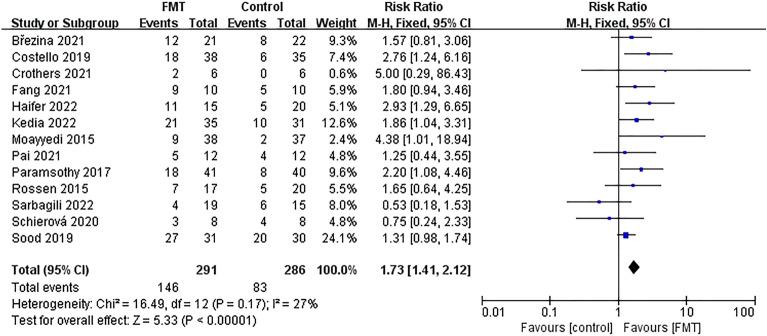
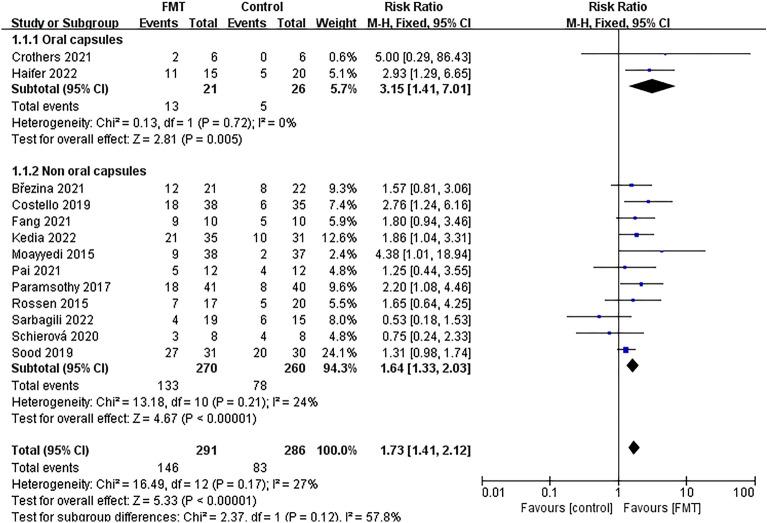
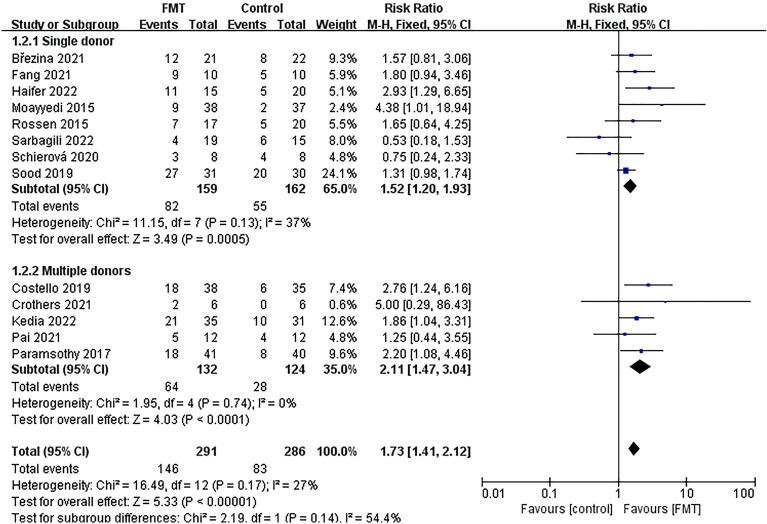
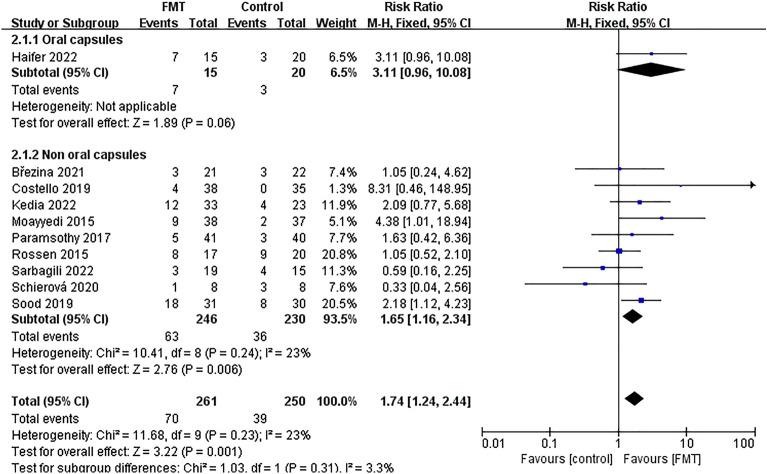
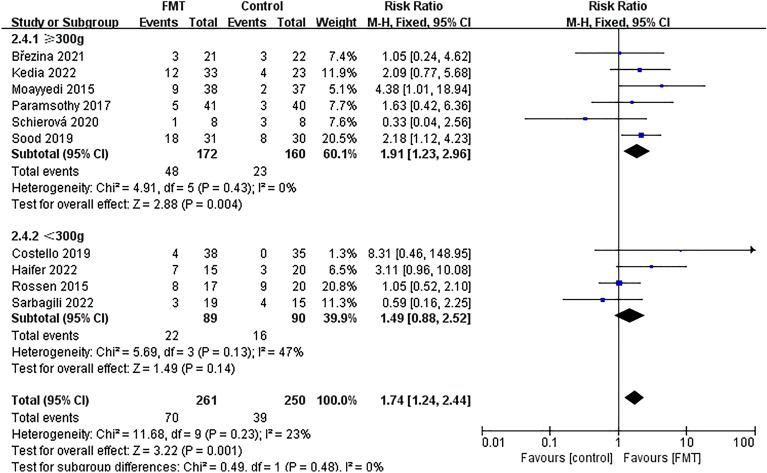
To explore the efficacy and safety of fecal microbiota transplantation (FMT) as a treatment approach for ulcerative colitis (UC), a comprehensive systematic review and meta-analysis of randomized controlled trials was conducted. To collect and evaluate randomized controlled trials of high quality on FMT for UC, we searched a number of databases, including PubMed, Web of Science, Cochrane, Embase, and Medline, for studies published between the establishment of the databases and March 2023. We conducted a meta-analysis of the studies using Review Manager software (version 5.4.1) to determine the differences in rates of remission and adverse reactions between the FMT group and the control group, utilizing the risk ratio (RR) and 95% confidence interval (CI) to combine our findings. A total of 13 randomized controlled trials (RCTs) on the efficacy of FMT in patients with UC were included in the study, in which 580 patients participated, including 293 patients treated with FMT and 287 control subjects. Meta-analysis revealed that clinical remission was significantly better in the FMT group than in the control group [RR = 1.73; 95% CI = (1.41, 2.12); P < 0.00001]; endoscopic remission was significantly better in the FMT group than in the control group [RR = 1.74; 95% CI = (1.24, 2.44); P = 0.001]. Additionally, there were no significant differences in the incidence of adverse reactions between the two groups [RR = 1.00; 95% CI = (0.86, 1.15); P = 0.96]. Fecal microbiota transplantation has shown potential as a therapeutic intervention for inducing clinical remission in ulcerative colitis UC; nevertheless, the attainment of endoscopic remission and the maintenance of long-term remission continue to present challenges. Safety concerns persist throughout the treatment process, necessitating the implementation of measures to augment both safety and success rates.
为了探索粪便微生物群移植(FMT)作为溃疡性结肠炎(UC)治疗方法的疗效和安全性,我们对高质量的随机对照试验进行了全面的系统评价和荟萃分析。为了收集和评估 FMT 治疗 UC 的高质量随机对照试验,我们检索了多个数据库,包括 PubMed、Web of Science、Cochrane、Embase 和 Medline,检索时间为数据库建立至 2023 年 3 月。我们使用 Review Manager 软件(版本 5.4.1)对这些研究进行荟萃分析,以确定 FMT 组和对照组之间缓解率和不良反应发生率的差异,使用风险比(RR)和 95%置信区间(CI)合并我们的发现。共有 13 项关于 FMT 治疗 UC 患者疗效的随机对照试验纳入本研究,其中 580 名患者参与,包括 293 名接受 FMT 治疗的患者和 287 名对照组患者。荟萃分析显示,FMT 组的临床缓解率明显优于对照组[RR=1.73;95%CI(1.41, 2.12);P<0.00001];FMT 组的内镜缓解率明显优于对照组[RR=1.74;95%CI(1.24, 2.44);P=0.001]。此外,两组不良反应发生率无显著差异[RR=1.00;95%CI(0.86, 1.15);P=0.96]。粪便微生物群移植已显示出作为溃疡性结肠炎(UC)诱导临床缓解的治疗干预的潜力;然而,实现内镜缓解和维持长期缓解仍然是挑战。整个治疗过程中存在安全性问题,需要采取措施提高安全性和成功率。





 Zotero 插件