
性暴力受害者会寻求何处帮助,在性健康保健环境中常规询问是否可以接受?一项基于人群的调查结果。
Where do those experiencing sexual violence seek help and is routine enquiry acceptable within a sexual healthcare setting? Findings from a population-based survey.
机构信息
Department of Sexual Health and HIV Medicine, University Hospitals Birmingham NHS Foundation Trust, Birmingham, UK
School of Nursing and Midwifery, University of Birmingham, Birmingham, UK.
出版信息
BMJ Open. 2023 Sep 6;13(9):e073204. doi: 10.1136/bmjopen-2023-073204.
OBJECTIVES
Most sexual violence (SV) remains undisclosed to healthcare professionals. The aims of this study were to identify where support would be sought after SV and whether routine enquiry about SV was acceptable in a sexual healthcare setting.
DESIGN
An online population-based survey collected data on a history of SV and preferences on support after SV, in addition to sociodemographic data. Respondents' views on being routinely asked about SV were sought.
SETTING AND PARTICIPANTS
This online survey was based in England, UK. There were 2007 respondents.
RESULTS
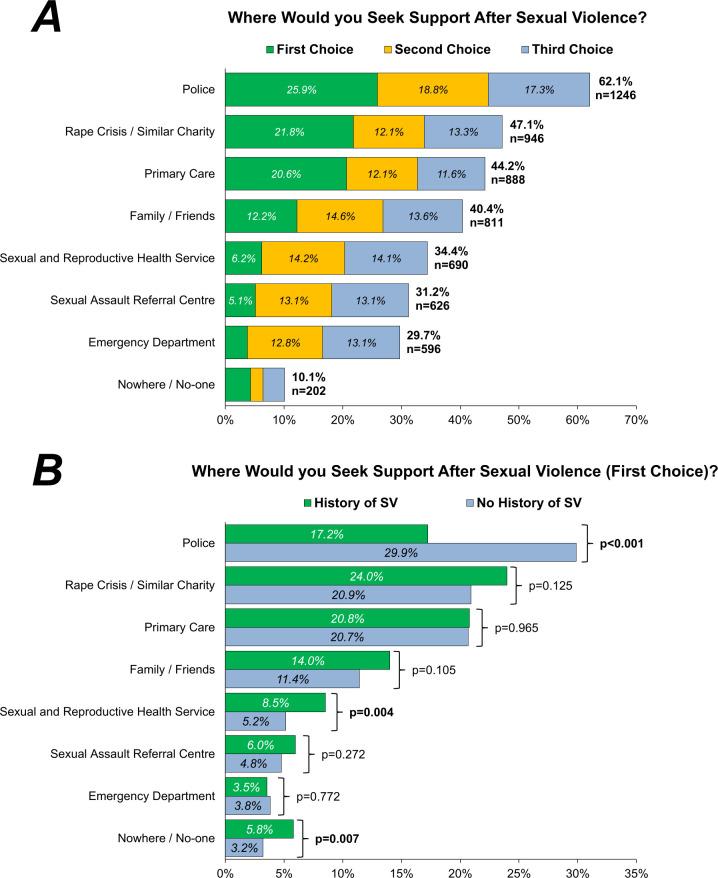
The police were the most frequent first choice for support after experiencing SV (n=520; 25.9%); however, this was less common in individuals in younger age groups (p<0.001) and in those with a history of SV (17.2% vs 29.9%, p<0.001). For the 27.1% (532 of 1960) of respondents who reported a history of SV, the first choice of place for support was Rape Crisis or similar third-sector organisation. The majority of respondents supported routine enquiry about SV during Sexual and Reproductive Health Service (SRHS) consultations (84.4%), although acceptability was significantly lower in older age groups.
CONCLUSIONS AND STUDY IMPLICATIONS
A greater awareness of the influence of sociodemographic factors, including ethnicity, age, gender, disability and a history of SV, when planning and delivering services for those who have experienced SV is needed. A history of SV is common in the general population, and a 'one-size-fits-all' approach to encourage disclosure and access to support is unlikely to be optimal. Routine enquiry about SV is highly acceptable in an SRHS setting and likely to improve disclosure when appropriately implemented.
目的
大多数性暴力(SV)仍未向医疗保健专业人员披露。本研究旨在确定在发生 SV 后会寻求何处支持,以及在性保健环境中常规询问 SV 是否可接受。
设计
一项基于人群的在线调查收集了 SV 病史和 SV 后支持偏好的数据,以及社会人口统计学数据。调查了受访者对常规询问 SV 的看法。
地点和参与者
这项在线调查基于英国英格兰。共有 2007 名受访者。
结果
经历 SV 后,警察是寻求支持的最常见首选(n=520;25.9%);然而,在年龄较小的群体(p<0.001)和有 SV 病史的个体中,这种情况较少见(17.2%对 29.9%,p<0.001)。对于报告有 SV 病史的 27.1%(1960 名中的 532 名)受访者,支持的首选地点是强奸危机或类似的第三方组织。大多数受访者支持在性和生殖健康服务(SRHS)咨询期间常规询问 SV(84.4%),尽管在年龄较大的群体中,接受程度明显较低。
结论和研究意义
在规划和提供 SV 经历者服务时,需要更深入地了解社会人口因素(包括种族、年龄、性别、残疾和 SV 病史)的影响。SV 病史在普通人群中很常见,因此,采用一刀切的方法来鼓励披露和获得支持不太可能是最佳方法。在 SRHS 环境中常规询问 SV 是高度可接受的,并且在适当实施时可能会提高披露率。
 Zotero 插件