
抗生物膜策略:聚焦于生物膜分散酶。
Strategy to combat biofilms: a focus on biofilm dispersal enzymes.
机构信息
Otorhinolaryngology Hospital, The First Affiliated Hospital of Zhengzhou University, 450052, Zhengzhou, China.
Translational Medicine Center, The First Affiliated Hospital of Zhengzhou University, 450052, Zhengzhou, China.
出版信息
NPJ Biofilms Microbiomes. 2023 Sep 7;9(1):63. doi: 10.1038/s41522-023-00427-y.
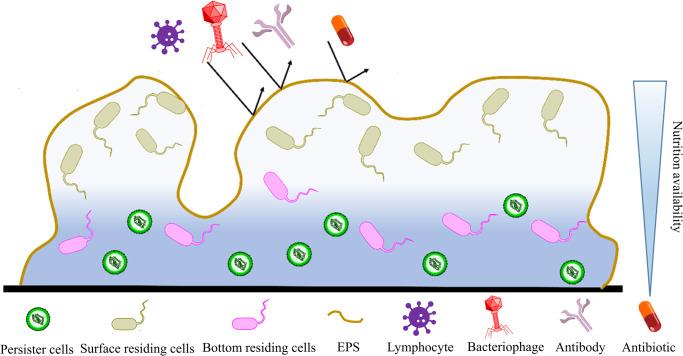
Bacterial biofilms, which consist of three-dimensional extracellular polymeric substance (EPS), not only function as signaling networks, provide nutritional support, and facilitate surface adhesion, but also serve as a protective shield for the residing bacterial inhabitants against external stress, such as antibiotics, antimicrobials, and host immune responses. Biofilm-associated infections account for 65-80% of all human microbial infections that lead to serious mortality and morbidity. Tremendous effort has been spent to address the problem by developing biofilm-dispersing agents to discharge colonized microbial cells to a more vulnerable planktonic state. Here, we discuss the recent progress of enzymatic eradicating strategies against medical biofilms, with a focus on dispersal mechanisms. Particularly, we review three enzyme classes that have been extensively investigated, namely glycoside hydrolases, proteases, and deoxyribonucleases.
细菌生物膜由三维细胞外聚合物质(EPS)组成,不仅具有信号网络功能,提供营养支持并促进表面附着,还为栖息在其中的细菌提供了抵御外部压力(如抗生素、抗菌剂和宿主免疫反应)的保护屏障。生物膜相关感染占所有人类微生物感染的 65-80%,导致严重的死亡率和发病率。人们投入了巨大的努力来解决这个问题,开发了生物膜分散剂,将定植的微生物细胞排到更脆弱的浮游状态。在这里,我们讨论了针对医学生物膜的酶清除策略的最新进展,重点讨论了分散机制。特别地,我们回顾了三种经过广泛研究的酶类,即糖苷水解酶、蛋白酶和脱氧核糖核酸酶。


 Zotero 插件