
β-地中海贫血导致的动脉粥样硬化加速。
Accelerated atherosclerosis in beta-thalassemia.
机构信息
Division of Cardiology, Department of Medicine, Emory University School of Medicine, Atlanta, Georgia, United States.
Aflac Cancer and Blood Disorders Center at Children's Healthcare of Atlanta and the Department of Pediatrics, Emory University School of Medicine, Atlanta, Georgia, United States.
出版信息
Am J Physiol Heart Circ Physiol. 2023 Nov 1;325(5):H1133-H1143. doi: 10.1152/ajpheart.00306.2023. Epub 2023 Sep 8.
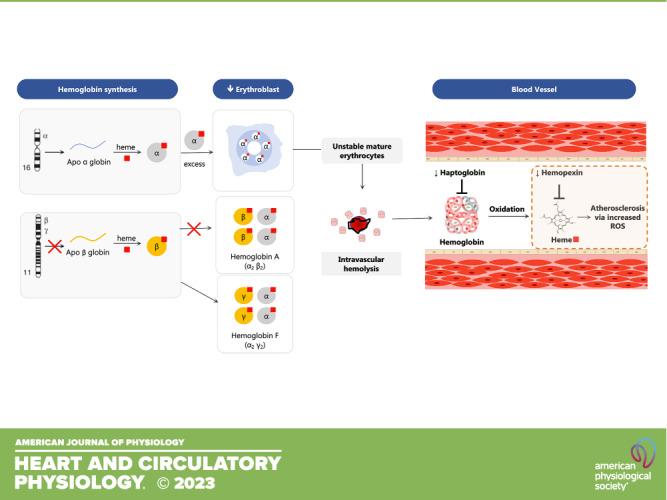
Children with beta-thalassemia (BT) present with an increase in carotid intima-medial thickness, an early sign suggestive of premature atherosclerosis. However, it is unknown if there is a direct relationship between BT and atherosclerotic disease. To evaluate this, wild-type (WT, littermates) and BT (Hbb) mice, both male and female, were placed on a 3-mo high-fat diet with low-density lipoprotein receptor suppression via overexpression of proprotein convertase subtilisin/kexin type 9 (PCSK9) gain-of-function mutation (D377Y). Mechanistically, we hypothesize that heme-mediated oxidative stress creates a proatherogenic environment in BT because BT is a hemolytic anemia that has increased free heme and exhausted hemopexin, heme's endogenous scavenger, in the vasculature. We evaluated the effect of hemopexin (HPX) therapy, mediated via an adeno-associated virus, to the progression of atherosclerosis in BT and a phenylhydrazine-induced model of intravascular hemolysis. In addition, we evaluated the effect of deferiprone (DFP)-mediated iron chelation in the progression of atherosclerosis in BT mice. Aortic en face and aortic root lesion area analysis revealed elevated plaque accumulation in both male and female BT mice compared with WT mice. Hemopexin therapy was able to decrease plaque accumulation in both BT mice and mice on our phenylhydrazine (PHZ)-induced model of hemolysis. DFP decreased atherosclerosis in BT mice but did not provide an additive benefit to HPX therapy. Our data demonstrate for the first time that the underlying pathophysiology of BT leads to accelerated atherosclerosis and shows that heme contributes to atherosclerotic plaque development in BT. This work definitively shows for the first time that beta-thalassemia leads to accelerated atherosclerosis. We demonstrated that intravascular hemolysis is a prominent feature in beta-thalassemia and the resulting increases in free heme are mechanistically relevant. Adeno-associated virus (AAV)-hemopexin therapy led to decreased free heme and atherosclerotic plaque area in both beta-thalassemia and phenylhydrazine-treated mice. Deferiprone-mediated iron chelation led to deceased plaque accumulation in beta-thalassemia mice but provided no additive benefit to hemopexin therapy.
患有β-地中海贫血症(BT)的儿童会出现颈动脉内膜中层增厚,这是动脉粥样硬化早期的一个迹象。然而,目前尚不清楚 BT 是否与动脉粥样硬化疾病有直接关系。为了评估这一点,我们将野生型(WT,同窝仔鼠)和 BT(Hbb)雄性和雌性小鼠分别置于 3 个月的高脂肪饮食中,并通过过表达前蛋白转化酶枯草溶菌素/柯萨奇蛋白酶 9(PCSK9)获得性功能突变(D377Y)来抑制低密度脂蛋白受体。从机制上讲,我们假设血红素介导的氧化应激在 BT 中创造了一个促动脉粥样硬化的环境,因为 BT 是一种溶血性贫血,血管中游离血红素增加,血红素的内源性清除剂血卟啉耗尽。我们评估了通过腺相关病毒介导的血卟啉(HPX)治疗对 BT 中动脉粥样硬化进展的影响,以及苯肼诱导的血管内溶血模型。此外,我们评估了 deferiprone(DFP)介导的铁螯合对 BT 小鼠动脉粥样硬化进展的影响。主动脉全面和主动脉根部病变面积分析显示,与 WT 小鼠相比,雄性和雌性 BT 小鼠的斑块积累增加。HPX 治疗能够减少 BT 小鼠和苯肼(PHZ)诱导的溶血模型小鼠的斑块积累。DFP 降低了 BT 小鼠的动脉粥样硬化,但对 HPX 治疗没有额外的益处。我们的数据首次证明 BT 的潜在病理生理学导致了动脉粥样硬化的加速,并表明血红素有助于 BT 中的动脉粥样硬化斑块形成。这项工作首次明确表明β-地中海贫血症导致了动脉粥样硬化的加速。我们证明了血管内溶血是β-地中海贫血症的一个突出特征,并且由此产生的游离血红素增加在机制上是相关的。腺相关病毒(AAV)-血卟啉治疗导致 BT 和苯肼处理的小鼠的游离血红素减少和动脉粥样硬化斑块面积减少。DFP 介导的铁螯合导致 BT 小鼠的斑块积累减少,但对 HPX 治疗没有额外的益处。
 Zotero 插件