
钙动态失衡驱动与年龄相关的神经退行性疾病的病理生理学和神经元死亡。
Calcium Dyshomeostasis Drives Pathophysiology and Neuronal Demise in Age-Related Neurodegenerative Diseases.
机构信息
ReMYND N.V., Gaston Geenslaan 1, 3001 Leuven, Belgium.
出版信息
Int J Mol Sci. 2023 Aug 26;24(17):13243. doi: 10.3390/ijms241713243.
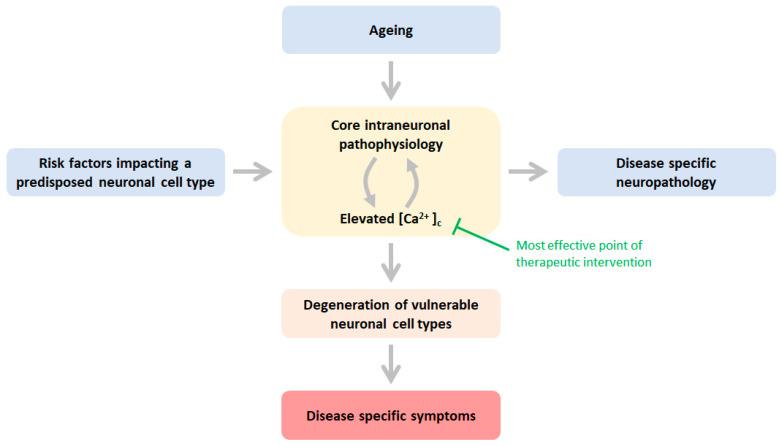
This review postulates that age-related neurodegeneration entails inappropriate activation of intrinsic pathways to enable brain plasticity through deregulated calcium (Ca) signalling. Ca in the cytosol comprises a versatile signal controlling neuronal cell physiology to accommodate adaptive structural and functional changes of neuronal networks (neuronal plasticity) and, as such, is essential for brain function. Although disease risk factors selectively affect different neuronal cell types across age-related neurodegenerative diseases (NDDs), these appear to have in common the ability to impair the specificity of the Ca signal. As a result, non-specific Ca signalling facilitates the development of intraneuronal pathophysiology shared by age-related NDDs, including mitochondrial dysfunction, elevated reactive oxygen species (ROS) levels, impaired proteostasis, and decreased axonal transport, leading to even more Ca dyshomeostasis. These core pathophysiological processes and elevated cytosolic Ca levels comprise a self-enforcing feedforward cycle inevitably spiralling toward high levels of cytosolic Ca. The resultant elevated cytosolic Ca levels ultimately gear otherwise physiological effector pathways underlying plasticity toward neuronal demise. Ageing impacts mitochondrial function indiscriminately of the neuronal cell type and, therefore, contributes to the feedforward cycle of pathophysiology development seen in all age-related NDDs. From this perspective, therapeutic interventions to safely restore Ca homeostasis would mitigate the excessive activation of neuronal destruction pathways and, therefore, are expected to have promising neuroprotective potential.
本篇综述认为,与年龄相关的神经退行性变涉及内在途径的不适当激活,通过失调的钙(Ca)信号来实现大脑可塑性。细胞质中的 Ca 构成了一种多功能信号,控制神经元细胞的生理学,以适应神经元网络的适应性结构和功能变化(神经元可塑性),因此对于大脑功能至关重要。尽管与年龄相关的神经退行性疾病(NDD)中的疾病风险因素选择性地影响不同的神经元细胞类型,但这些因素似乎具有共同的能力,即损害 Ca 信号的特异性。结果,非特异性 Ca 信号促进了与年龄相关的 NDD 共享的细胞内病理生理学的发展,包括线粒体功能障碍、活性氧(ROS)水平升高、蛋白质稳态受损和轴突运输减少,导致 Ca 稳态进一步失调。这些核心病理生理过程和升高的细胞溶质 Ca 水平构成了一个自我加强的正反馈循环,不可避免地导致细胞溶质 Ca 水平升高。由此产生的升高的细胞溶质 Ca 水平最终使可塑性的其他生理性效应途径朝着神经元死亡的方向发展。衰老对神经元细胞类型的线粒体功能产生无差别的影响,因此,促进了所有与年龄相关的 NDD 中所见的病理生理学发展的正反馈循环。从这个角度来看,安全恢复 Ca 稳态的治疗干预措施将减轻神经元破坏途径的过度激活,因此有望具有有前途的神经保护潜力。
 Zotero 插件