
探讨 SARS-CoV-2 感染中脂肪细胞因子与炎症反应的网络关系:范围综述。
Exploring the Network between Adipocytokines and Inflammatory Response in SARS-CoV-2 Infection: A Scoping Review.
机构信息
CEINGE-Biotecnologie Avanzate Scarl "Franco Salvatore", Via G. Salvatore 486, 80145 Napoli, Italy.
Dipartimento di Scienze e Tecnologie Ambientali, Biologiche e Farmaceutiche, Università della Campania "Luigi Vanvitelli", Via Vivaldi 43, 81100 Caserta, Italy.
出版信息
Nutrients. 2023 Aug 30;15(17):3806. doi: 10.3390/nu15173806.
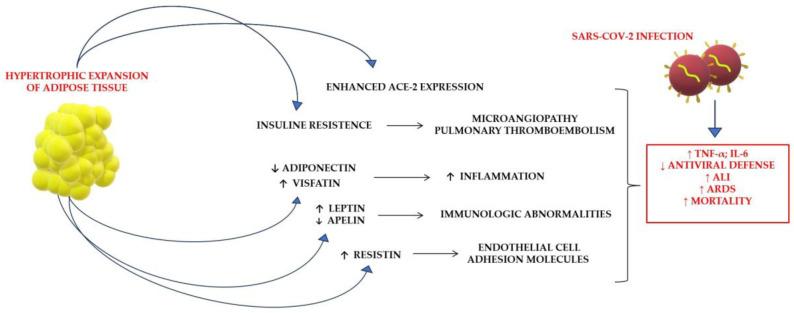
Adipose tissue is actually regarded as an endocrine organ, rather than as an organ that merely stores energy. During the COVID-19 pandemic, obesity has undoubtedly emerged as one of the most important risk factors for disease severity and poor outcomes related to SARS-CoV-2 infection. The aberrant production of cytokine-like hormones, called adipokines, may contribute to alterations in metabolism, dysfunction in vascular endothelium and the creation of a state of general chronic inflammation. Moreover, chronic, low-grade inflammation linked to obesity predisposes the host to immunosuppression and excessive cytokine activation. In this respect, understanding the mechanisms that link obesity with the severity of SARS-CoV-2 infection could represent a real game changer in the development of new therapeutic strategies. Our review therefore examines the pathogenic mechanisms of SARS-CoV-2, the implications with visceral adipose tissue and the influences of the adipose tissue and its adipokines on the clinical behavior of COVID-19.
脂肪组织实际上被认为是一种内分泌器官,而不仅仅是储存能量的器官。在 COVID-19 大流行期间,肥胖无疑成为与 SARS-CoV-2 感染相关的疾病严重程度和不良结局的最重要危险因素之一。异常产生的细胞因子样激素,称为脂肪因子,可能导致代谢紊乱、血管内皮功能障碍和全身性慢性炎症状态。此外,与肥胖相关的慢性、低水平炎症使宿主易发生免疫抑制和细胞因子过度激活。在这方面,了解肥胖与 SARS-CoV-2 感染严重程度之间的联系的机制可能代表着开发新的治疗策略方面的真正改变。因此,我们的综述研究了 SARS-CoV-2 的发病机制、内脏脂肪组织的意义以及脂肪组织及其脂肪因子对 COVID-19 临床行为的影响。


 Zotero 插件