
橙皮素对乳腺癌细胞BT-549中MLH1和MSH2表达的影响。
Hesperetin effect on MLH1 and MSH2 expression on breast cancer cells BT-549.
作者信息
Hasan Assim Khattab, Babaei Esmaeil, Al-Khafaji Ahmed Salim Kadhim
机构信息
Department of Animal Biology, Faculty of Natural Sciences, University of Tabriz, Tabriz, Iran.
Department of Biology, College of Science, University of Baghdad, Baghdad, Iraq.
出版信息
J Adv Pharm Technol Res. 2023 Jul-Sep;14(3):241-247. doi: 10.4103/japtr.japtr_277_23. Epub 2023 Jul 28.
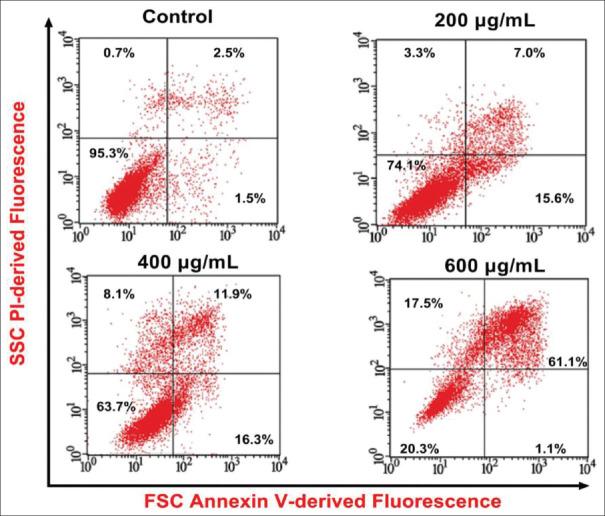
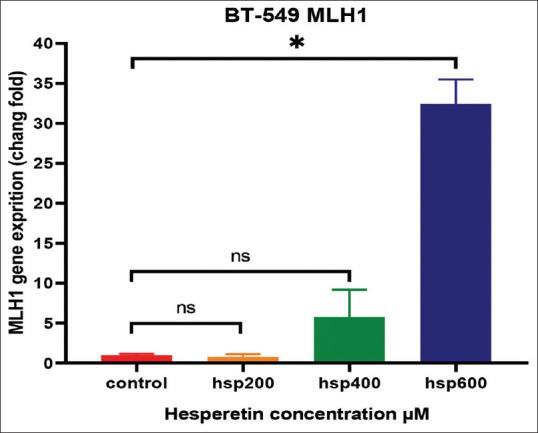
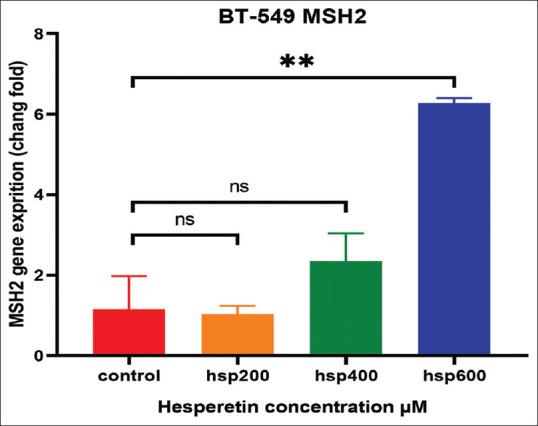
Due to its genetic and phenotypic heterogeneity, breast cancer is very difficult to eliminate. The harmful consequences of conventional therapies like radiation and chemotherapy have prompted the search for organic-based alternatives. Hesperetin (HSP), a flavonoid, has been discovered to possess the ability to hinder the proliferation of cell associated with breast cancer by acting as an epigenetic agent and modifying gene expression. In this investigation, breast cancer cells (BT-549) and normal cells (MCF-10a) were subjected to the 3-(4,5-dimethylthiazol-2-yl)-2,5-diphenyltetrazolium bromide) test and three different doses (200, 400, and 600 μM/mL) of HSP for real-time polymerase chain reaction and flow cytometry to examine its cytotoxic and anti-malignant potential. HSP was shown to be cytotoxic to both normal and breast cancer cells, but had a more pronounced effect on the cancer cell lines. After 48 h of treatment, the half-maximal inhibitory concentration (IC) for BT-549 was 279.2 μM/mL, whereas the IC for MCF-10a was 855.4 μM/mL. At high HSP concentrations, upregulation of the MLH1 and MSH2 genes was observed in both cell lines. The influence of HSP on MLH1 gene expression was concentration dependent. Moreover, HSP had a concentration-dependent effect on MSH2 gene expression in the BT-549 cell line but not in the MCF-10a cell line. Cell death and early apoptosis were shown to be concentration dependent upon the application of HSP, as determined by flow cytometric analysis. HSP's capacity to cause apoptosis and its stronger impact on the malignant cell line when analyzed with the normal cell line imply that it might be useful as an effective therapeutic approach for combating breast cancer.
由于其基因和表型的异质性,乳腺癌很难被根除。放疗和化疗等传统疗法的有害后果促使人们寻找基于有机物质的替代疗法。已发现类黄酮橙皮素(HSP)具有作为表观遗传剂并修饰基因表达来阻碍与乳腺癌相关的细胞增殖的能力。在本研究中,对乳腺癌细胞(BT-549)和正常细胞(MCF-10a)进行了3-(4,5-二甲基噻唑-2-基)-2,5-二苯基四氮唑溴盐)试验,并使用三种不同剂量(200、400和600μM/mL)的HSP进行实时聚合酶链反应和流式细胞术,以检测其细胞毒性和抗恶性潜能。结果表明,HSP对正常细胞和乳腺癌细胞均具有细胞毒性,但对癌细胞系的影响更为明显。处理48小时后,BT-549的半数最大抑制浓度(IC)为279.2μM/mL,而MCF-10a的IC为855.4μM/mL。在高HSP浓度下,两个细胞系中均观察到MLH1和MSH2基因的上调。HSP对MLH1基因表达的影响具有浓度依赖性。此外,HSP对BT-549细胞系中MSH2基因表达具有浓度依赖性影响,但对MCF-10a细胞系则无此影响。流式细胞术分析表明,细胞死亡和早期凋亡显示出对HSP应用的浓度依赖性。当与正常细胞系进行分析比较时,HSP诱导凋亡的能力及其对恶性细胞系更强的影响表明,它可能作为一种有效的治疗方法用于对抗乳腺癌。

 Zotero 插件