
政治倾向对新冠疫苗犹豫态度的影响:基于网络的多重中介分析
Impact of Political Leaning on COVID-19 Vaccine Hesitancy: A Network-Based Multiple Mediation Analysis.
作者信息
Alemi Farrokh, Lee Kyung Hee
机构信息
Health Administration and Policy, George Mason University, Fairfax, USA.
Recreation, Parks, and Leisure Service, Central Michigan University, Mount Pleasant, USA.
出版信息
Cureus. 2023 Aug 9;15(8):e43232. doi: 10.7759/cureus.43232. eCollection 2023 Aug.
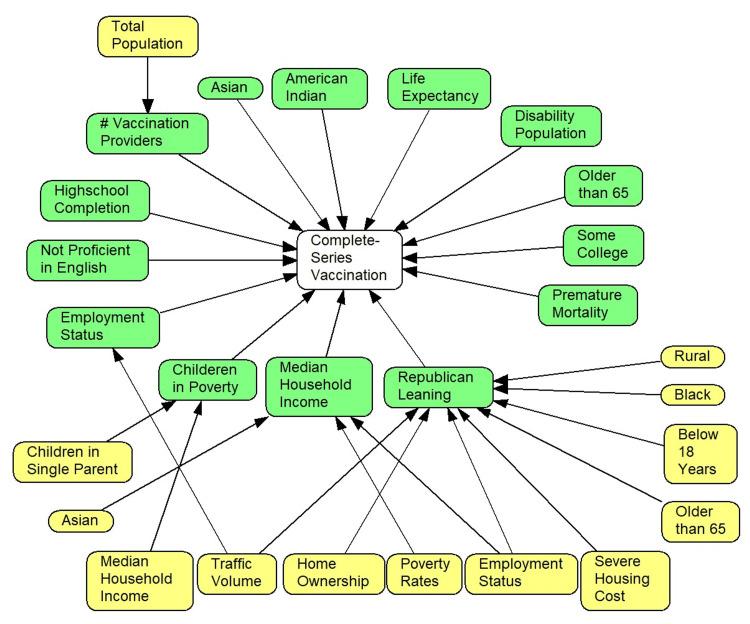
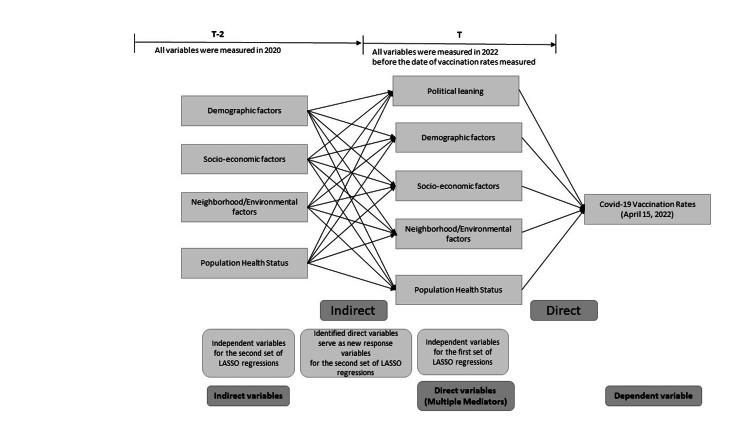
Prior studies have shown that political affiliation affected COVID-19 vaccine hesitancy. This study re-examined the data to see if these findings hold after controlling for alternative explanations. The dependent variable in the study was COVID-19 vaccination rates in 3,109 counties in the United States as of April 2022. The study examined 36 possible alternative explanations for vaccine hesitancy, including demographic, social, economic, environmental, and medical variables known to affect vaccine hesitancy. County-level political affiliation was measured as a percent of voters in the county who were affiliated with Democratic or Republican political parties. Data were analyzed using a temporally constrained multiple mediation network, which allowed for the identification of both direct and indirect predictors of vaccination rates. Despite controlling for alternative explanations of hesitancy, there was a statistically significant relationship between the percentage of Republican supporters and rates of vaccine hesitancy. The higher the Republican affiliation, the lower the vaccination rates. It is possible that the Republican Party has played an organizing role in encouraging vaccine hesitancy and patient harm.
先前的研究表明,政治派别会影响对新冠疫苗的犹豫态度。本研究重新审视了数据,以查看在控制了其他解释因素后这些发现是否依然成立。该研究的因变量是截至2022年4月美国3109个县的新冠疫苗接种率。该研究考察了36种可能导致疫苗犹豫态度的其他解释因素,包括已知会影响疫苗犹豫态度的人口统计学、社会、经济、环境和医学变量。县级政治派别以该县隶属于民主党或共和党的选民百分比来衡量。数据使用时间受限的多重中介网络进行分析,该网络能够识别疫苗接种率的直接和间接预测因素。尽管控制了对犹豫态度的其他解释因素,但共和党支持者的百分比与疫苗犹豫率之间仍存在统计学上的显著关系。共和党支持者比例越高,疫苗接种率越低。共和党可能在鼓励疫苗犹豫态度和对患者造成伤害方面起到了组织作用。
 Zotero 插件