
细菌的运动能力可以控制抗生素耐药性进化的动态。
Bacterial motility can govern the dynamics of antibiotic resistance evolution.
机构信息
Department of Applied Mathematics and Theoretical Physics, Centre for Mathematical Sciences, University of Cambridge, Wilberforce Road, Cambridge, CB3 0WA, UK.
Mathematical Institute, University of Oxford, Woodstock Road, Oxford, OX2 6GG, UK.
出版信息
Nat Commun. 2023 Sep 11;14(1):5584. doi: 10.1038/s41467-023-41196-8.
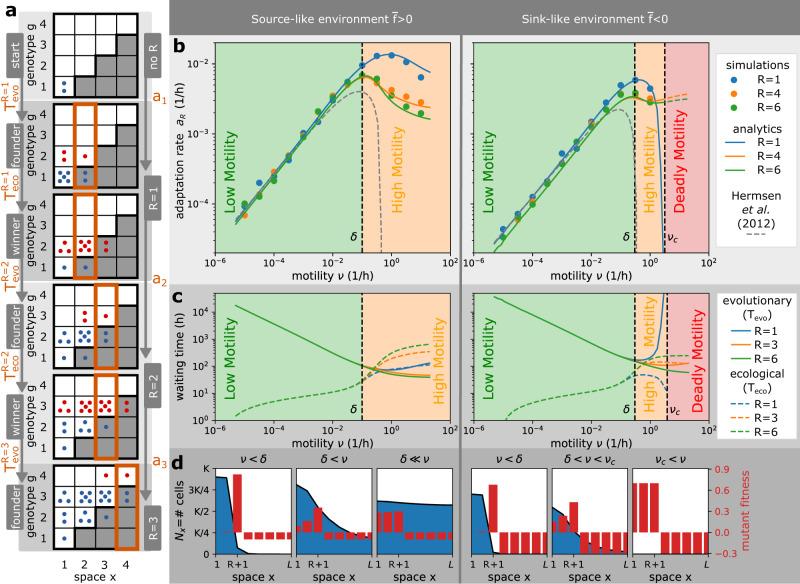
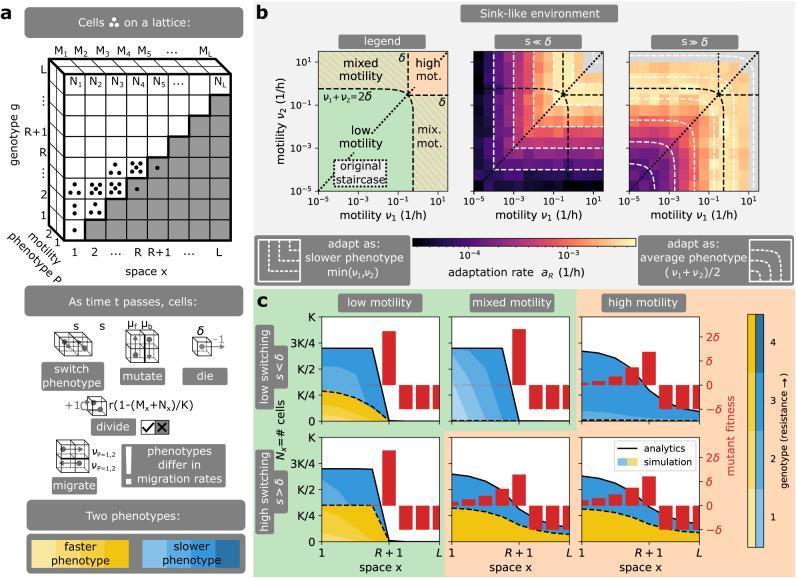
Spatial heterogeneity in antibiotic concentrations is thought to accelerate the evolution of antibiotic resistance, but current theory and experiments have overlooked the effect of cell motility on bacterial adaptation. Here, we study bacterial evolution in antibiotic landscapes with a quantitative model where bacteria evolve under the stochastic processes of proliferation, death, mutation and migration. Numerical and analytical results show that cell motility can both accelerate and decelerate bacterial adaptation by affecting the degree of genotypic mixing and ecological competition. Moreover, we find that for sufficiently high rates, cell motility can limit bacterial survival, and we derive conditions for all these regimes. Similar patterns are observed in more complex scenarios, namely where bacteria can bias their motion in chemical gradients (chemotaxis) or switch between motility phenotypes either stochastically or in a density-dependent manner. Overall, our work reveals limits to bacterial adaptation in antibiotic landscapes that are set by cell motility.
空间异质性抗生素浓度被认为会加速抗生素耐药性的进化,但目前的理论和实验都忽略了细胞迁移对细菌适应的影响。在这里,我们在一个定量模型中研究抗生素环境中的细菌进化,其中细菌在增殖、死亡、突变和迁移的随机过程中进化。数值和分析结果表明,细胞迁移可以通过影响基因型混合和生态竞争的程度,加速和减缓细菌的适应。此外,我们发现对于足够高的速度,细胞迁移可以限制细菌的生存,我们推导出了所有这些状态的条件。在更复杂的情况下也观察到了类似的模式,即细菌可以在化学梯度中偏向运动(趋化性),或者以随机或密度依赖的方式在运动表型之间切换。总的来说,我们的工作揭示了细胞迁移设定的抗生素环境中细菌适应的限制。



 Zotero 插件