
利用深度神经网络加速动态 DNA 折纸器件的特性描述。
Accelerating the characterization of dynamic DNA origami devices with deep neural networks.
机构信息
Department of Mechanical and Aerospace Engineering, The Ohio State University, Columbus, OH, 43210, USA.
Department of Computer Science and Engineering, The Ohio State University, Columbus, OH, 43210, USA.
出版信息
Sci Rep. 2023 Sep 14;13(1):15196. doi: 10.1038/s41598-023-41459-w.
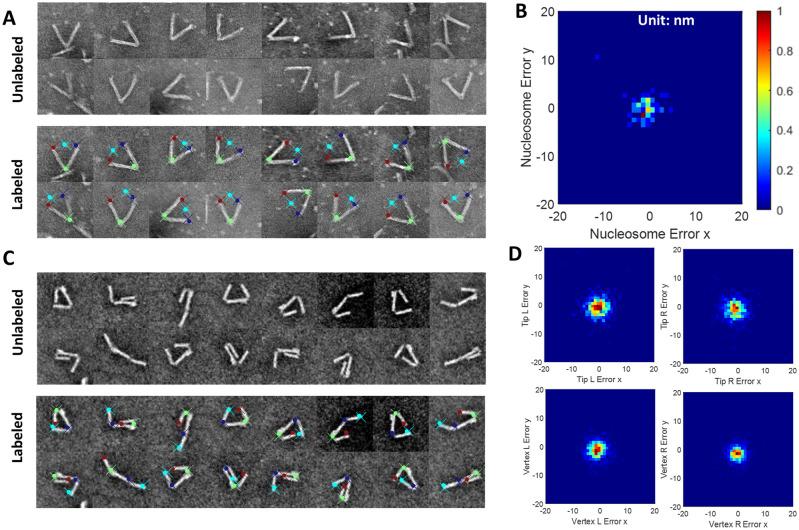
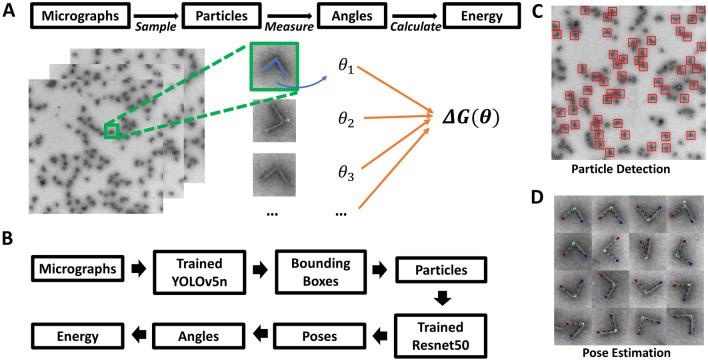
Mechanical characterization of dynamic DNA nanodevices is essential to facilitate their use in applications like molecular diagnostics, force sensing, and nanorobotics that rely on device reconfiguration and interactions with other materials. A common approach to evaluate the mechanical properties of dynamic DNA nanodevices is by quantifying conformational distributions, where the magnitude of fluctuations correlates to the stiffness. This is generally carried out through manual measurement from experimental images, which is a tedious process and a critical bottleneck in the characterization pipeline. While many tools support the analysis of static molecular structures, there is a need for tools to facilitate the rapid characterization of dynamic DNA devices that undergo large conformational fluctuations. Here, we develop a data processing pipeline based on Deep Neural Networks (DNNs) to address this problem. The YOLOv5 and Resnet50 network architecture were used for the two key subtasks: particle detection and pose (i.e. conformation) estimation. We demonstrate effective network performance (F1 score 0.85 in particle detection) and good agreement with experimental distributions with limited user input and small training sets (~ 5 to 10 images). We also demonstrate this pipeline can be applied to multiple nanodevices, providing a robust approach for the rapid characterization of dynamic DNA devices.
动态 DNA 纳米器件的力学特性的研究对于促进其在分子诊断、力传感和纳米机器人等领域的应用至关重要,这些应用依赖于器件的重新配置和与其他材料的相互作用。评估动态 DNA 纳米器件力学性能的一种常见方法是量化构象分布,其中波动幅度与刚度相关。这通常是通过从实验图像中手动测量来完成的,这是一个繁琐的过程,也是表征流水线的一个关键瓶颈。虽然许多工具支持静态分子结构的分析,但需要工具来促进对经历大构象波动的动态 DNA 器件的快速表征。在这里,我们开发了一个基于深度神经网络(DNN)的数据处理管道来解决这个问题。YOLOv5 和 Resnet50 网络架构被用于两个关键的子任务:粒子检测和位姿(即构象)估计。我们展示了有效的网络性能(粒子检测的 F1 分数为 0.85),并且与实验分布具有良好的一致性,只需有限的用户输入和较小的训练集(~5 到 10 张图像)。我们还证明了该管道可以应用于多个纳米器件,为动态 DNA 器件的快速表征提供了一种稳健的方法。


 Zotero 插件