
新鉴定出的猪血凝性脑脊髓炎病毒谱系表现出呼吸道表型。
Newly identified lineages of porcine hemagglutinating encephalomyelitis virus exhibit respiratory phenotype.
作者信息
He Wan-Ting, Li Dongyan, Baele Guy, Zhao Jin, Jiang Zhiwen, Ji Xiang, Veit Michael, Suchard Marc A, Holmes Edward C, Lemey Philippe, Boni Maciej F, Su Shuo
机构信息
Jiangsu Engineering Laboratory of Animal Immunology, Institute of Immunology, College of Veterinary Medicine, Academy for Advanced Interdisciplinary Studies, Nanjing Agricultural University, Nanjing 210095, China.
Department of Microbiology, Immunology and Transplantation, Rega Institute, Laboratory for Clinical and Epidemiological Virology, KU Leuven, Leuven 3000, Belgium.
出版信息
Virus Evol. 2023 Aug 18;9(2):vead051. doi: 10.1093/ve/vead051. eCollection 2023.
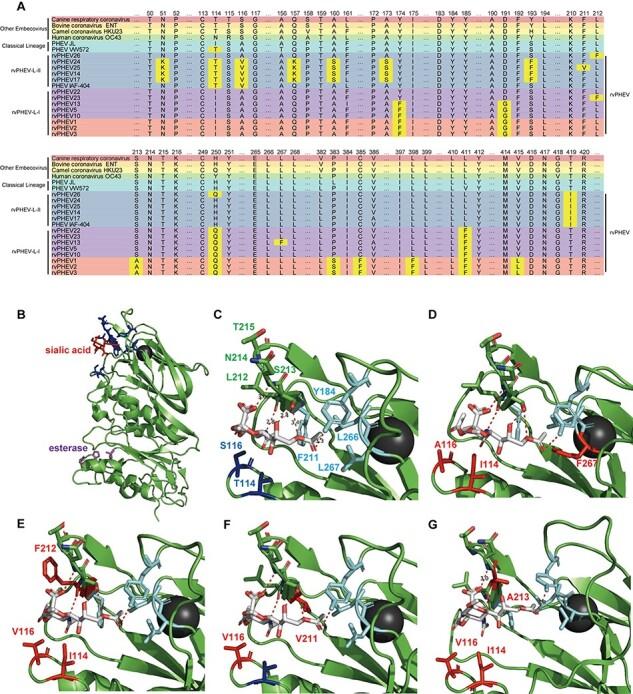
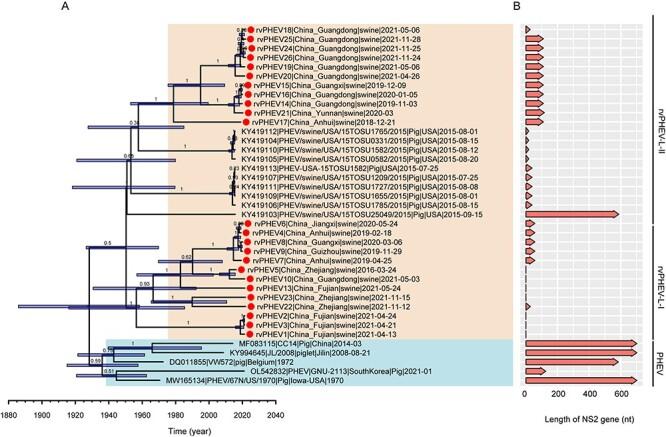
Swine pathogens have a long history of zoonotic transmission to humans, occasionally leading to sustained outbreaks or pandemics. Through a retrospective epidemiological study of swine populations in China, we describe novel lineages of porcine hemagglutinating encephalomyelitis virus (PHEV) complex coronaviruses (CoVs) that cause exclusively respiratory symptoms with no signs of the neurological symptoms typically associated with classical PHEV infection. Through large-scale epidemiological surveillance, we show that these novel lineages have circulated in at least eight provinces in southeastern China. Phylogenetic and recombination analyses of twenty-four genomes identified two major viral lineages causing respiratory symptoms with extensive recombination within them, between them, and between classical PHEV and the novel respiratory variant PHEV (rvPHEV) lineages. Divergence times among the sampled lineages in the PHEV virus complex date back to 1886-1958 (mean estimate 1928), with the two major rvPHEV lineages separating approximately 20 years later. Many rvPHEV viruses show amino acid substitutions at the carbohydrate-binding site of hemagglutinin esterase (HE) and/or have lost the cysteine required for HE dimerization. This resembles the early adaptation of human CoVs, where HE lost its hemagglutination ability to adapt to growth in the human respiratory tract. Our study represents the first report of the evolutionary history of rvPHEV circulating in swine and highlights the importance of characterizing CoV diversity and recombination in swine to identify pathogens with outbreak potential that could threaten swine farming.
猪病原体具有长期的人畜共患病传播给人类的历史,偶尔会导致持续的疫情爆发或大流行。通过对中国猪群的回顾性流行病学研究,我们描述了猪血凝性脑脊髓炎病毒(PHEV)复合冠状病毒(CoV)的新谱系,这些病毒仅引起呼吸道症状,没有经典PHEV感染通常伴随的神经症状迹象。通过大规模的流行病学监测,我们表明这些新谱系已在中国东南部至少八个省份传播。对24个基因组的系统发育和重组分析确定了两个主要的病毒谱系,它们引起呼吸道症状,在谱系内部、谱系之间以及经典PHEV和新型呼吸道变体PHEV(rvPHEV)谱系之间存在广泛的重组。PHEV病毒复合体中采样谱系之间的分歧时间可追溯到1886 - 1958年(平均估计为1928年),两个主要的rvPHEV谱系大约在20年后分离。许多rvPHEV病毒在血凝素酯酶(HE)的碳水化合物结合位点显示氨基酸替换和/或失去了HE二聚化所需的半胱氨酸。这类似于人类冠状病毒的早期适应性变化,即HE失去其血凝能力以适应在人类呼吸道中的生长。我们的研究是关于rvPHEV在猪中传播的进化史的首次报告,并强调了表征猪中CoV多样性和重组以识别可能威胁养猪业的具有爆发潜力的病原体的重要性。


 Zotero 插件