
针对老年人休闲时间活动水平的身体活动干预:一项群组随机试验。
Physical Activity Intervention for Leisure-Time Activity Levels Among Older Adults: A Cluster Randomized Trial.
机构信息
West China School of Public Health and West China Fourth Hospital, Sichuan University, Chengdu, Sichuan, China.
出版信息
JAMA Netw Open. 2023 Sep 5;6(9):e2333195. doi: 10.1001/jamanetworkopen.2023.33195.
IMPORTANCE
Current randomized trial evidence of the effects of physical activity interventions in older adults is mainly from developed countries, with little reliable evidence from low- and middle-income countries, such as China, where race, culture, and lifestyles differ substantially from those in Western populations.
OBJECTIVE
To evaluate the effects of a multilevel intervention for increasing leisure-time activity levels in Chinese older adults.
DESIGN, SETTING, AND PARTICIPANTS: This cluster randomized trial was conducted from May 2021 to May 2023, including an 8-week intervention period and a follow-up period of 24 months. Eight villages in China were randomly assigned to the intervention (4 villages) or the control (4 villages) group. Potentially eligible participants were 60 years or older. A total of 511 older adults from the selected 8 villages were enrolled.
INTERVENTIONS
The intervention group received an 8-week socioecological model-based intervention, comprising individual, interpersonal, and community-level components, whereas the control group did not.
MAIN OUTCOME AND MEASURE
The primary outcome was the change in leisure-time activity at 8 weeks, measured by the Physical Activity Scale for the Elderly (PASE). Possible PASE scores for leisure-time activity range from 0 to 502, with higher scores indicating higher activity levels.
RESULTS
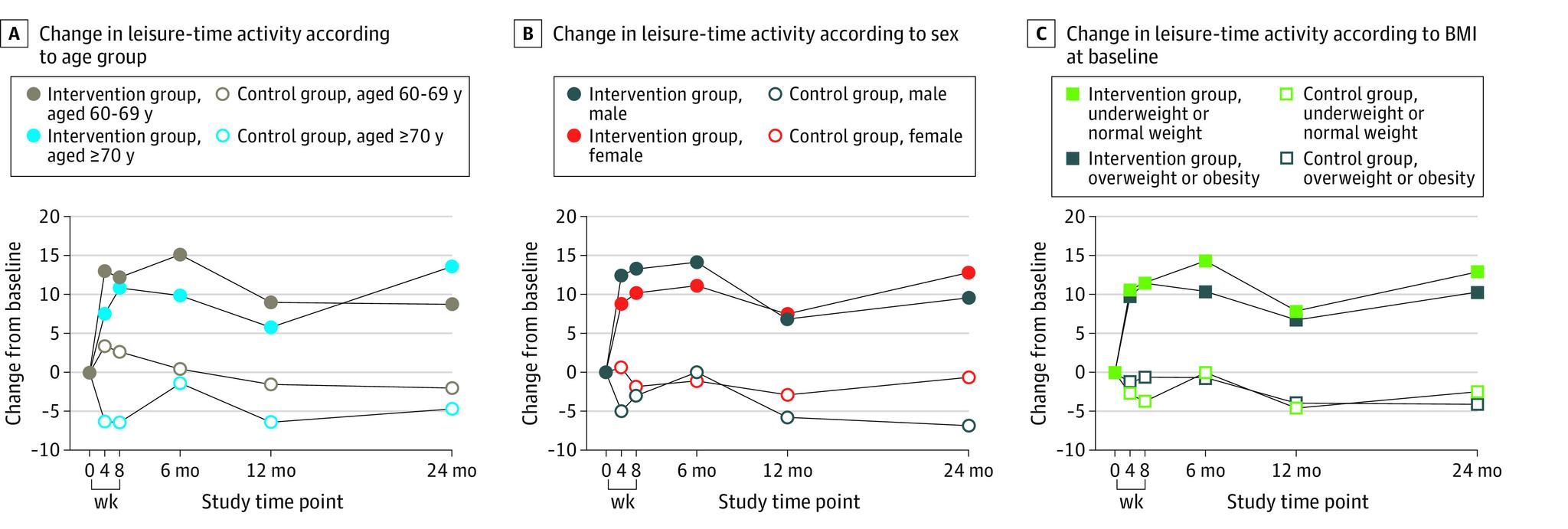
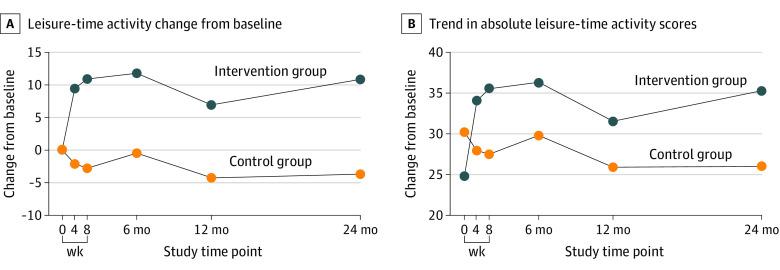
A total of 511 older adults from 8 villages were recruited and randomly allocated to the intervention (240 participants, 4 villages) or control (271 participants, 4 villages) groups. The mean (SD) age was 70.95 (5.72) years, and 284 (55.6%) were female participants. Seven serious adverse events (unrelated deaths) were reported. Participants in the intervention group increased leisure-time activity more than those in the control group, with a mean difference in PASE scores of 13.74 points (95% CI, 8.58-18.91 points) between the groups at 8 weeks (P < .001). Significant differences in leisure-time activity were also found over 24 months (mean difference in scores at 4 weeks, 11.66 points; 95% CI, 6.41-16.90 points; P < .001; at 6 months, 12.35 points; 95% CI, 7.19-17.50 points; P < .001; at 12 months, 11.55 points; 95% CI, 6.32-16.78 points; P < .001; and at 24 months, 14.51 points; 95% CI, 9.28-19.75 points; P < .001).
CONCLUSIONS AND RELEVANCE
In this cluster randomized trial, the multilevel intervention was effective in promoting leisure-time activity over 24 months of follow-up in older adults from China. This finding suggests that implementation of such interventions could be an important step in addressing physical inactivity in older adults in low- and middle-income countries.
TRIAL REGISTRATION
Chinese Clinical Trial Registry Identifier: ChiCTR2100045653.
重要性
目前关于体力活动干预对老年人影响的随机试验证据主要来自发达国家,来自中国等中低收入国家的可靠证据很少,中国与西方人群在种族、文化和生活方式方面存在很大差异。
目的
评估多层次干预措施对提高中国老年人休闲时间活动水平的效果。
设计、地点和参与者:这项整群随机试验于 2021 年 5 月至 2023 年 5 月进行,包括 8 周的干预期和 24 个月的随访期。中国的 8 个村庄被随机分为干预(4 个村庄)或对照组(4 个村庄)。潜在合格的参与者为 60 岁或以上。从选定的 8 个村庄共招募了 511 名老年人。
干预措施
干预组接受基于社会生态学模型的 8 周干预,包括个体、人际和社区层面的干预,而对照组不接受干预。
主要结局和测量
主要结局是 8 周时休闲时间活动的变化,采用老年人体力活动量表(PASE)进行测量。PASE 可能的得分范围为 0 至 502,得分越高表示活动水平越高。
结果
共有 8 个村庄的 511 名老年人被招募并随机分配到干预组(240 名参与者,4 个村庄)或对照组(271 名参与者,4 个村庄)。参与者的平均(SD)年龄为 70.95(5.72)岁,284 名(55.6%)为女性。报告了 7 例严重不良事件(无关死亡)。与对照组相比,干预组的休闲时间活动增加更多,8 周时 PASE 评分平均差异为 13.74 分(95%置信区间,8.58-18.91 分)(P < .001)。在 24 个月的随访中也发现了休闲时间活动的显著差异(4 周时评分的平均差异为 11.66 分;95%置信区间,6.41-16.90 分;P < .001;6 个月时为 12.35 分;95%置信区间,7.19-17.50 分;P < .001;12 个月时为 11.55 分;95%置信区间,6.32-16.78 分;P < .001;24 个月时为 14.51 分;95%置信区间,9.28-19.75 分;P < .001)。
结论和相关性
在这项整群随机试验中,多层次干预在 24 个月的随访中有效促进了中国老年人的休闲时间活动。这一发现表明,在中低收入国家实施此类干预措施可能是解决老年人身体活动不足的重要步骤。
试验注册
中国临床试验注册中心标识符:ChiCTR2100045653。

 Zotero 插件