
学校卫生保健中心、获得医疗服务的机会与基于收入的差异
School-Based Health Centers, Access to Care, and Income-Based Disparities.
机构信息
Department of Health Policy and Management, University of Maryland, College Park.
Department of Sociology, Anthropology, and Public Health, University of Maryland, Baltimore County, Baltimore.
出版信息
JAMA Netw Open. 2023 Sep 5;6(9):e2334532. doi: 10.1001/jamanetworkopen.2023.34532.
IMPORTANCE
School-based health centers (SBHCs) are primary care clinics colocated at schools. SBHCs have the potential to improve health care access and reduce disparities, but there is limited rigorous evidence on their effectiveness at the national level.
OBJECTIVE
To determine whether county-level adoption of SBHCs was associated with access, utilization, and health among children from low-income families and to measure reductions in income-based disparities.
DESIGN, SETTING, AND PARTICIPANTS: This survey study used a difference-in-differences design and data from a nationally representative sample of children in the US merged with SBHC indicators from the National Census of School-Based Health Centers. The main sample included children aged 5 to 17 years with family incomes that were less than 200% of the federal poverty level observed in the National Health Interview Survey, collected between 1997 to 2018. The sample was restricted to children living in a county that adopted a center between 2003 and 2013 or that did not have a center at any time during the study period. Analyses of income-based disparities included children from higher income families (ie, 200% or higher than the federal poverty level). Data were analyzed between January 2020 and July 2023.
EXPOSURE
County-by-year SBHC adoption.
MAIN OUTCOMES AND MEASURES
Outcomes included access (usual source of care, insurance status, barriers), ambulatory care use (general physician, eye doctor, dental, mental health visits), and health (general health status, missed school days due to illness). P values were adjusted for multiple comparisons using the sharpened q value method.
RESULTS
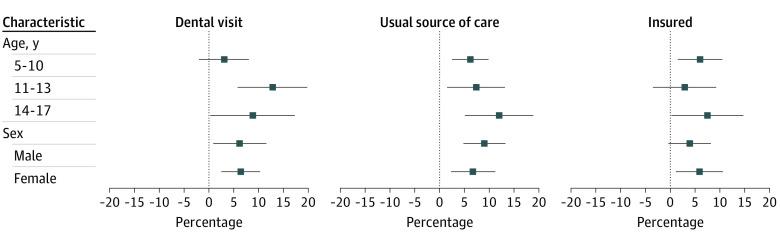
This study included 12 624 unweighted children from low-income families and 24 631 unweighted children from higher income families. The weighted percentage of children in low-income families who resided in counties with SBHC adoption included 50.0% aged 5 to 10 years. The weighted percentages of the race and ethnicity of these children included 36.7% Hispanic children, 25.2% non-Hispanic Black children, and 30.6% non-Hispanic White children. The weighted percentages of children in the counties that never adopted SBHCs included 50.1% aged 5 to 10 years. The weighted percentages of the race and ethnicity of these children included 20.7% Hispanic children, 22.4% non-Hispanic Black children, and 52.9% non-Hispanic White children. SBHC adoption was associated with a 6.4 percentage point increase in dental visits (95% CI, 3.2-9.6 percentage points; P < .001), an 8.0 percentage point increase in having a usual source of care (95% CI, 4.5-11.5 percentage points; P < .001), and a 5.2 percentage point increase in insurance (95% CI, 1.2-9.2 percentage points; P = .03). No other statistically significant associations were found with other outcomes. SBHCs were associated with relative reductions in income-based disparities to dental visits by 76% (4.9 percentage points; 95% CI, 2.0-7.7 percentage points), to insured status by 63% (3.5 percentage points; 95% CI, 1.3-5.7 percentage points), and to having a usual source of care by 98% (7.2 percentage points; 95% CI, 5.4-9.1 percentage points).
CONCLUSIONS AND RELEVANCE
In this survey study with difference-in-differences analysis of SBHC adoption, SBHCs were associated with access to care and reduced income-based disparities. These findings support additional SBHC expansion.
重要性:学校卫生中心(SBHC)是设在学校的初级保健诊所。SBHC 有提高医疗保健可及性和减少差距的潜力,但在国家层面上,其效果的严格证据有限。
目的:确定县一级采用 SBHC 是否与低收入家庭儿童的获得、利用和健康相关,并衡量减少基于收入的差距。
设计、地点和参与者:这项调查研究使用了差异中的差异设计,并使用了来自美国全国代表性样本的儿童数据,这些儿童的家庭收入低于全国健康访谈调查中观察到的联邦贫困线的 200%,调查时间为 1997 年至 2018 年。样本仅限于居住在 2003 年至 2013 年期间采用中心或在研究期间任何时候都没有中心的县的儿童。基于收入的差距分析包括来自高收入家庭(即 200%或更高于联邦贫困线)的儿童。数据分析于 2020 年 1 月至 2023 年 7 月进行。
暴露:县年 SBHC 采用。
主要结果和措施:结果包括获得(通常的医疗来源、保险状况、障碍)、门诊护理使用(普通医生、眼科医生、牙科、心理健康就诊)和健康(一般健康状况、因病缺课天数)。使用尖锐 q 值法对多重比较进行了 P 值调整。
结果:这项研究包括 12624 名未加权的低收入家庭儿童和 24631 名未加权的高收入家庭儿童。有 SBHC 采用的县的低收入家庭儿童的加权百分比包括 50.0%的 5 至 10 岁儿童。这些儿童的种族和族裔的加权百分比包括 36.7%的西班牙裔儿童、25.2%的非西班牙裔黑人儿童和 30.6%的非西班牙裔白人儿童。从未采用 SBHC 的县的儿童的加权百分比包括 50.1%的 5 至 10 岁儿童。这些儿童的种族和族裔的加权百分比包括 20.7%的西班牙裔儿童、22.4%的非西班牙裔黑人儿童和 52.9%的非西班牙裔白人儿童。SBHC 的采用与牙科就诊增加了 6.4 个百分点(95%置信区间,3.2-9.6 个百分点;P<0.001)、有通常的医疗来源增加了 8.0 个百分点(95%置信区间,4.5-11.5 个百分点;P<0.001)和保险增加了 5.2 个百分点(95%置信区间,1.2-9.2 个百分点;P=0.03)。没有发现其他具有统计学意义的结果。SBHC 与牙科就诊的收入差距相对减少了 76%(4.9 个百分点;95%置信区间,2.0-7.7 个百分点)、保险状态减少了 63%(3.5 个百分点;95%置信区间,1.3-5.7 个百分点)和有通常的医疗来源减少了 98%(7.2 个百分点;95%置信区间,5.4-9.1 个百分点)。
结论和相关性:在这项使用 SBHC 采用的差异中的差异分析的调查研究中,SBHC 与获得医疗保健和减少基于收入的差距有关。这些发现支持了更多的 SBHC 扩张。


 Zotero 插件