
寿命延长但身体更脆弱?瑞典老年人预期寿命和虚弱的时间趋势。
Living Longer But Frailer? Temporal Trends in Life Expectancy and Frailty in Older Swedish Adults.
机构信息
Aging Research Center, Department of Neurobiology, Care Sciences and Society, Karolinska Institutet, Solna, Sweden.
Stockholm Gerontology Research Center, Stockholm, Sweden.
出版信息
J Gerontol A Biol Sci Med Sci. 2024 Jan 1;79(1). doi: 10.1093/gerona/glad212.
BACKGROUND
This study aims to examine temporal trends in frailty state transitions, and years spent frail, in older Swedish adults.
METHODS
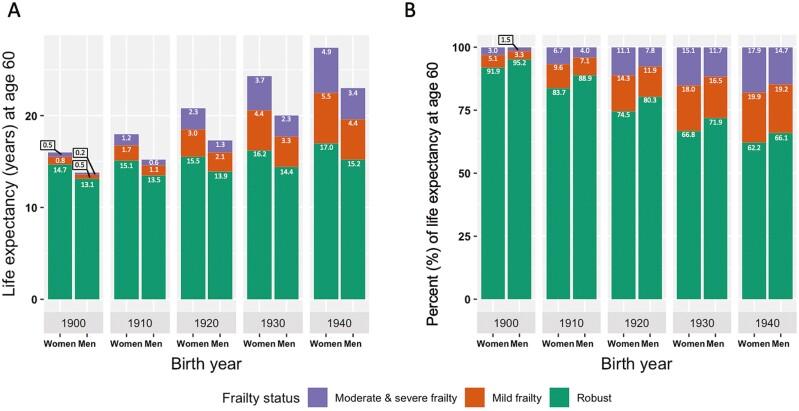
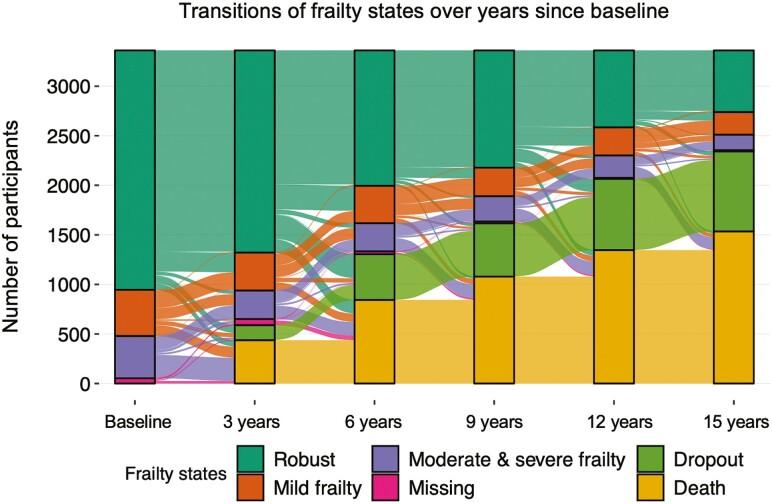
We followed the Swedish National Study on Aging and Care in Kungsholmen participants from baseline (2001-2004) for 15 (median: 9.6) years. A 40-deficit frailty index (FI) was constructed to identify 3 frailty states: robust (FI ≤ 0.125), mild frailty (0.125 < FI ≤ 0.25), and moderate and severe frailty (FI > 0.25). Multistate survival analyses were implemented to obtain hazard ratios (HRs) for frailty state transitions, with birth year and sex as predictors. To examine temporal trends, frailty state-specific life expectancies at age 60 were forecasted for robust persons born in different years (1900, 1910, 1920, 1930, and 1940), also by sex.
RESULTS
At baseline, the 2 941 participants' mean age was 75 years and 65% were women. Predicted life expectancy and time spent frail from age 60 followed an increasing trend by birth year. Hazards of transitioning from mild frailty to death (HR: 0.89; 95% confidence interval [CI]: 0.83-0.97) and moderate and severe frailty to death (HR: 0.98; 95% CI: 0.97-1.00) were lower for those born later. Women were less likely to transition from robust to mild frailty (HR: 0.81; 95% CI: 0.70-0.93), mild frailty to moderate and severe frailty (HR: 0.80; 95% CI: 0.68-0.93), and moderate and severe frailty to death (HR: 0.68; 95% CI: 0.59-0.78), but spent more time frail.
CONCLUSIONS
Our results point to an expansion of time spent frail among older Swedish adults over time.
背景
本研究旨在探讨瑞典老年人虚弱状态转变的时间趋势以及虚弱状态持续的时间。
方法
我们对 Kungsholmen 瑞典老龄化和护理国家研究的参与者进行了随访,从基线(2001-2004 年)开始,随访时间为 15 年(中位数:9.6 年)。构建了一个 40 项缺陷的衰弱指数(FI)来确定 3 种衰弱状态:健壮(FI≤0.125)、轻度衰弱(0.125<FI≤0.25)和中度和重度衰弱(FI>0.25)。采用多状态生存分析来获得衰弱状态转变的风险比(HR),以出生年份和性别为预测因子。为了研究时间趋势,根据出生年份(1900 年、1910 年、1920 年、1930 年和 1940 年),预测 60 岁时健壮人群的特定年龄预期寿命和虚弱状态持续时间。
结果
基线时,2941 名参与者的平均年龄为 75 岁,65%为女性。从年龄 60 岁开始,预测的预期寿命和虚弱状态持续时间呈现出随出生年份增加的趋势。从轻度衰弱到死亡(HR:0.89;95%置信区间[CI]:0.83-0.97)和从中度和重度衰弱到死亡(HR:0.98;95%CI:0.97-1.00)的转变风险对于较晚出生的人较低。女性从健壮状态转变为轻度衰弱(HR:0.81;95%CI:0.70-0.93)、从轻度衰弱转变为中重度衰弱(HR:0.80;95%CI:0.68-0.93)以及从中重度衰弱转变为死亡(HR:0.68;95%CI:0.59-0.78)的可能性较小,但虚弱状态持续时间较长。
结论
我们的研究结果表明,瑞典老年人的虚弱状态持续时间随着时间的推移而扩大。

 Zotero 插件