
幼虫治疗与传统的银敷料治疗全厚烧伤的随机对照试验。
Larval therapy vs conventional silver dressings for full-thickness burns: a randomized controlled trial.
机构信息
Department of Medical Entomology and Vector Control, School of Public Health, Tehran University of Medical Sciences, Tehran, Iran.
Cancer Research Center, Shahid Beheshti University of Medical Sciences, Tehran, Iran.
出版信息
BMC Med. 2023 Sep 19;21(1):361. doi: 10.1186/s12916-023-03063-7.
BACKGROUND
This is the first clinical trial to investigate the effectiveness of maggot debridement therapy (MDT) for full-thickness burn injuries in comparison to conventional silver dressings.
METHODS
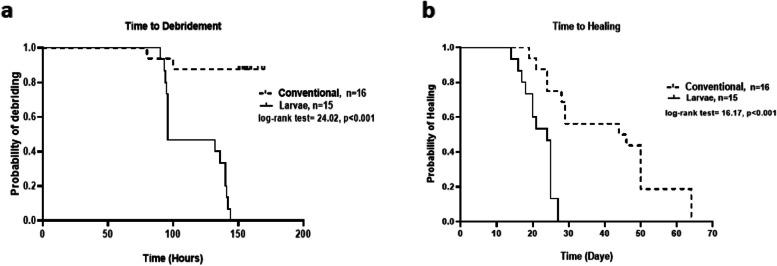
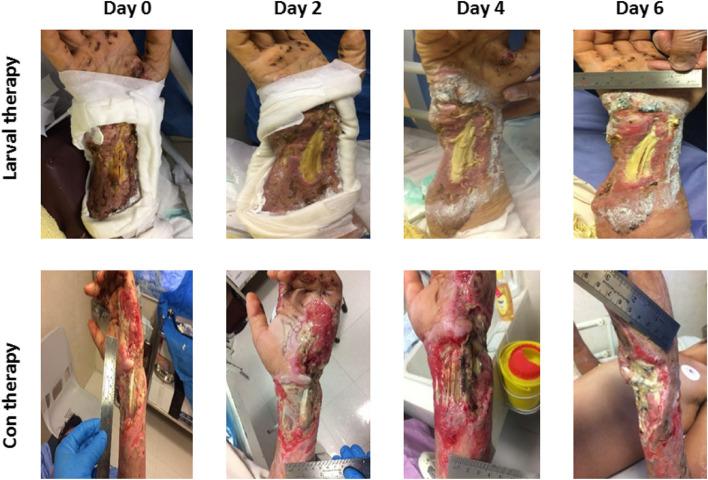
Thirty-one cases with full-thickness (grade III based on ICD-10 classifications version 2019) burns were assigned into larval therapy (15 cases) and conventional treatment (16 cases) groups. Participants in the MDT group have received loose larvae on days 0, 2, 4, and 6, while controls received a conventional regimen comprised of sharp debridement, silver sulfadiazine, antibiotic therapy, and offloading every day. The primary and secondary outcomes were defined as the time to debridement (from admission to skin autograft) and time to healing (from admission to complete healing post-skin autograft). Patients in two groups were also compared in terms of necrosis resolution, granulation, and granulation/necrosis (g/n) ratio during study time periods.
RESULTS
Participants who received larvae had significantly decreased necrosis on days 2 (p = 0.028) and 4 (p = 0.023) compared to those who received control treatment. Significant differences (p < 0.001) were also observed for granulation between the two groups in favor of MDT and the fold changes of g/n in the larvae group were 5, 15, and 13 times higher than that for the conventional regimen on days 2, 4, and 6 of treatment, respectively. Strikingly, a subgroup analysis of high necrotic burns (necrosis > 50%) revealed a significant improvement (p < 0.001) for MDT compared to the control treatment. There were also significant differences (p < 0.001) for the time to debridement and time to healing between the two groups. However, bacterial contamination did not show significant changes between the two treatment regimens.
CONCLUSIONS
Our findings revealed that MDT has a favorable superiority over conventional regimen for the treatment of grade-III burns, and thus further clinical trials with larger sample size are warranted to confirm these results.
背景
这是首次临床试验,旨在比较蛆虫清创疗法(MDT)与传统银敷料治疗全层烧伤的疗效。
方法
31 例全层(根据 ICD-10 分类版本 2019 为 3 级)烧伤患者被分为幼虫治疗组(15 例)和常规治疗组(16 例)。幼虫治疗组在第 0、2、4、6 天接受松散幼虫治疗,而对照组则接受常规治疗,包括锐性清创、磺胺嘧啶银、抗生素治疗和每天减压。主要和次要结局定义为清创时间(从入院到皮肤自体移植)和愈合时间(从入院到皮肤自体移植后完全愈合)。在研究期间,还比较了两组患者的坏死组织清除、肉芽形成和肉芽/坏死(g/n)比值。
结果
与接受对照组治疗的患者相比,接受幼虫治疗的患者在第 2 天(p=0.028)和第 4 天(p=0.023)的坏死组织明显减少。两组之间的肉芽形成也存在显著差异(p<0.001),MDT 组更为有利,幼虫组的 g/n 比值在治疗第 2、4 和 6 天分别是对照组的 5、15 和 13 倍。值得注意的是,高坏死烧伤(坏死>50%)亚组分析显示,与对照组相比,MDT 治疗有显著改善(p<0.001)。两组之间的清创时间和愈合时间也存在显著差异。然而,两种治疗方案之间的细菌污染没有明显变化。
结论
我们的研究结果表明,MDT 在治疗 3 级烧伤方面优于传统治疗方案,因此需要进行更大样本量的临床试验来证实这些结果。


 Zotero 插件