
影响液体反应性预测的变量:系统评价和荟萃分析。
Variables influencing the prediction of fluid responsiveness: a systematic review and meta-analysis.
机构信息
Fundación Santa Fe de Bogotá, Department of Intensive Care, Bogotá, Colombia.
Department of Physiology Sciences, Faculty of Medicine, Universidad Nacional de Colombia, Bogotá, Colombia.
出版信息
Crit Care. 2023 Sep 20;27(1):361. doi: 10.1186/s13054-023-04629-w.
INTRODUCTION
Prediction of fluid responsiveness in acutely ill patients might be influenced by a number of clinical and technical factors. We aim to identify variables potentially modifying the operative performance of fluid responsiveness predictors commonly used in clinical practice.
METHODS
A sensitive strategy was conducted in the Medline and Embase databases to search for prospective studies assessing the operative performance of pulse pressure variation, stroke volume variation, passive leg raising (PLR), end-expiratory occlusion test (EEOT), mini-fluid challenge, and tidal volume challenge to predict fluid responsiveness in critically ill and acutely ill surgical patients published between January 1999 and February 2023. Adjusted diagnostic odds ratios (DORs) were calculated by subgroup analyses (inverse variance method) and meta-regression (test of moderators). Variables potentially modifying the operative performance of such predictor tests were classified as technical and clinical.
RESULTS
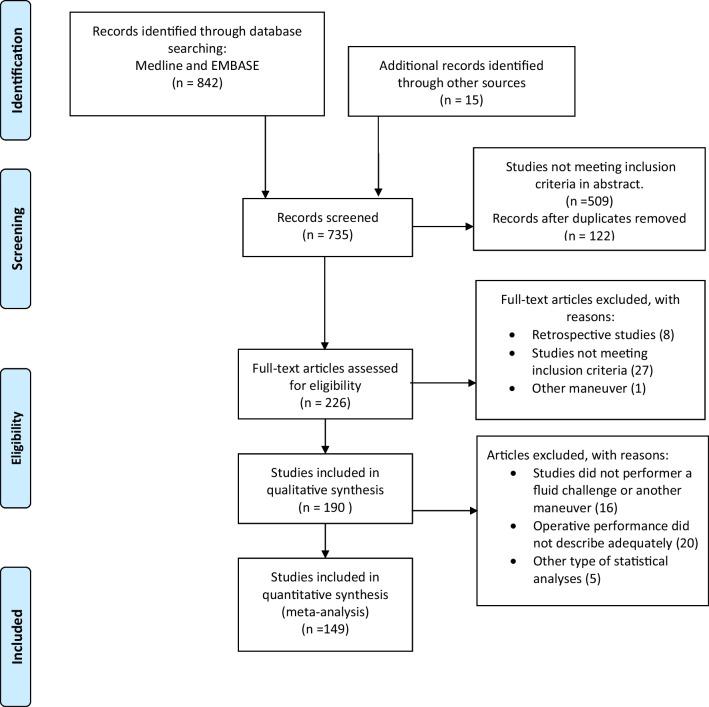
A total of 149 studies were included in the analysis. The volume used during fluid loading, the method used to assess variations in macrovascular flow (cardiac output, stroke volume, aortic blood flow, volume‒time integral, etc.) in response to PLR/EEOT, and the apneic time selected during the EEOT were identified as technical variables modifying the operative performance of such fluid responsiveness predictor tests (p < 0.05 for all adjusted vs. unadjusted DORs). In addition, the operative performance of fluid responsiveness predictors was also influenced by clinical variables such as the positive end-expiratory pressure (in the case of EEOT) and the dose of norepinephrine used during the fluid responsiveness assessment for PLR and EEOT (for all adjusted vs. unadjusted DORs).
CONCLUSION
Prediction of fluid responsiveness in critically and acutely ill patients is strongly influenced by a number of technical and clinical aspects. Such factors should be considered for individual intervention decisions.
简介
在急性病患者中,预测液体反应性可能受到许多临床和技术因素的影响。我们旨在确定可能改变临床实践中常用的液体反应性预测指标的操作性能的变量。
方法
在 Medline 和 Embase 数据库中采用敏感策略,检索 1999 年 1 月至 2023 年 2 月期间发表的评估脉压变异度、每搏量变异度、被动抬腿(PLR)、呼气末阻断试验(EEOT)、迷你液体挑战和潮气量挑战预测危重病和急性病手术患者液体反应性的前瞻性研究。通过亚组分析(方差倒数法)和荟萃回归(调节因素检验)计算调整后的诊断优势比(DOR)。将可能改变这些预测因子测试操作性能的变量分为技术和临床变量。
结果
共有 149 项研究纳入分析。在液体负荷期间使用的容量、用于评估 PLR/EEOT 对大血管流量(心输出量、每搏量、主动脉血流、容量-时间积分等)变化的方法以及在 EEOT 期间选择的呼吸暂停时间被确定为技术变量,这些变量会改变此类液体反应性预测因子测试的操作性能(所有调整后的与未调整的 DOR 相比,p 值均<0.05)。此外,液体反应性预测因子的操作性能还受到临床变量的影响,例如 EEOT 中的呼气末正压(PEEP)和 PLR 和 EEOT 期间用于评估液体反应性的去甲肾上腺素剂量(所有调整后的与未调整的 DOR 相比)。
结论
对危重病和急性病患者的液体反应性预测受到许多技术和临床因素的强烈影响。应考虑这些因素来进行个体化干预决策。
 Zotero 插件