
44 个低收入和中等收入国家的糖尿病风险和糖尿病预防活动提供情况:基于全国代表性、个人层面调查数据的横断面分析。
Diabetes risk and provision of diabetes prevention activities in 44 low-income and middle-income countries: a cross-sectional analysis of nationally representative, individual-level survey data.
机构信息
Medical Practice Evaluation Center, Massachusetts General Hospital, Harvard Medical School, Boston, MA, USA.
Department of Medicine, University of Michigan, Ann Arbor, MI, USA.
出版信息
Lancet Glob Health. 2023 Oct;11(10):e1576-e1586. doi: 10.1016/S2214-109X(23)00348-0.
BACKGROUND
The global burden of diabetes is rising rapidly, yet there is little evidence on individual-level diabetes prevention activities undertaken by health systems in low-income and middle-income countries (LMICs). Here we describe the population at high risk of developing diabetes, estimate diabetes prevention activities, and explore sociodemographic variation in these activities across LMICs.
METHODS
We performed a pooled, cross-sectional analysis of individual-level data from nationally representative, population-based surveys conducted in 44 LMICs between October, 2009, and May, 2019. Our sample included all participants older than 25 years who did not have diabetes and were not pregnant. We defined the population at high risk of diabetes on the basis of either the presence of impaired fasting glucose (or prediabetes in countries with a haemoglobin A available) or overweight or obesity, consistent with the WHO Package of Essential Noncommunicable Disease Guidelines for type 2 diabetes management. We estimated the proportion of survey participants that were at high risk of developing diabetes based on this definition. We also estimated the proportion of the population at high risk that reported each of four fundamental diabetes prevention activities: physical activity counselling, weight loss counselling, dietary counselling, and blood glucose screening, overall and stratified by World Bank income group. Finally, we used multivariable Poisson regression models to evaluate associations between sociodemographic characteristics and these activities.
FINDINGS
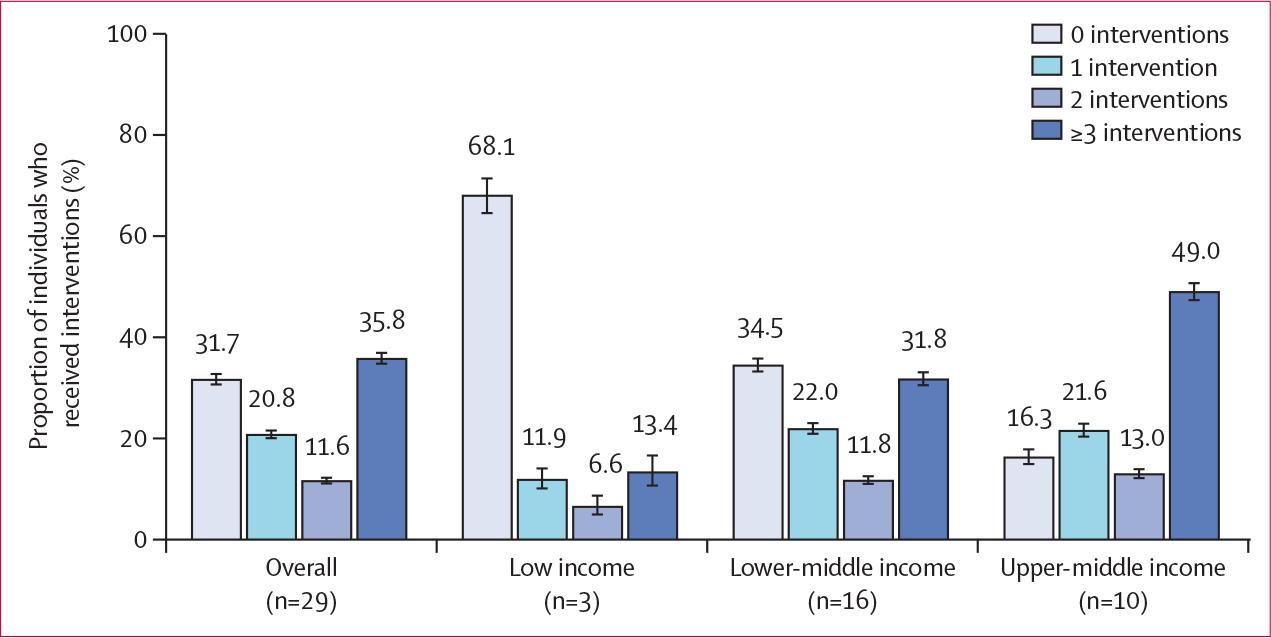
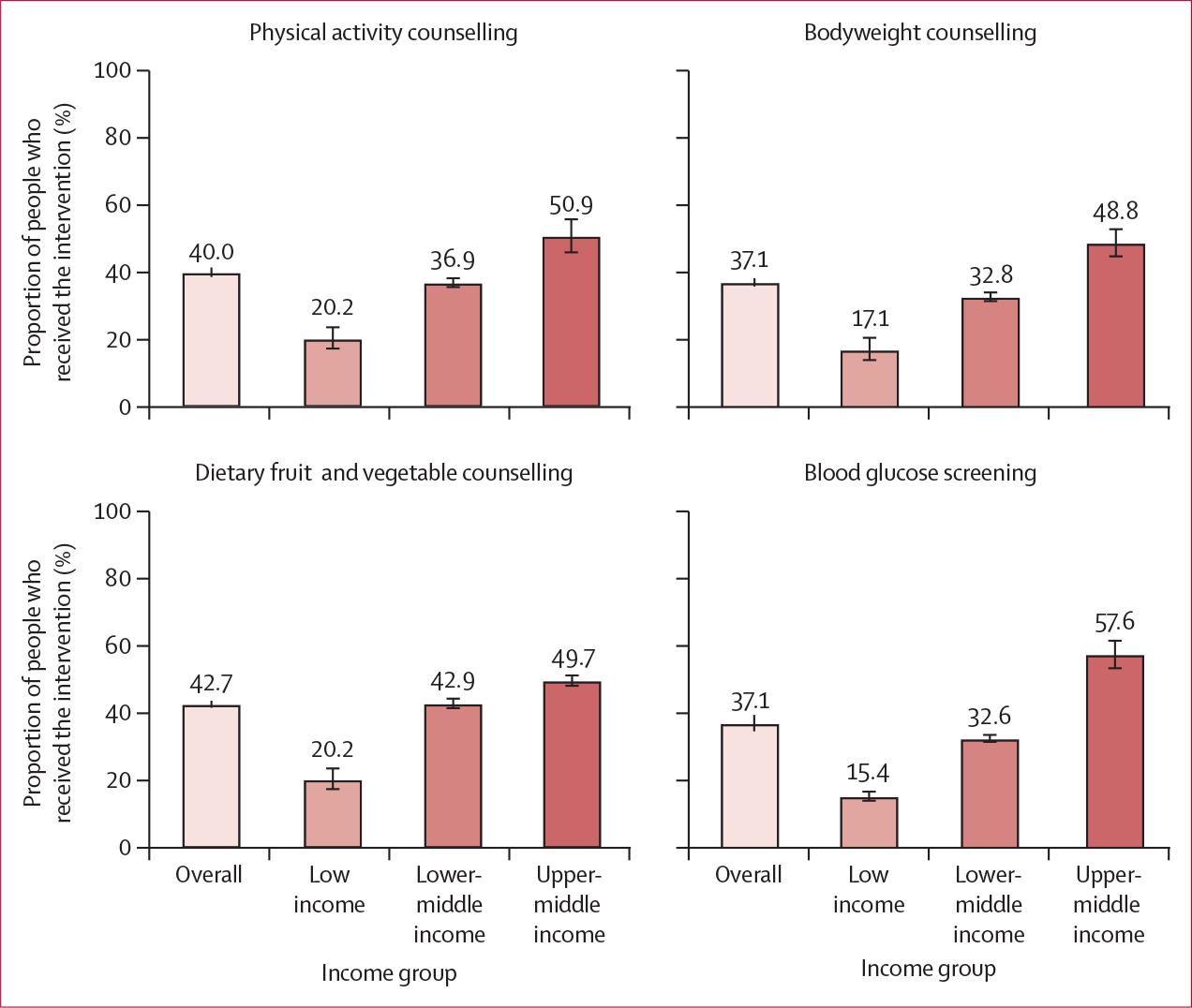
The final pooled sample included 145 739 adults (86 269 [59·2%] of whom were female and 59 468 [40·4%] of whom were male) across 44 LMICs, of whom 59 308 (40·6% [95% CI 38·5-42·8]) were considered at high risk of diabetes (20·6% [19·8-21·5] in low-income countries, 38·0% [37·2-38·9] in lower-middle-income countries, and 57·5% [54·3-60·6] in upper-middle-income countries). Overall, the reach of diabetes prevention activities was low at 40·0% (38·6-41·4) for physical activity counselling, 37·1% (35·9-38·4) for weight loss counselling, 42·7% (41·6-43·7) for dietary counselling, and 37·1% (34·7-39·6) for blood glucose screening. Diabetes prevention varied widely by national-level wealth: 68·1% (64·6-71·4) of people at high risk of diabetes in low-income countries reported none of these activities, whereas 49·0% (47·4-50·7) at high risk in upper-middle-income countries reported at least three activities. Educational attainment was associated with diabetes prevention, with estimated increases in the predicted probability of receipt ranging between 6·5 (3·6-9·4) percentage points for dietary fruit and vegetable counselling and 21·3 (19·5-23·2) percentage points for blood glucose screening, among people with some secondary schooling compared with people with no formal education.
INTERPRETATION
A large proportion of individuals across LMICs are at high risk of diabetes but less than half reported receiving fundamental prevention activities overall, with the lowest receipt of these activities among people in low-income countries and with no formal education. These findings offer foundational evidence to inform future global targets for diabetes prevention and to strengthen policies and programmes to prevent continued increases in diabetes worldwide.
FUNDING
Harvard T H Chan School of Public Health McLennan Fund: Dean's Challenge Grant Program and the EU's Research and Innovation programme Horizon 2020.
背景
全球糖尿病负担正在迅速增加,但在低收入和中等收入国家(LMICs)的卫生系统中,针对个人层面的糖尿病预防活动,证据有限。本文描述了高危糖尿病人群,评估了糖尿病预防活动,并探讨了这些活动在 LMICs 中的社会人口学差异。
方法
我们对 2009 年 10 月至 2019 年 5 月期间在 44 个 LMICs 进行的全国代表性、基于人群的调查的个体水平数据进行了汇总、横断面分析。我们的样本包括所有年龄大于 25 岁、没有糖尿病且未怀孕的参与者。我们根据空腹血糖受损(或在有血红蛋白 A 可用的国家有糖尿病前期)或超重或肥胖的存在,来确定糖尿病高危人群,这与世界卫生组织 2 型糖尿病管理基本非传染性疾病指南一致。我们根据这一定义估计了有发展为糖尿病风险的调查参与者的比例。我们还估计了报告了四项基本糖尿病预防活动(身体活动咨询、减肥咨询、饮食咨询和血糖筛查)的高危人群的比例,以及按世界银行收入组分层的总体和分层情况。最后,我们使用多变量泊松回归模型评估了社会人口学特征与这些活动之间的关联。
发现
最终的汇总样本包括来自 44 个 LMICs 的 145739 名成年人(86269 名[59.2%]为女性,59468 名[40.4%]为男性),其中 59308 名(40.6%[38.5-42.8])被认为有糖尿病高危风险(低收入国家为 20.6%[19.8-21.5],中下收入国家为 38.0%[37.2-38.9],中上收入国家为 57.5%[54.3-60.6])。总的来说,糖尿病预防活动的普及程度很低,身体活动咨询的比例为 40.0%(38.6-41.4),减肥咨询的比例为 37.1%(35.9-38.4),饮食咨询的比例为 42.7%(41.6-43.7),血糖筛查的比例为 37.1%(34.7-39.6)。各国的财富水平差异很大:在低收入国家,有糖尿病高危风险的人中,有 68.1%(64.6-71.4)的人没有报告这些活动,而在中上收入国家,有 49.0%(47.4-50.7)的高危人群报告了至少三项活动。受教育程度与糖尿病预防有关,与没有正规教育的人相比,接受饮食中水果和蔬菜咨询的预测概率增加了 6.5(3.6-9.4)个百分点,接受血糖筛查的预测概率增加了 21.3(19.5-23.2)个百分点。
解释
LMICs 中有很大一部分人有患糖尿病的高风险,但总体而言,不到一半的人报告接受了基本的预防活动,其中在低收入国家和没有正规教育的人中,这些活动的接受程度最低。这些发现为未来全球糖尿病预防目标提供了基础证据,并为加强全球预防糖尿病的政策和计划提供了信息。
资金
哈佛 T H Chan 公共卫生学院 McLennan 基金:院长挑战赠款计划和欧盟研究与创新计划地平线 2020。


 Zotero 插件