
研究未来:探索人类基因组编辑未来的情景。
Researching the future: scenarios to explore the future of human genome editing.
机构信息
School for the Future of Innovation in Society at Arizona State University, PO Box 876002, 85287-6002, Tempe, AZ, USA.
School of Sustainability at Arizona State University, 4th floor, Walton Center for Planetary Health, 85281, Tempe, AZ, USA.
出版信息
BMC Med Ethics. 2023 Sep 21;24(1):72. doi: 10.1186/s12910-023-00951-8.
BACKGROUND
Forward-looking, democratically oriented governance is needed to ensure that human genome editing serves rather than undercuts public values. Scientific, policy, and ethics communities have recognized this necessity but have demonstrated limited understanding of how to fulfill it. The field of bioethics has long attempted to grapple with the unintended consequences of emerging technologies, but too often such foresight has lacked adequate scientific grounding, overemphasized regulation to the exclusion of examining underlying values, and failed to adequately engage the public.
METHODS
This research investigates the application of scenario planning, a tool developed in the high-stakes, uncertainty-ridden world of corporate strategy, for the equally high-stakes and uncertain world of the governance of emerging technologies. The scenario planning methodology is non-predictive, looking instead at a spread of plausible futures which diverge in their implications for different communities' needs, cares, and desires.
RESULTS
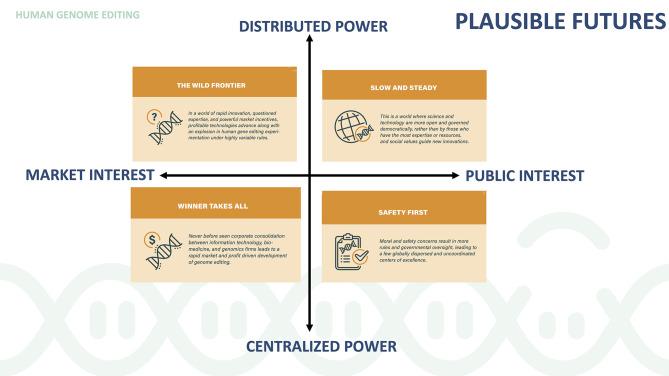
In this article we share how the scenario development process can further understandings of the complex and dynamic systems which generate and shape new biomedical technologies and provide opportunities to re-examine and re-think questions of governance, ethics and values. We detail the results of a year-long scenario planning study that engaged experts from the biological sciences, bioethics, social sciences, law, policy, private industry, and civic organizations to articulate alternative futures of human genome editing.
CONCLUSIONS
Through sharing and critiquing our methodological approach and results of this study, we advance understandings of anticipatory methods deployed in bioethics, demonstrating how this approach provides unique insights and helps to derive better research questions and policy strategies.
背景
为了确保人类基因组编辑服务于而非破坏公共价值观,需要前瞻性、民主导向的治理。科学、政策和伦理界已经认识到这一必要性,但对如何实现这一目标的理解有限。生物伦理学领域长期以来一直试图应对新兴技术的意外后果,但这种前瞻性往往缺乏足够的科学依据,过于强调监管而排除了对潜在价值观的审查,并且未能充分让公众参与。
方法
本研究调查了情景规划的应用,情景规划是一种在企业战略的高风险、不确定的世界中开发的工具,用于治理新兴技术同样高风险和不确定的世界。情景规划方法是非预测性的,而是着眼于一系列可能的未来,这些未来在对不同社区的需求、关注和愿望的影响上存在分歧。
结果
在本文中,我们分享了情景开发过程如何进一步理解产生和塑造新的生物医学技术的复杂和动态系统,并提供了重新审视和重新思考治理、伦理和价值观问题的机会。我们详细介绍了一项为期一年的情景规划研究的结果,该研究吸引了来自生物学、生物伦理学、社会科学、法律、政策、私营企业和公民组织的专家参与,以阐明人类基因组编辑的替代未来。
结论
通过分享和批评我们的方法学方法和这项研究的结果,我们推进了生物伦理学中使用的预期方法的理解,展示了这种方法如何提供独特的见解,并有助于得出更好的研究问题和政策策略。
 Zotero 插件