
癌症免疫治疗中的非编码 RNA:预测生物标志物和靶点。
Non-coding RNAs in cancer immunotherapy: Predictive biomarkers and targets.
机构信息
Johns Hopkins All Children's Hospital, St, Petersburg, Florida, USA.
Department of Oncology, Sydney Kimmel Cancer Center, School of Medicine, Johns Hopkins University, Baltimore, Maryland, USA.
出版信息
Clin Transl Med. 2023 Sep;13(9):e1425. doi: 10.1002/ctm2.1425.
BACKGROUND
To date, standardising clinical predictive biomarkers for assessing the response to immunotherapy remains challenging due to variations in personal genetic signatures, tumour microenvironment complexities and epigenetic onco-mechanisms.
MAIN BODY
Early monitoring of key non-coding RNA (ncRNA) biomarkers may help in predicting the clinical efficacy of cancer immunotherapy and come up with standard predictive ncRNA biomarkers. For instance, reduced miR-125b-5p level in the plasma of non-small cell lung cancer patients treated with anti-PD-1 predicts a positive outcome. The level of miR-153 in the plasma of colorectal cancer patients treated with chimeric antigen receptor T lymphocyte (CAR-T) cell therapy may indicate the activation of T-cell killing activity. miR-148a-3p and miR-375 levels may forecast favourable responses to CAR-T-cell therapy in B-cell acute lymphoblastic leukaemia. In cancer patients treated with the GPC3 peptide vaccine, serum levels of miR-1228-5p, miR-193a-5p and miR-375-3p were reported as predictive biomarkers of good response and improved overall survival. Therefore, there is a critical need for further studies to elaborate on the key ncRNA biomarkers that have the potential to predict early clinical responses to immunotherapy.
CONCLUSION
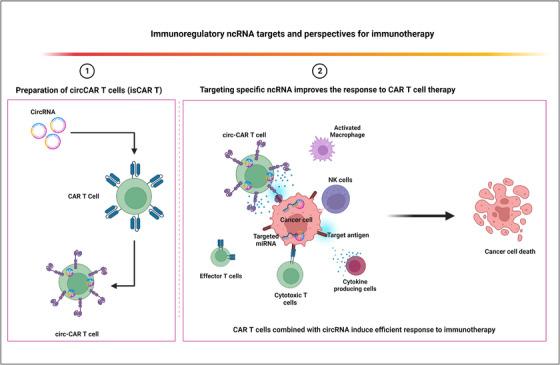
This review summarises important predictive ncRNA biomarkers that were reported in cancer patients treated with different immunotherapeutic modalities, including monoclonal antibodies, small molecule inhibitors, cancer vaccines and CAR-T cells. In addition, a concise discussion on forthcoming perspectives is provided, outlining technical approaches for the optimal utilisation of immunomodulatory ncRNA biomarkers as predictive tools and therapeutic targets.
背景
迄今为止,由于个人遗传特征、肿瘤微环境复杂性和表观遗传致癌机制的变化,标准化用于评估免疫治疗反应的临床预测生物标志物仍然具有挑战性。
主要内容
早期监测关键非编码 RNA(ncRNA)生物标志物可能有助于预测癌症免疫治疗的临床疗效,并提出标准的预测 ncRNA 生物标志物。例如,接受抗 PD-1 治疗的非小细胞肺癌患者血浆中 miR-125b-5p 水平降低可预测阳性结果。接受嵌合抗原受体 T 淋巴细胞(CAR-T)细胞治疗的结直肠癌患者血浆中 miR-153 的水平可能表明 T 细胞杀伤活性的激活。miR-148a-3p 和 miR-375 水平可能预示着 B 细胞急性淋巴细胞白血病对 CAR-T 细胞治疗的良好反应。在接受 GPC3 肽疫苗治疗的癌症患者中,血清 miR-1228-5p、miR-193a-5p 和 miR-375-3p 水平被报道为预测良好反应和改善总生存期的生物标志物。因此,迫切需要进一步研究来阐述具有预测免疫治疗早期临床反应潜力的关键 ncRNA 生物标志物。
结论
本综述总结了在接受不同免疫治疗方式(包括单克隆抗体、小分子抑制剂、癌症疫苗和 CAR-T 细胞)治疗的癌症患者中报道的重要预测性 ncRNA 生物标志物。此外,还提供了对未来展望的简明讨论,概述了最佳利用免疫调节 ncRNA 生物标志物作为预测工具和治疗靶点的技术方法。

 Zotero 插件