
网络医学和基于机制的分子内型重新定义痴呆症
Re-Addressing Dementia by Network Medicine and Mechanism-Based Molecular Endotypes.
机构信息
Department of Pharmacology and Personalised Medicine, School of Mental Health and Neuroscience, Maastricht University, Maastricht, The Netherlands.
Universitätsklinikum Essen, Klinik für Neurologie, Essen, Germany.
出版信息
J Alzheimers Dis. 2023;96(1):47-56. doi: 10.3233/JAD-230694.
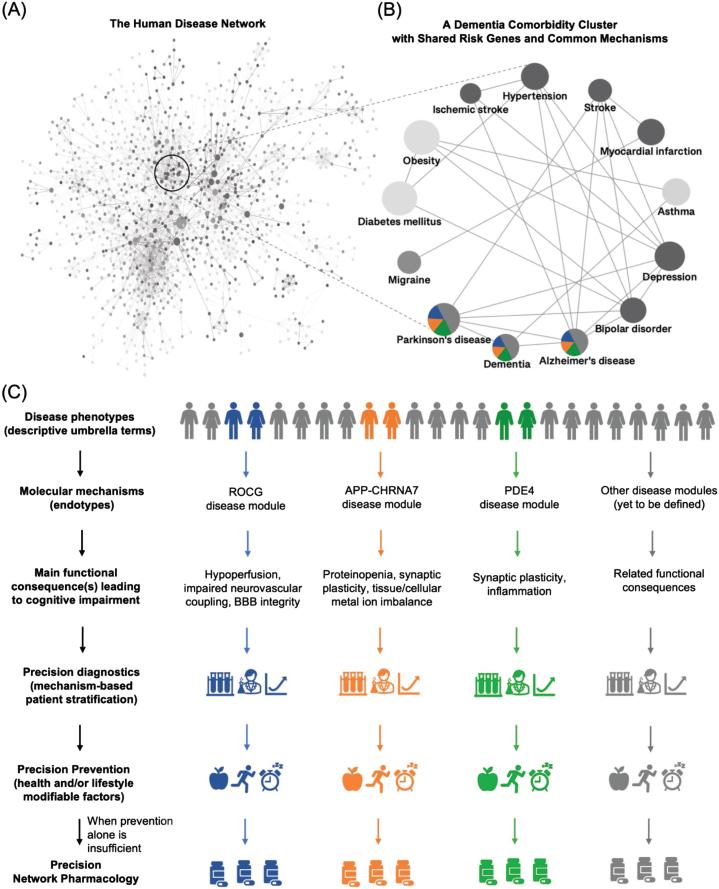
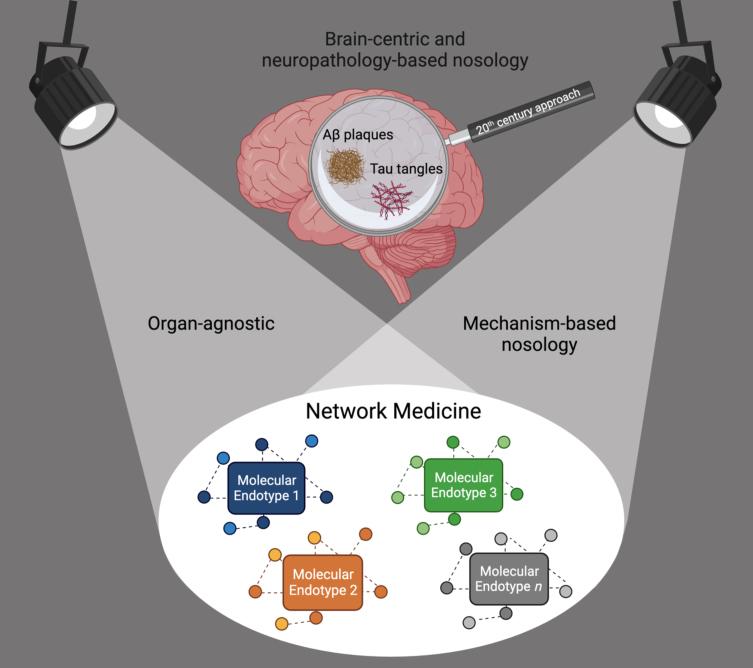
Alzheimer's disease (AD) and other forms of dementia are together a leading cause of disability and death in the aging global population, imposing a high personal, societal, and economic burden. They are also among the most prominent examples of failed drug developments. Indeed, after more than 40 AD trials of anti-amyloid interventions, reduction of amyloid-β (Aβ) has never translated into clinically relevant benefits, and in several cases yielded harm. The fundamental problem is the century-old, brain-centric phenotype-based definitions of diseases that ignore causal mechanisms and comorbidities. In this hypothesis article, we discuss how such current outdated nosology of dementia is a key roadblock to precision medicine and articulate how Network Medicine enables the substitution of clinicopathologic phenotypes with molecular endotypes and propose a new framework to achieve precision and curative medicine for patients with neurodegenerative disorders.
阿尔茨海默病(AD)和其他形式的痴呆症共同导致老龄化全球人口残疾和死亡的主要原因,给个人、社会和经济带来了沉重的负担。它们也是药物开发失败的最显著例子之一。事实上,在 40 多次针对淀粉样蛋白干预的 AD 试验之后,淀粉样蛋白-β(Aβ)的减少从未转化为临床相关的益处,而且在某些情况下还产生了危害。根本问题在于以大脑为中心、基于表型的疾病定义已有一个世纪之久,这种定义忽略了因果机制和共病。在这篇假说文章中,我们讨论了当前这种过时的痴呆症分类学如何成为精准医学的主要障碍,并阐明网络医学如何用分子内型替代临床病理表型,并为神经退行性疾病患者提出实现精准和治疗医学的新框架。
 Zotero 插件