
比较高危子宫内膜癌和结直肠癌患者中林奇综合征检测的直接种系测序和多步筛查。
Comparison of immediate germline sequencing and multi-step screening for Lynch syndrome detection in high-risk endometrial and colorectal cancer patients.
机构信息
Department of Obstetrics and Gynecology, New Taipei Municipal Tu Cheng Hospital, New Taipei City, Taiwan.
Department of Obstetrics and Gynecology, Linkou Chang Gung Memorial Hospital and Chang Gung University, College of Medicine, Taoyuan, Taiwan.
出版信息
J Gynecol Oncol. 2024 Jan;35(1):e5. doi: 10.3802/jgo.2024.35.e5. Epub 2023 Sep 5.
OBJECTIVE
Lynch syndrome (LS) is a hereditary cancer predisposition syndrome with a significantly increased risk of colorectal and endometrial cancers. Current standard practice involves universal screening for LS in patients with newly diagnosed colorectal or endometrial cancer using a multi-step screening protocol (MSP). However, MSP may not always accurately identify LS cases. To address this limitation, we compared the diagnostic performance of immediate germline sequencing (IGS) with MSP in a high-risk group.
METHODS
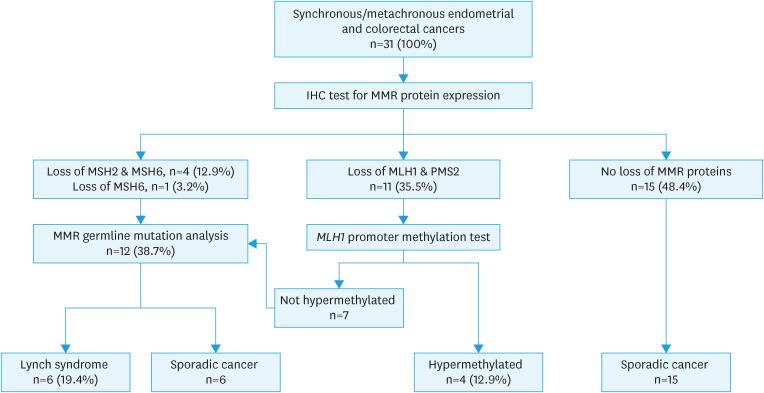
A total of 31 Taiwanese women with synchronous or metachronous endometrial and colorectal malignancies underwent MSP which included immunohistochemical staining of DNA mismatch repair (MMR) proteins, promoter hypermethylation analysis, and germline sequencing to identify pathogenic variants. All patients who were excluded during MSP received germline sequencing for MMR genes to simulate IGS for the detection of LS.
RESULTS
Our findings indicate that IGS surpassed MSP in terms of diagnostic yield (29.0% vs. 19.4%, respectively) and sensitivity (90% vs. 60%, respectively). Specifically, IGS successfully identified nine LS cases, which is 50% more than the number detected through MSP. Additionally, germline methylation analysis revealed one more LS case with constitutional promoter hypermethylation, bringing the total LS cases to ten (32.3%). Intriguingly, we observed no significant differences in clinical characteristics or overall survival between patients with and without LS in our cohort.
CONCLUSION
Our study suggests that IGS may potentially offer a more effective approach compared to MSP in identifying LS among high-risk patients. This advantage is evident when patients have been pre-selected utilizing specific clinical criteria.
目的
林奇综合征(LS)是一种遗传性癌症易感性综合征,结直肠癌和子宫内膜癌的风险显著增加。目前的标准实践包括使用多步筛选方案(MSP)对新诊断的结直肠癌或子宫内膜癌患者进行 LS 的普遍筛查。然而,MSP 并不总是能准确识别 LS 病例。为了解决这一局限性,我们比较了高风险组中直接种系测序(IGS)与 MSP 的诊断性能。
方法
共有 31 名台湾女性患有同步或异时性子宫内膜和结直肠恶性肿瘤,接受了 MSP,包括 DNA 错配修复(MMR)蛋白的免疫组织化学染色、启动子超甲基化分析和种系测序,以识别致病性变异。所有在 MSP 期间被排除的患者均接受 MMR 基因的种系测序,以模拟 IGS 用于 LS 的检测。
结果
我们的研究结果表明,IGS 在诊断率(分别为 29.0%和 19.4%)和敏感性(分别为 90%和 60%)方面均优于 MSP。具体而言,IGS 成功鉴定了 9 例 LS 病例,比 MSP 检测到的病例多 50%。此外,种系甲基化分析还揭示了一个具有结构启动子超甲基化的 LS 病例,使 LS 病例总数达到 10 例(32.3%)。有趣的是,我们在队列中观察到 LS 患者与无 LS 患者的临床特征或总体生存率之间没有显著差异。
结论
我们的研究表明,与 MSP 相比,IGS 可能在高风险患者中识别 LS 方面提供了更有效的方法。当患者已经通过特定的临床标准预先选择时,这种优势是明显的。

 Zotero 插件