
手动标记、二维姿态估计算法和基于三维标记的系统之间的步态分析比较。
Gait analysis comparison between manual marking, 2D pose estimation algorithms, and 3D marker-based system.
作者信息
Menychtas Dimitrios, Petrou Nikolaos, Kansizoglou Ioannis, Giannakou Erasmia, Grekidis Athanasios, Gasteratos Antonios, Gourgoulis Vassilios, Douda Eleni, Smilios Ilias, Michalopoulou Maria, Sirakoulis Georgios Ch, Aggelousis Nikolaos
机构信息
Biomechanics Laboratory, Department of Physical Education and Sports Science, Democritus University of Thrace, Komotini, Greece.
Laboratory of Robotics and Automation, Department of Production and Management Engineering, Democritus University of Thrace, Xanthi, Greece.
出版信息
Front Rehabil Sci. 2023 Sep 6;4:1238134. doi: 10.3389/fresc.2023.1238134. eCollection 2023.
INTRODUCTION
Recent advances in Artificial Intelligence (AI) and Computer Vision (CV) have led to automated pose estimation algorithms using simple 2D videos. This has created the potential to perform kinematic measurements without the need for specialized, and often expensive, equipment. Even though there's a growing body of literature on the development and validation of such algorithms for practical use, they haven't been adopted by health professionals. As a result, manual video annotation tools remain pretty common. Part of the reason is that the pose estimation modules can be erratic, producing errors that are difficult to rectify. Because of that, health professionals prefer the use of tried and true methods despite the time and cost savings pose estimation can offer.
METHODS
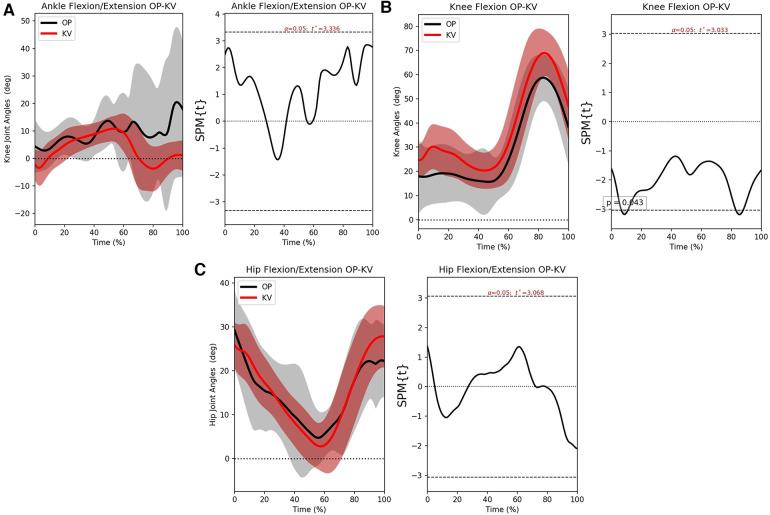
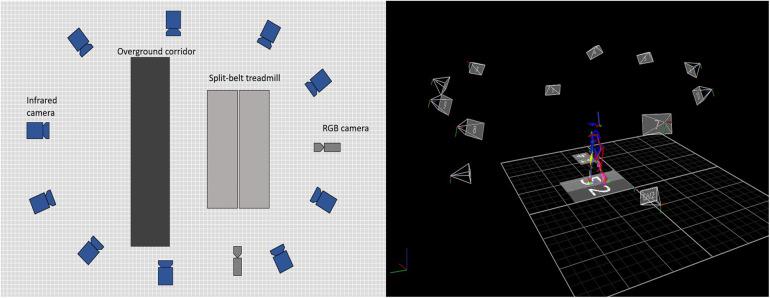
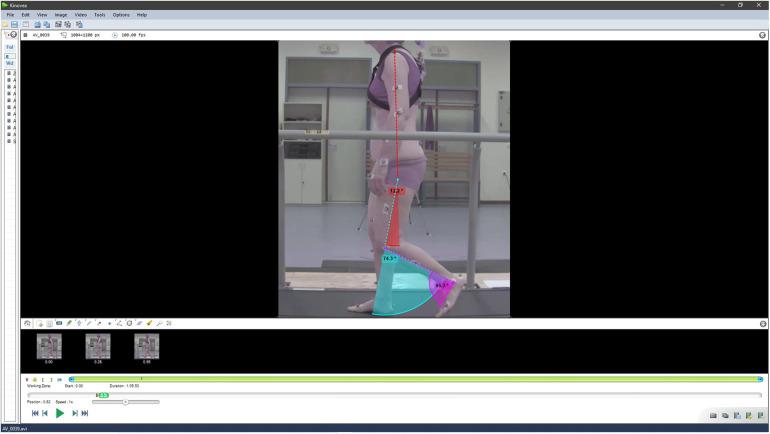
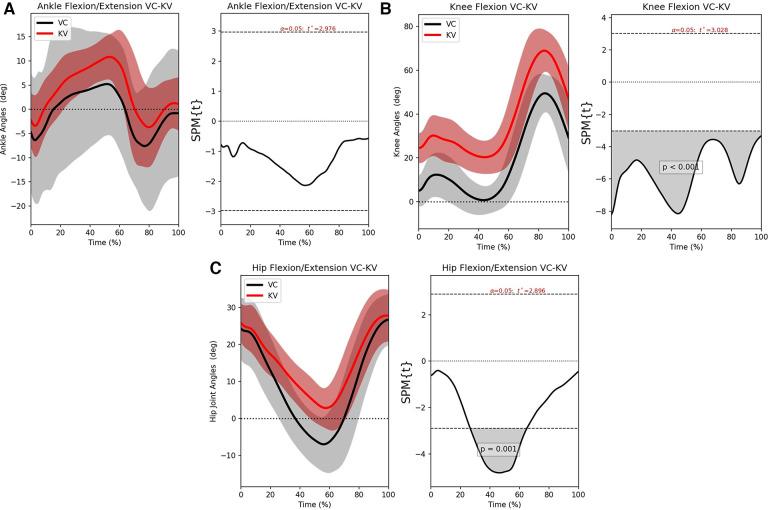
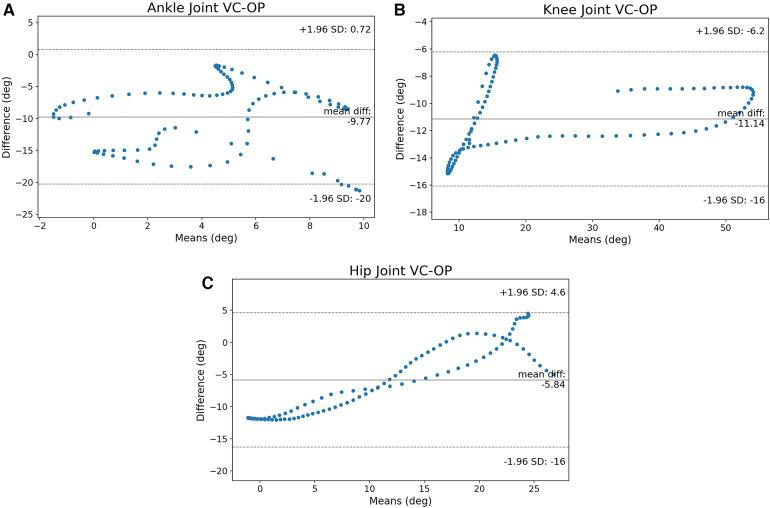
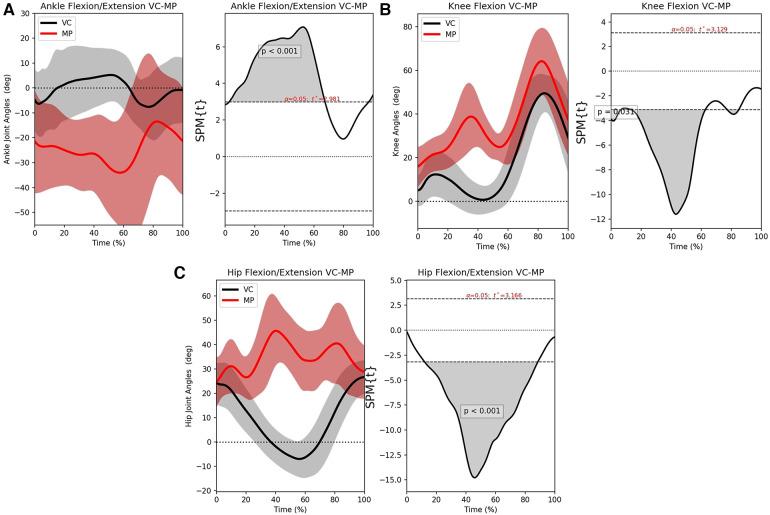
In this work, the gait cycle of a sample of the elderly population on a split-belt treadmill is examined. The Openpose (OP) and Mediapipe (MP) AI pose estimation algorithms are compared to joint kinematics from a marker-based 3D motion capture system (Vicon), as well as from a video annotation tool designed for biomechanics (Kinovea). Bland-Altman (B-A) graphs and Statistical Parametric Mapping (SPM) are used to identify regions of statistically significant difference.
RESULTS
Results showed that pose estimation can achieve motion tracking comparable to marker-based systems but struggle to identify joints that exhibit small, but crucial motion.
DISCUSSION
Joints such as the ankle, can suffer from misidentification of their anatomical landmarks. Manual tools don't have that problem, but the user will introduce a static offset across the measurements. It is proposed that an AI-powered video annotation tool that allows the user to correct errors would bring the benefits of pose estimation to professionals at a low cost.
引言
人工智能(AI)和计算机视觉(CV)的最新进展催生了使用简单二维视频的自动姿态估计算法。这使得在无需使用专门且通常昂贵的设备的情况下进行运动学测量成为可能。尽管关于此类算法在实际应用中的开发和验证的文献越来越多,但健康专业人员尚未采用它们。因此,手动视频注释工具仍然相当普遍。部分原因是姿态估计模块可能不稳定,会产生难以纠正的错误。正因如此,尽管姿态估计可以节省时间和成本,但健康专业人员仍更喜欢使用经过验证的可靠方法。
方法
在这项研究中,对老年人群体在分体式跑步机上的步态周期进行了研究。将Openpose(OP)和Mediapipe(MP)人工智能姿态估计算法与基于标记的3D运动捕捉系统(Vicon)以及为生物力学设计的视频注释工具(Kinovea)得出的关节运动学数据进行了比较。使用布兰德-奥特曼(B-A)图和统计参数映射(SPM)来识别具有统计学显著差异的区域。
结果
结果表明,姿态估计能够实现与基于标记的系统相当的运动跟踪,但在识别表现出微小但关键运动的关节方面存在困难。
讨论
诸如脚踝等关节可能会出现解剖标志识别错误的情况。手动工具不存在这个问题,但用户会在测量中引入静态偏差。有人提出,一种由人工智能驱动的视频注释工具,允许用户纠正错误,将以低成本为专业人员带来姿态估计的好处。




 Zotero 插件