
Mini-BESTest量表和定时起立行走试验的转身持续时间可为神经科患者提供有效的平衡测量指标:一项以跌倒作为平衡标准的前瞻性研究。
The Mini-BESTest scale and the turning duration of the TUG test provide valid balance measures in neurological patients: a prospective study with falls as the balance criterion.
作者信息
Caronni Antonio, Picardi Michela, Scarano Stefano, Malloggi Chiara, Tropea Peppino, Gilardone Giulia, Aristidou Evdoxia, Pintavalle Giuseppe, Redaelli Valentina, Antoniotti Paola, Corbo Massimo
机构信息
Department of Neurorehabilitation Sciences, IRCCS Istituto Auxologico Italiano, Ospedale San Luca, Milan, Italy.
Department of Biomedical Sciences for Health, University of Milan, Milan, Italy.
出版信息
Front Neurol. 2023 Sep 8;14:1228302. doi: 10.3389/fneur.2023.1228302. eCollection 2023.
BACKGROUND
Balance, i.e., the ability not to fall, is often poor in neurological patients and this impairment increases their risk of falling. The Mini-Balance Evaluation System Test (Mini-BESTest), a rating scale, the Timed Up and Go (TUG) test, and gait measures are commonly used to quantify balance. This study assesses the criterion validity of these measures as balance measures.
METHODS
The probability of being a faller within nine months was used as the balance criterion. The Mini-BESTest, TUG (instrumented with inertial sensors), and walking test were administered before and after inpatient rehabilitation. Multiple and LASSO logistic regressions were used for the analysis. The diagnostic accuracy of the model was assessed with the area under the curve (AUC) of the receiver operating characteristic curve. Mobility measure validity was compared with the Akaike Information Criterion (AIC).
RESULTS
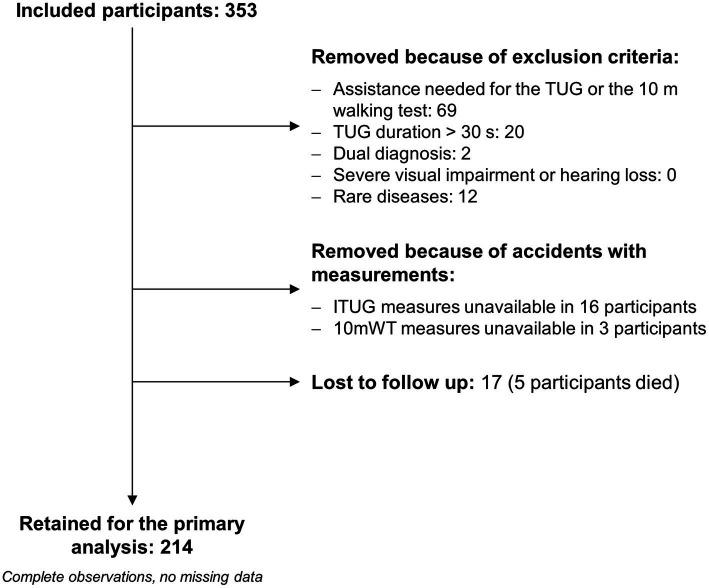
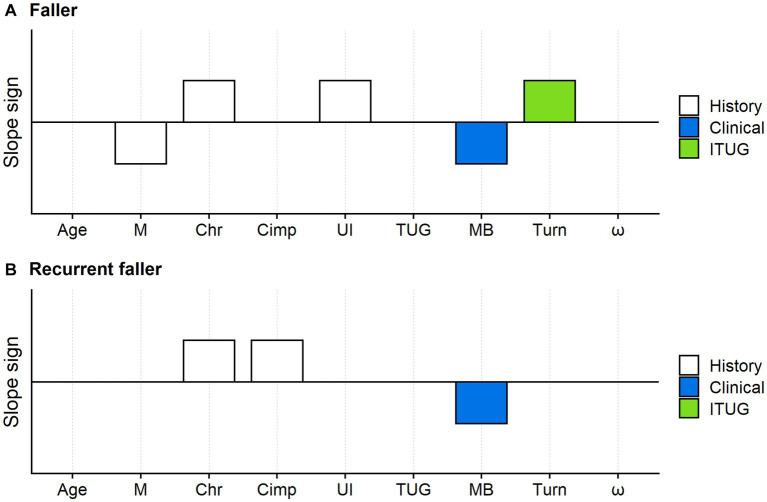
Two hundred and fourteen neurological patients (stroke, peripheral neuropathy, or parkinsonism) were recruited. In total, 82 patients fell at least once in the nine-month follow-up. The Mini-BESTest (AUC = 0.69; 95%CI: 0.62-0.76), the duration of the TUG turning phase (AUC = 0.69; 0.62-0.76), and other TUG measures were significant faller predictors in regression models. However, only the turning duration (AIC = 274.0) and Mini-BESTest (AIC = 276.1) substantially improved the prediction of a baseline model, which only included fall risk factors from the medical history (AIC = 281.7). The LASSO procedure selected gender, disease chronicity, urinary incontinence, the Mini-BESTest, and turning duration as optimal faller predictors.
CONCLUSION
The TUG turning duration and the Mini-BESTest predict the chance of being a faller. Their criterion validity as balance measures in neurological patients is substantial.
背景
平衡能力,即不摔倒的能力,在神经系统疾病患者中通常较差,这种损害会增加他们摔倒的风险。迷你平衡评估系统测试(Mini-BESTest)、一种评分量表、定时起立行走测试(TUG)以及步态测量通常用于量化平衡能力。本研究评估这些测量方法作为平衡测量指标的标准效度。
方法
将九个月内摔倒的可能性作为平衡标准。在住院康复前后进行Mini-BESTest、TUG(配备惯性传感器)和步行测试。采用多元和LASSO逻辑回归进行分析。使用受试者工作特征曲线的曲线下面积(AUC)评估模型的诊断准确性。将移动性测量效度与赤池信息准则(AIC)进行比较。
结果
招募了214名神经系统疾病患者(中风、周围神经病变或帕金森病)。在九个月的随访中,共有82名患者至少摔倒过一次。Mini-BESTest(AUC = 0.69;95%CI:0.62 - 0.76)、TUG转弯阶段持续时间(AUC = 0.69;0.62 - 0.76)以及其他TUG测量指标在回归模型中是摔倒的显著预测因素。然而,只有转弯持续时间(AIC = 274.0)和Mini-BESTest(AIC = 276.1)显著改善了仅包含病史中摔倒风险因素的基线模型的预测(AIC = 281.7)。LASSO程序选择性别、疾病慢性程度、尿失禁、Mini-BESTest和转弯持续时间作为最佳摔倒预测因素。
结论
TUG转弯持续时间和Mini-BESTest可预测摔倒的可能性。它们作为神经系统疾病患者平衡测量指标的标准效度较高。


 Zotero 插件