
验证一种基于人工智能的方法,以实现对青少年特发性脊柱侧凸患儿的脊柱 X 光片 Cobb 角的自动测量。
Validation of an artificial intelligence-based method to automate Cobb angle measurement on spinal radiographs of children with adolescent idiopathic scoliosis.
机构信息
Department of Electrical and Computer Engineering, University of Alberta, Edmonton, Canada.
Department of Physical Therapy, University of Alberta, Edmonton, Canada.
出版信息
Eur J Phys Rehabil Med. 2023 Aug;59(4):535-542. doi: 10.23736/S1973-9087.23.08091-7.
BACKGROUND
Accurately measuring the Cobb angle on radiographs is crucial for diagnosis and treatment decisions for adolescent idiopathic scoliosis (AIS). However, manual Cobb angle measurement is time-consuming and subject to measurement variation, especially for inexperienced clinicians.
AIM
This study aimed to validate a novel artificial-intelligence-based (AI) algorithm that automatically measures the Cobb angle on radiographs.
DESIGN
This is a retrospective cross-sectional study.
SETTING
The population of patients attended the Stollery Children's Hospital in Alberta, Canada.
POPULATION
Children who: 1) were diagnosed with AIS, 2) were aged between 10 and 18 years old, 3) had no prior surgery, and 4) had a radiograph out of brace, were enrolled.
METHODS
A total of 330 spinal radiographs were used. Among those, 130 were used for AI model development and 200 were used for measurement validation. Automatic Cobb angle measurements were validated by comparing them with manual ones measured by a rater with 20+ years of experience. Analysis was performed using the standard error of measurement (SEM), inter-method intraclass correlation coefficient (ICC
RESULTS
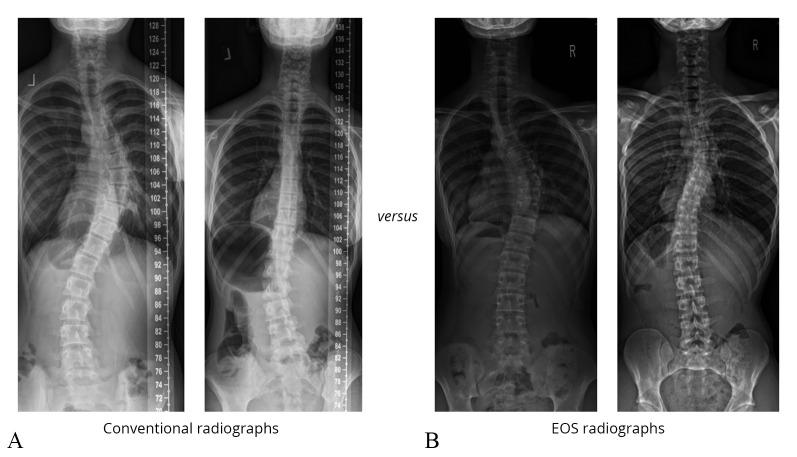
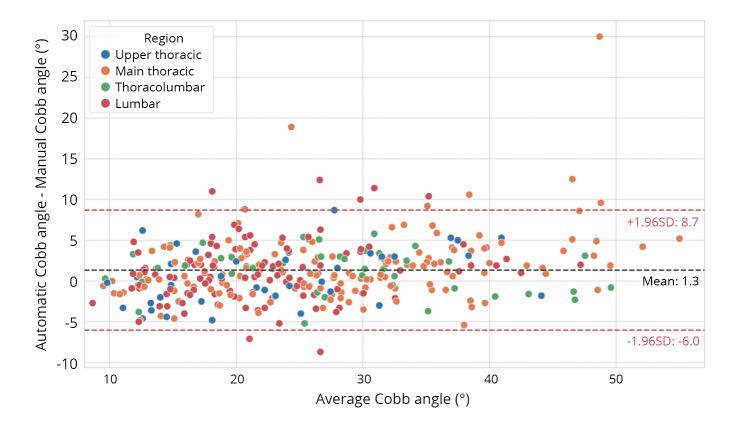
The AI method detected 346 of 352 manually measured curves (mean±standard deviation: 24.7±9.5°), achieving 91% (316/346) of measurements within clinical acceptance. Excellent reliability was obtained with 0.92 ICC and 0.79° SEM. Comparable performance was found throughout all subgroups, and no systematic biases in performance affecting any subgroup were discovered. The algorithm measured each radiograph approximately 18s on average which is slightly faster than the estimated measurement time of an experienced rater. Radiographs taken by the EOS X-ray system were measured more quickly on average than those taken by a conventional digital X-ray system (10s vs. 26s).
CONCLUSIONS
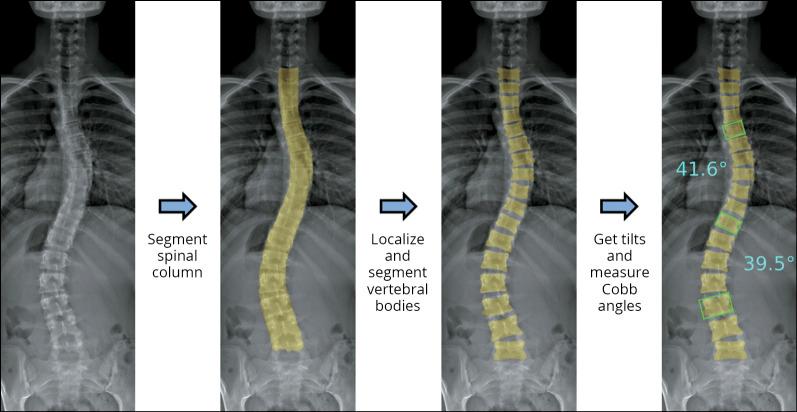
An AI-based algorithm was developed to measure the Cobb angle automatically on radiographs and yielded reliable measurements quickly. The algorithm provides detailed images on how the angles were measured, providing interpretability that can give clinicians confidence in the measurements.
CLINICAL REHABILITATION IMPACT
Employing the algorithm in practice could streamline clinical workflow and optimize measurement accuracy and speed in order to inform AIS treatment decisions.
背景
准确测量放射影像上的 Cobb 角对于青少年特发性脊柱侧凸(AIS)的诊断和治疗决策至关重要。然而,手动 Cobb 角测量既耗时又容易受到测量变化的影响,尤其是对于经验不足的临床医生。
目的
本研究旨在验证一种新的基于人工智能(AI)的算法,该算法可自动测量放射影像上的 Cobb 角。
设计
这是一项回顾性的横断面研究。
地点
该研究人群来自加拿大艾伯塔省斯特罗利儿童医院。
患者
纳入符合以下条件的患者:1)诊断为 AIS,2)年龄在 10 至 18 岁之间,3)无既往手术史,4)有支具外的放射影像。
方法
共使用了 330 张脊柱放射影像。其中,130 张用于 AI 模型开发,200 张用于测量验证。通过比较由一位具有 20 多年经验的评分者手动测量的 Cobb 角,对自动 Cobb 角测量进行验证。使用测量标准误差(SEM)、组内 ICC
结果
AI 方法检测到 346 张手动测量曲线上的 352 个(平均值±标准差:24.7±9.5°),有 91%(316/346)的测量值在临床可接受范围内。具有 0.92 ICC 和 0.79° SEM 的可靠性非常高。在所有亚组中都发现了类似的性能,并且没有发现影响任何亚组的系统性能偏差。该算法平均每张放射影像的测量时间约为 18 秒,略快于经验丰富的评分者的估计测量时间。EOS X 射线系统拍摄的放射影像的平均测量速度快于传统数字 X 射线系统(10 秒比 26 秒)。
结论
开发了一种基于 AI 的算法来自动测量放射影像上的 Cobb 角,并且能够快速获得可靠的测量结果。该算法提供了有关角度测量方式的详细信息,提供了可解释性,使临床医生对测量结果更有信心。
临床康复影响
在实际中采用该算法可以简化临床工作流程,优化测量准确性和速度,从而为 AIS 治疗决策提供信息。

 Zotero 插件