
影响医疗保健中会话代理的可接受性、接受度和采用的因素:综合回顾。
Factors Influencing the Acceptability, Acceptance, and Adoption of Conversational Agents in Health Care: Integrative Review.
机构信息
Center for Health Economics and Health Services Research, Schumpeter School of Business and Economics, University of Wuppertal, Wuppertal, Germany.
出版信息
J Med Internet Res. 2023 Sep 26;25:e46548. doi: 10.2196/46548.
BACKGROUND
Conversational agents (CAs), also known as chatbots, are digital dialog systems that enable people to have a text-based, speech-based, or nonverbal conversation with a computer or another machine based on natural language via an interface. The use of CAs offers new opportunities and various benefits for health care. However, they are not yet ubiquitous in daily practice. Nevertheless, research regarding the implementation of CAs in health care has grown tremendously in recent years.
OBJECTIVE
This review aims to present a synthesis of the factors that facilitate or hinder the implementation of CAs from the perspectives of patients and health care professionals. Specifically, it focuses on the early implementation outcomes of acceptability, acceptance, and adoption as cornerstones of later implementation success.
METHODS
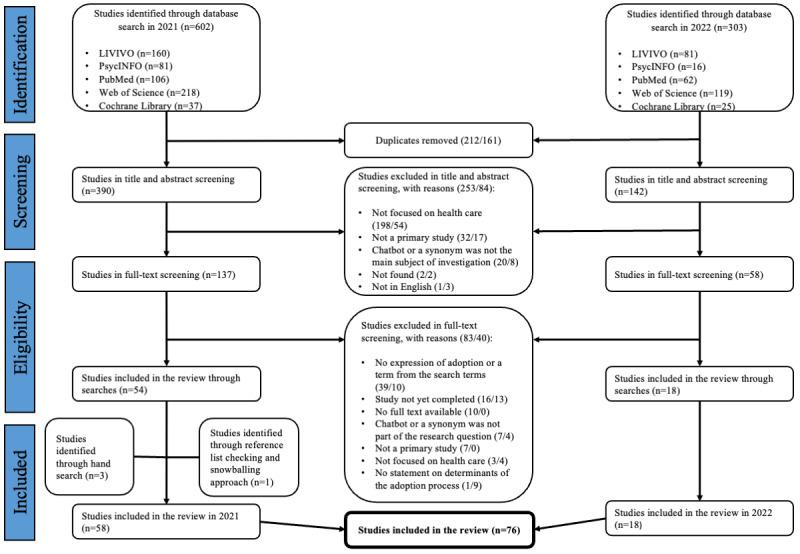
We performed an integrative review. To identify relevant literature, a broad literature search was conducted in June 2021 with no date limits and using all fields in PubMed, Cochrane Library, Web of Science, LIVIVO, and PsycINFO. To keep the review current, another search was conducted in March 2022. To identify as many eligible primary sources as possible, we used a snowballing approach by searching reference lists and conducted a hand search. Factors influencing the acceptability, acceptance, and adoption of CAs in health care were coded through parallel deductive and inductive approaches, which were informed by current technology acceptance and adoption models. Finally, the factors were synthesized in a thematic map.
RESULTS
Overall, 76 studies were included in this review. We identified influencing factors related to 4 core Unified Theory of Acceptance and Use of Technology (UTAUT) and Unified Theory of Acceptance and Use of Technology 2 (UTAUT2) factors (performance expectancy, effort expectancy, facilitating conditions, and hedonic motivation), with most studies underlining the relevance of performance and effort expectancy. To meet the particularities of the health care context, we redefined the UTAUT2 factors social influence, habit, and price value. We identified 6 other influencing factors: perceived risk, trust, anthropomorphism, health issue, working alliance, and user characteristics. Overall, we identified 10 factors influencing acceptability, acceptance, and adoption among health care professionals (performance expectancy, effort expectancy, facilitating conditions, social influence, price value, perceived risk, trust, anthropomorphism, working alliance, and user characteristics) and 13 factors influencing acceptability, acceptance, and adoption among patients (additionally hedonic motivation, habit, and health issue).
CONCLUSIONS
This review shows manifold factors influencing the acceptability, acceptance, and adoption of CAs in health care. Knowledge of these factors is fundamental for implementation planning. Therefore, the findings of this review can serve as a basis for future studies to develop appropriate implementation strategies. Furthermore, this review provides an empirical test of current technology acceptance and adoption models and identifies areas where additional research is necessary.
TRIAL REGISTRATION
PROSPERO CRD42022343690; https://www.crd.york.ac.uk/prospero/display_record.php?RecordID=343690.
背景
对话代理(CA),也称为聊天机器人,是一种数字对话系统,通过界面使人们能够基于自然语言与计算机或其他机器进行基于文本的、基于语音的或非语言的对话。CA 的使用为医疗保健提供了新的机会和各种好处。然而,它们在日常实践中尚未普及。尽管如此,近年来,关于 CA 在医疗保健中的实施的研究已经大大增加。
目的
本综述旨在从患者和医疗保健专业人员的角度综合阐述促进或阻碍 CA 实施的因素。具体来说,它侧重于可接受性、接受度和采用等早期实施成果作为后续实施成功的基石。
方法
我们进行了综合综述。为了确定相关文献,我们于 2021 年 6 月进行了一次广泛的文献检索,没有时间限制,并在 PubMed、Cochrane 图书馆、Web of Science、LIVIVO 和 PsycINFO 中使用所有字段。为了保持综述的时效性,我们于 2022 年 3 月进行了另一次搜索。为了尽可能多地确定合格的原始来源,我们使用了滚雪球的方法来搜索参考文献,并进行了手工搜索。通过并行演绎和归纳方法对影响 CA 在医疗保健中可接受性、接受度和采用的因素进行了编码,这些方法受到了当前技术接受和采用模型的启发。最后,将这些因素综合在一个主题地图中。
结果
总体而言,本综述共纳入 76 项研究。我们确定了与 4 个核心统一技术接受和使用理论(UTAUT)和统一技术接受和使用理论 2(UTAUT2)因素(绩效期望、努力期望、促进条件和享乐动机)相关的影响因素,其中大多数研究强调了绩效和努力期望的相关性。为了满足医疗保健环境的特殊性,我们重新定义了 UTAUT2 因素社会影响、习惯和价格价值。我们还确定了其他 6 个影响因素:感知风险、信任、拟人化、健康问题、工作联盟和用户特征。总体而言,我们确定了影响医疗保健专业人员可接受性、接受度和采用的 10 个因素(绩效期望、努力期望、促进条件、社会影响、价格价值、感知风险、信任、拟人化、工作联盟和用户特征)和影响患者可接受性、接受度和采用的 13 个因素(此外还有享乐动机、习惯和健康问题)。
结论
本综述表明,影响 CA 在医疗保健中可接受性、接受度和采用的因素有很多。了解这些因素是实施规划的基础。因此,本综述的研究结果可以作为未来研究制定适当实施策略的基础。此外,本综述对当前技术接受和采用模型进行了实证检验,并确定了需要进一步研究的领域。
试验注册
PROSPERO CRD42022343690;https://www.crd.york.ac.uk/prospero/display_record.php?RecordID=343690。

 Zotero 插件