
胃饥饿素增强尼古丁诱导的终纹床核(BNST)中多巴胺的释放。
Ghrelin Amplifies the Nicotine-Induced Release of Dopamine in the Bed Nucleus of Stria Terminalis (BNST).
作者信息
Ayman Jázmin, Palotai Miklós, Dochnal Roberta, Bagosi Zsolt
机构信息
Department of Obstetrics and Gynecology, Albert Szent-Györgyi School of Medicine, University of Szeged, H-6701 Szeged, Hungary.
Department of Radiology, Brigham and Women's Hospital, Harvard Medical School, Boston, MA 02115, USA.
出版信息
Biomedicines. 2023 Sep 4;11(9):2456. doi: 10.3390/biomedicines11092456.
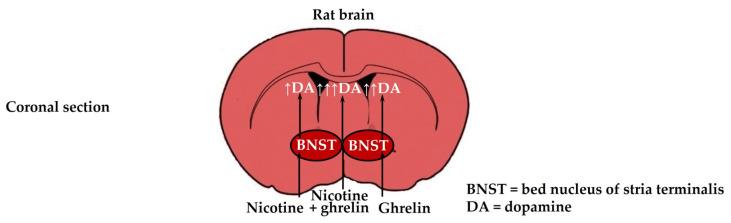
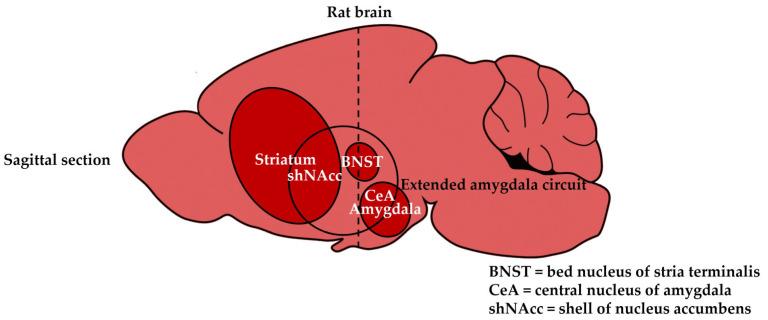
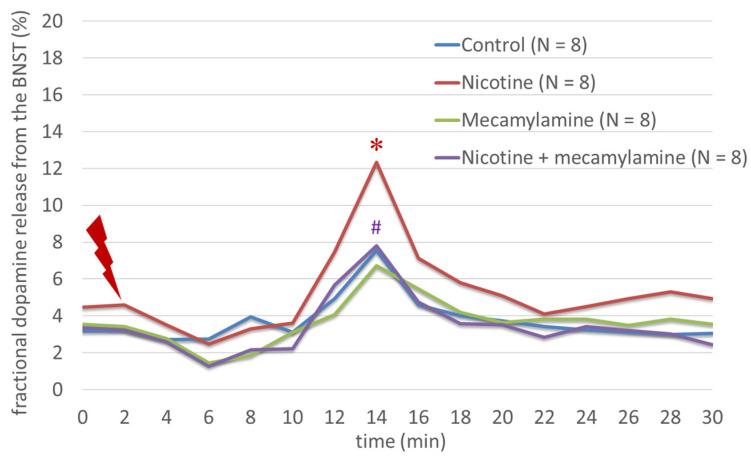
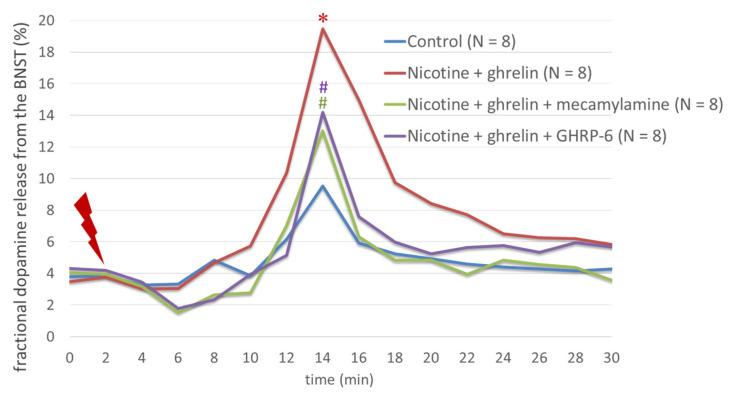
Ghrelin is an orexigenic neuropeptide that is known for stimulating the release of growth hormone (GH) and appetite. In addition, ghrelin has been implicated in addiction to drugs such as nicotine. Nicotine is the principal psychoactive component in tobacco and is responsible for the reward sensation produced by smoking. In our previous in vitro superfusion studies, it was demonstrated that ghrelin and nicotine stimulate equally the dopamine release in the rat amygdala, and ghrelin amplifies the nicotine-induced dopamine release in the rat striatum. However, less attention was paid to the actions of ghrelin and nicotine in the bed nucleus of the stria terminalis (BNST). Therefore, in the present study, nicotine and ghrelin were superfused to the BNST of male Wistar rats, and the dopamine release from the BNST was measured in vitro. In order to determine which receptors mediate these effects, mecamylamine, a non-selective nicotinic acetylcholine receptor (nAchR) antagonist, and GHRP-6, a selective growth hormone secretagogue receptor (GHS-R1A) antagonist, were also superfused to the rat BNST. Nicotine significantly increased the release of dopamine, and this effect was significantly inhibited by mecamylamine. Ghrelin increased dopamine release even more significantly than nicotine did, and this effect was significantly inhibited by GHRP-6. Moreover, when administered together, ghrelin significantly amplified the nicotine-induced release of dopamine in the BNST, and this additive effect was reversed partly by mecamylamine and partly by GHRP-6. Therefore, the present study provides a new base of evidence for the involvement of ghrelin in dopamine signaling implicated in nicotine addiction.
胃饥饿素是一种促食欲神经肽,以刺激生长激素(GH)释放和食欲而闻名。此外,胃饥饿素还与尼古丁等药物成瘾有关。尼古丁是烟草中的主要精神活性成分,负责吸烟产生的奖赏感。在我们之前的体外灌流研究中,已证明胃饥饿素和尼古丁同等程度地刺激大鼠杏仁核中的多巴胺释放,并且胃饥饿素会放大尼古丁诱导的大鼠纹状体中的多巴胺释放。然而,胃饥饿素和尼古丁在终纹床核(BNST)中的作用较少受到关注。因此,在本研究中,将尼古丁和胃饥饿素灌流于雄性Wistar大鼠的BNST,并在体外测量BNST中的多巴胺释放。为了确定哪些受体介导这些作用,还将非选择性烟碱型乙酰胆碱受体(nAchR)拮抗剂美加明和选择性生长激素促分泌素受体(GHS-R1A)拮抗剂GHRP-6灌流于大鼠BNST。尼古丁显著增加多巴胺释放,且该作用被美加明显著抑制。胃饥饿素比尼古丁更显著地增加多巴胺释放,且该作用被GHRP-6显著抑制。此外,当一起给药时,胃饥饿素显著放大尼古丁诱导的BNST中的多巴胺释放,且这种相加作用部分被美加明和部分被GHRP-6逆转。因此,本研究为胃饥饿素参与尼古丁成瘾所涉及的多巴胺信号传导提供了新的证据基础。


 Zotero 插件