
奥地利普通民众关注和支持的领域:对2020/21年冬季至2022年春季期间转变的定性内容分析映射
Areas of Concern and Support among the Austrian General Population: A Qualitative Content Analytic Mapping of the Shift between Winter 2020/21 and Spring 2022.
作者信息
Gächter Afsaneh, Zauner Barbara, Haider Katja, Schaffler Yvonne, Probst Thomas, Pieh Christoph, Humer Elke
机构信息
Department for Psychosomatic Medicine and Psychotherapy, University for Continuing Education Krems, 3500 Krems, Austria.
Division of Psychotherapy, Department of Psychology, Paris Lodron University Salzburg, 5020 Salzburg, Austria.
出版信息
Healthcare (Basel). 2023 Sep 14;11(18):2539. doi: 10.3390/healthcare11182539.
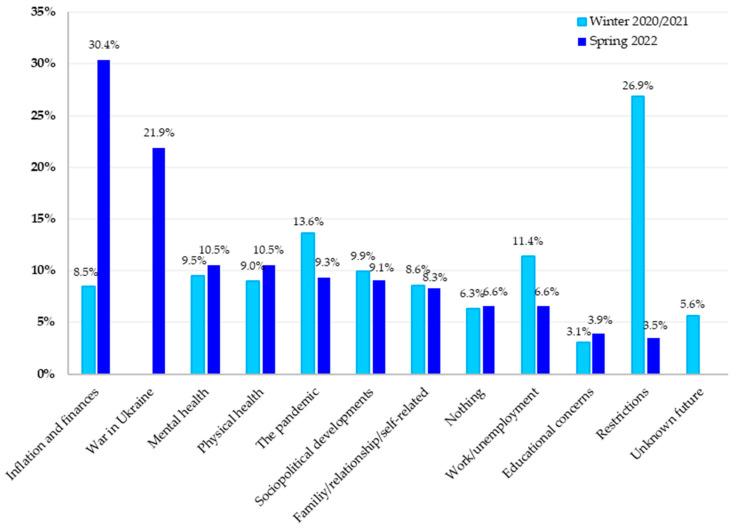
This study aimed to analyze areas of concern and support of the Austrian general population two years into the COVID-19 pandemic. A representative sample (N = 1031) of the Austrian general population was surveyed online between 19 April 2022 and 26 April 2022. A qualitative study design was used to explore the factors of most considerable current concern (Question 1) and the most important sources of support (Question 2). The responses to the two open-ended questions were evaluated using a conventional content analysis, and categories were formed according to the frequency of the answers. The analysis revealed that inflation and finances (30% of participants) and the war in Ukraine (22%) were the greatest sources of concern, followed by mental health (11%), and physical health (11%). Factors such as social contacts within and outside the family were mentioned most frequently as sources of support (36% of participants), followed by recreational activities (23%) and attitudes and abilities (22%). Compared to data collected at the end of the first year of the pandemic (between 23 December 2020 and 4 January 2021), concern about one's financial situation was now mentioned more frequently (30% vs. 8,5%). On the other hand, different types of pandemic-related concerns were mentioned less often. Social contacts and recreation were mentioned as the most important sources of support at both time points (46% and 36% of the participants). The results suggest that the economic concerns are lagging behind the restrictions imposed by the pandemic. In addition, the impending war in Ukraine seems to have a relevant impact on mental health in Austria. Further nuanced qualitative research, particularly involving vulnerable groups such as low-income individuals and the unemployed, is crucial.
本研究旨在分析新冠疫情爆发两年后奥地利普通民众所关注的领域及得到支持的方面。2022年4月19日至26日期间,对奥地利普通民众的代表性样本(N = 1031)进行了在线调查。采用定性研究设计来探究当前最受关注的因素(问题1)和最重要的支持来源(问题2)。对这两个开放式问题的回答采用传统内容分析法进行评估,并根据答案出现的频率形成类别。分析结果显示,通货膨胀和财务状况(30%的参与者提及)以及乌克兰战争(22%)是最大的担忧来源,其次是心理健康(11%)和身体健康(11%)。家庭内外的社交联系等因素被提及最多,是支持的来源(36%的参与者提及),其次是娱乐活动(23%)以及态度和能力(22%)。与疫情第一年年底(2020年12月23日至2021年1月4日)收集的数据相比,现在更多人提到对自身财务状况的担忧(30%对8.5%)。另一方面,与疫情相关的不同类型担忧被提及的频率降低。社交联系和娱乐在两个时间点均被提及为最重要的支持来源(分别为46%和36%的参与者提及)。结果表明,经济方面的担忧滞后于疫情所带来的限制。此外,乌克兰即将爆发的战争似乎对奥地利的心理健康产生了相关影响。进一步开展细致入微的定性研究,尤其是涉及低收入个体和失业者等弱势群体的研究,至关重要。


 Zotero 插件