
从先天免疫到代谢紊乱:糖尿病中NLRP3炎性小体综述
From Innate Immunity to Metabolic Disorder: A Review of the NLRP3 Inflammasome in Diabetes Mellitus.
作者信息
Nițulescu Iris Maria, Ciulei George, Cozma Angela, Procopciuc Lucia Maria, Orășan Olga Hilda
机构信息
Department 4 of Internal Medicine, Faculty of Medicine, Iuliu Hatieganu University of Medicine and Pharmacy, 400012 Cluj-Napoca, Romania.
Department 2 of Molecular Sciences, Faculty of Medicine, Iuliu Hatieganu University of Medicine and Pharmacy, 400012 Cluj-Napoca, Romania.
出版信息
J Clin Med. 2023 Sep 17;12(18):6022. doi: 10.3390/jcm12186022.
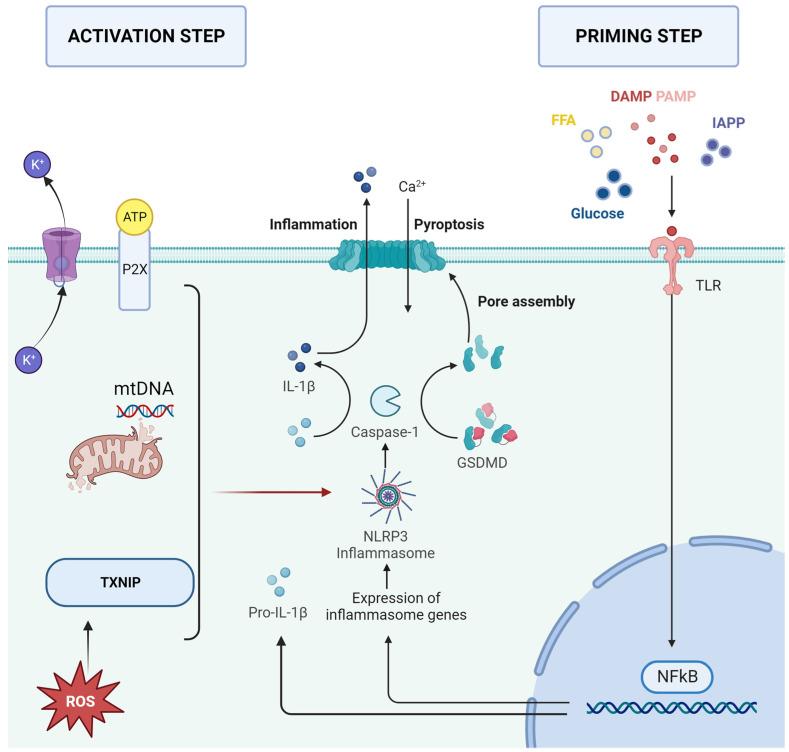
The role of the NLRP3 inflammasome is pivotal in the pathophysiology and progression of diabetes mellitus (DM), encompassing both type 1 (T1D), or type 2 (T2D). As part of the innate immune system, NLRP3 is also responsible for the chronic inflammation triggered by hyperglycemia. In both conditions, NLRP3 facilitates the release of interleukin-1β and interleukin-18. For T1D, NLRP3 perpetuates the autoimmune cascade, leading to the destruction of pancreatic islet cells. In T2D, its activation is associated with the presence of insulin resistance. NLRP3 activation is also instrumental for the presence of numerous complications associated with DM, microvascular and macrovascular. A considerable number of anti-diabetic drugs have demonstrated the ability to inhibit the NLRP3 inflammasome.
NLRP3炎性小体在糖尿病(DM)包括1型糖尿病(T1D)和2型糖尿病(T2D)的病理生理学及进展过程中起关键作用。作为固有免疫系统的一部分,NLRP3还引发由高血糖导致的慢性炎症。在这两种情况下,NLRP3都促进白细胞介素-1β和白细胞介素-18的释放。对于T1D,NLRP3使自身免疫级联反应持续存在,导致胰岛细胞被破坏。在T2D中,其激活与胰岛素抵抗的存在有关。NLRP3激活对于DM相关的众多微血管和大血管并发症的发生也有重要作用。相当数量的抗糖尿病药物已证明具有抑制NLRP3炎性小体的能力。
 Zotero 插件