
磷酸盐与慢性肾脏病患者的冠状动脉疾病。
Phosphate and Coronary Artery Disease in Patients with Chronic Kidney Disease.
机构信息
Division of Nephrology, Department of Internal Medicine, Showa University Northern Yokohama Hospital.
Department of Medical Education, Showa University School of Medicine.
出版信息
J Atheroscler Thromb. 2024 Jan 1;31(1):1-14. doi: 10.5551/jat.RV22012. Epub 2023 Sep 28.
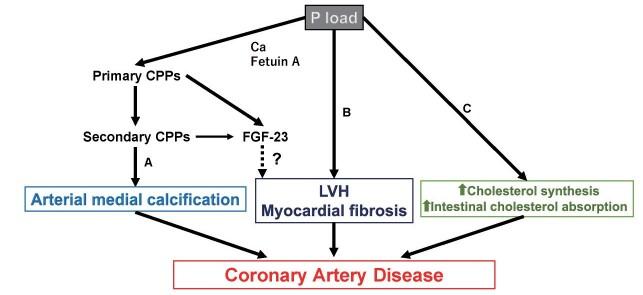
Cardiovascular disease (CVD) is the leading cause of death in patients with chronic kidney disease (CKD). Both traditional and CKD-related factors are associated with CVD in CKD patients. Traditional factors that play an important role in the atherosclerotic process directly contribute to a higher risk of coronary artery disease in patients with early-stage CKD. Among CKD-related factors, CKD-mineral and bone disorder plays a critical role in the pathomechanism of nonatherosclerotic diseases, which increases the risk of cardiovascular morbidity and mortality in patients with advanced CKD. Higher serum phosphate levels were significantly associated with cardiovascular events and all-cause mortality in patients with or without CKD. An increased phosphate load, directly and indirectly, promotes arterial medial calcification and left ventricular hypertrophy, both of which predispose patients to coronary artery disease. Calciprotein particles that form in a hyperphosphatemic state promote the transformation of vascular smooth muscle cells (VSMCs) into osteoblastic cells, thereby providing a scaffold for medial calcification in the artery. Increases in fibroblast growth factor-23 and disturbed vitamin D metabolism induced by an excessive phosphate load play a significant role in the development of cardiomyocyte hypertrophy and cardiac fibrosis. Recently, hyperphosphatemia was reported to promote de novo cholesterol synthesis in VSMCs and macrophages, which is likely to contribute to statin resistance in patients with end-stage kidney disease. This review outlines the association between increased phosphate load and coronary artery disease in patients with CKD.
心血管疾病(CVD)是慢性肾脏病(CKD)患者死亡的主要原因。传统因素和 CKD 相关因素都与 CKD 患者的 CVD 有关。在 CKD 患者中,在动脉粥样硬化过程中起重要作用的传统因素直接导致早期 CKD 患者发生冠心病的风险更高。在 CKD 相关因素中,CKD 矿物质和骨代谢紊乱在非动脉粥样硬化疾病的发病机制中起着关键作用,增加了晚期 CKD 患者心血管发病率和死亡率的风险。较高的血清磷酸盐水平与 CKD 患者和非 CKD 患者的心血管事件和全因死亡率显著相关。磷酸盐负荷的增加直接和间接促进了动脉中层钙化和左心室肥厚,这两者都使患者容易发生冠心病。在高磷酸盐状态下形成的钙磷蛋白颗粒促进血管平滑肌细胞(VSMCs)向成骨细胞转化,从而为动脉中层钙化提供支架。过量磷酸盐负荷引起的成纤维细胞生长因子-23 增加和维生素 D 代谢紊乱在心肌细胞肥大和心脏纤维化的发展中起着重要作用。最近,高磷酸盐血症被报道可促进 VSMCs 和巨噬细胞中胆固醇的从头合成,这可能导致终末期肾病患者对他汀类药物的耐药性。本综述概述了 CKD 患者中磷酸盐负荷增加与冠心病之间的关系。


 Zotero 插件