
建立并验证 MIMIC-III 数据库中肝硬化合并肝性脑病患者的预后列线图。
Establishment and validation of a prognosis nomogram for MIMIC-III patients with liver cirrhosis complicated with hepatic encephalopathy.
机构信息
Department of Gastroenterology, The First Affiliated Hospital of Jinan University, Guangzhou, 510630, China.
Department of Colorectal Surgery, The Sixth Affiliated Hospital, Sun Yat-Sen University, Guangzhou, 510655, China.
出版信息
BMC Gastroenterol. 2023 Sep 28;23(1):335. doi: 10.1186/s12876-023-02967-1.
INTRODUCE
The purpose of this study was to establish a comprehensive prognosis nomogram for patients with liver cirrhosis complicated with hepatic encephalopathy (HE) in the intensive care unit (ICU) and to evaluate the predictive value of the nomogram.
METHOD
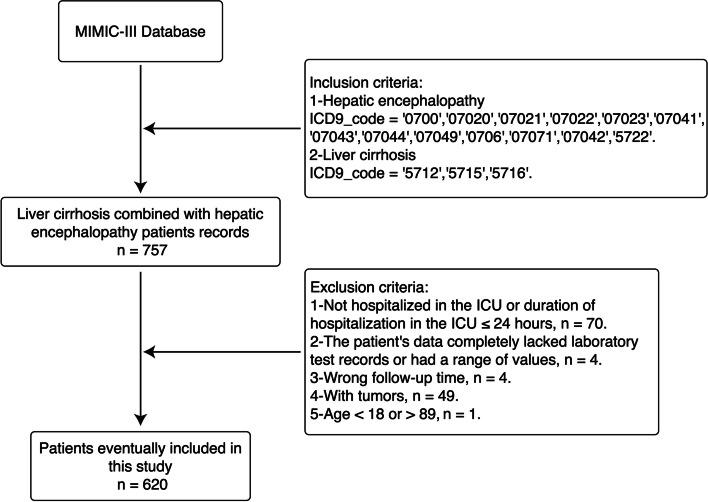
This study analyzed 620 patients with liver cirrhosis complicated with HE from the Medical Information Mart for Intensive Care III(MIMIC-III) database. The patients were randomly divided into two groups in a 7-to-3 ratio to form a training cohort (n = 434) and a validation cohort (n = 176). Cox regression analyses were used to identify associated risk variables. Based on the multivariate Cox regression model results, a nomogram was established using associated risk predictor variables to predict the 90-day survival rate of patients with cirrhosis complicated with HE. The new model was compared with the Sequential organ failure assessment (SOFA) scoring model in terms of the concordance index (C-index), the area under the curve (AUC) of receiver operating characteristic (ROC) analysis, the net reclassification improvement (NRI), the integrated discrimination improvement (IDI), calibration curve, and decision curve analysis (DCA).
RESULTS
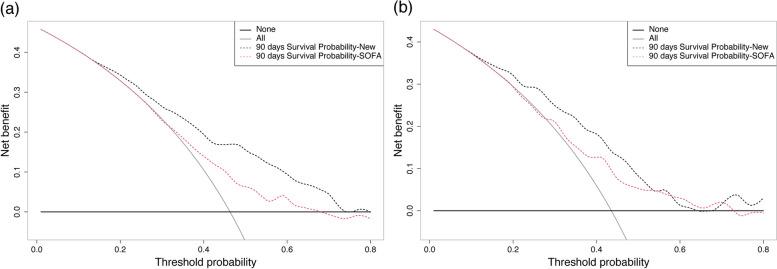
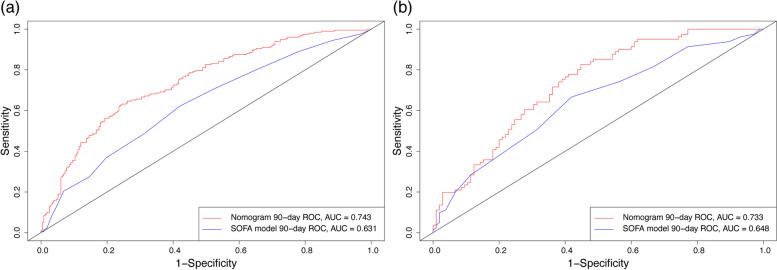
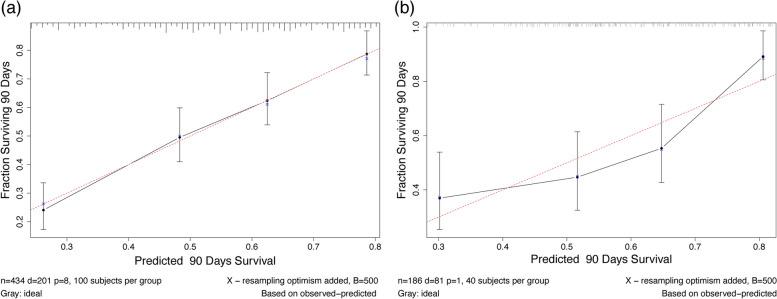
This study showed that older age, higher mean heart rate, lower mean arterial pressure, lower mean temperature, higher SOFA score, higher RDW, and the use of albumin were risk factors for the prognosis of patients with liver cirrhosis complicated with HE. The use of proton pump inhibitors (PPI) was a protective factor. The performance of the nomogram was evaluated using the C-index, AUC, IDI value, NRI value, and DCA curve, showing that the nomogram was superior to that of the SOFA model alone. Calibration curve results showed that the nomogram had excellent calibration capability. The decision curve analysis confirmed the good clinical application ability of the nomogram.
CONCLUSION
This study is the first study of the 90-day survival rate prediction of cirrhotic patients with HE in ICU through the data of the MIMIC-III database. It is confirmed that the eight-factor nomogram has good efficiency in predicting the 90-day survival rate of patients.
简介
本研究旨在为 ICU 中肝硬化合并肝性脑病(HE)患者建立全面的预后列线图,并评估该列线图的预测价值。
方法
本研究分析了来自医疗信息监护 III(MIMIC-III)数据库的 620 例肝硬化合并 HE 患者。患者按 7:3 的比例随机分为两组,分别形成训练队列(n=434)和验证队列(n=176)。采用 Cox 回归分析确定相关风险变量。基于多变量 Cox 回归模型结果,使用相关风险预测变量建立列线图,以预测肝硬化合并 HE 患者 90 天的生存率。将新模型与序贯器官衰竭评估(SOFA)评分模型进行比较,比较指标包括一致性指数(C 指数)、接受者操作特征(ROC)曲线下面积(AUC)、净重新分类改善(NRI)、综合判别改善(IDI)、校准曲线和决策曲线分析(DCA)。
结果
本研究表明,年龄较大、平均心率较高、平均动脉压较低、平均体温较低、SOFA 评分较高、红细胞分布宽度(RDW)较高、使用白蛋白是肝硬化合并 HE 患者预后的危险因素。使用质子泵抑制剂(PPI)是保护因素。通过 C 指数、AUC、IDI 值、NRI 值和 DCA 曲线评估列线图的性能,表明列线图优于 SOFA 模型。校准曲线结果表明,列线图具有良好的校准能力。决策曲线分析证实了列线图良好的临床应用能力。
结论
本研究是通过 MIMIC-III 数据库的数据首次对 ICU 中肝硬化合并 HE 患者的 90 天生存率进行预测。研究证实,八因素列线图在预测患者 90 天生存率方面具有良好的效率。

 Zotero 插件