
开发基于人工智能的儿童和青少年偏头痛诊断模型。
Developing an Artificial Intelligence-Based Pediatric and Adolescent Migraine Diagnostic Model.
作者信息
Sasaki Shiori, Katsuki Masahito, Kawahara Junko, Yamagishi Chinami, Koh Akihito, Kawamura Shin, Kashiwagi Kenta, Ikeda Takashi, Goto Tetsuya, Kaneko Kazuma, Wada Naomichi, Yamagishi Fuminori
机构信息
Department of Neurosurgery, Japanese Red Cross Suwa Hospital, Suwa, JPN.
Department of Neurosurgery, Itoigawa General Hospital, Itoigawa, JPN.
出版信息
Cureus. 2023 Aug 30;15(8):e44415. doi: 10.7759/cureus.44415. eCollection 2023 Aug.
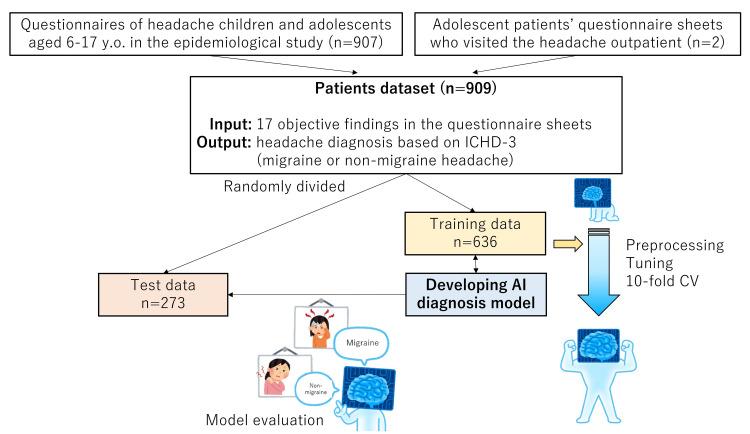
Introduction Misdiagnosis of pediatric and adolescent migraine is a significant problem. The first artificial intelligence (AI)-based pediatric migraine diagnosis model was made utilizing a database of questionnaires obtained from a previous epidemiological study, the Itoigawa Benizuwaigani Study. Methods The AI-based headache diagnosis model was created based on the internal validation based on a retrospective investigation of 909 patients (636 training dataset for model development and 273 test dataset for internal validation) aged six to 17 years diagnosed based on the International Classification of Headache Disorders 3rd edition. The diagnostic performance of the AI model was evaluated. Results The dataset included 234/909 (25.7%) pediatric or adolescent patients with migraine. The mean age was 11.3 (standard deviation 3.17) years. The model's accuracy, sensitivity (recall), specificity, precision, and F-values for the test dataset were 94.5%, 88.7%, 96.5%, 90.0%, and 89.4%, respectively. Conclusions The AI model exhibited high diagnostic performance for pediatric and adolescent migraine. It holds great potential as a powerful tool for diagnosing these conditions, especially when secondary headaches are ruled out. Nonetheless, further data collection and external validation are necessary to enhance the model's performance and ensure its applicability in real-world settings.
引言 儿童和青少年偏头痛的误诊是一个重大问题。首个基于人工智能(AI)的儿童偏头痛诊断模型是利用从之前一项流行病学研究——糸鱼川贝津川研究中获得的问卷数据库构建的。方法 基于《国际头痛疾病分类》第3版,对909名6至17岁已确诊的患者(636例用于模型开发的训练数据集和273例用于内部验证的测试数据集)进行回顾性调查,在此基础上进行内部验证,从而创建基于人工智能的头痛诊断模型。对该人工智能模型的诊断性能进行了评估。结果 数据集中包括234/909(25.7%)名患有偏头痛的儿童或青少年患者。平均年龄为11.3岁(标准差3.17)。测试数据集的模型准确率、敏感性(召回率)、特异性、精确率和F值分别为94.5%、88.7%、96.5%、90.0%和89.4%。结论 该人工智能模型对儿童和青少年偏头痛表现出较高的诊断性能。作为诊断这些疾病的有力工具,它具有巨大潜力,尤其是在排除继发性头痛的情况下。尽管如此,仍需要进一步收集数据和进行外部验证,以提高模型性能并确保其在实际环境中的适用性。


 Zotero 插件