
精确解析 Bürgi-Dunitz 角:二维能量分解分析的威力
Unraveling the Bürgi-Dunitz Angle with Precision: The Power of a Two-Dimensional Energy Decomposition Analysis.
作者信息
Fernández Israel, Bickelhaupt F Matthias, Svatunek Dennis
机构信息
Departamento de Química Orgánica and Centro de Innovación en Química Avanzada (ORFEO-CINQA), Facultad de Ciencias Químicas, Universidad Complutense de Madrid, 28040-Madrid, Spain.
Department of Chemistry and Pharmaceutical Sciences, AIMMS, Vrije Universiteit Amsterdam, De Boelelaan 1108, 1081 HZ Amsterdam, The Netherlands.
出版信息
J Chem Theory Comput. 2023 Oct 24;19(20):7300-7306. doi: 10.1021/acs.jctc.3c00907. Epub 2023 Oct 4.
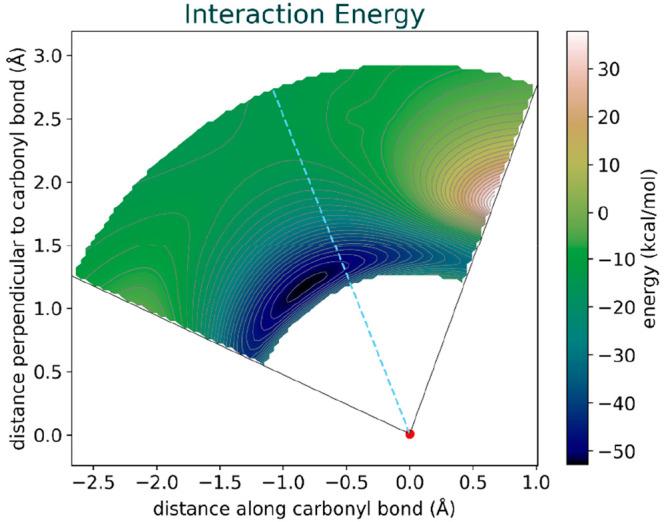
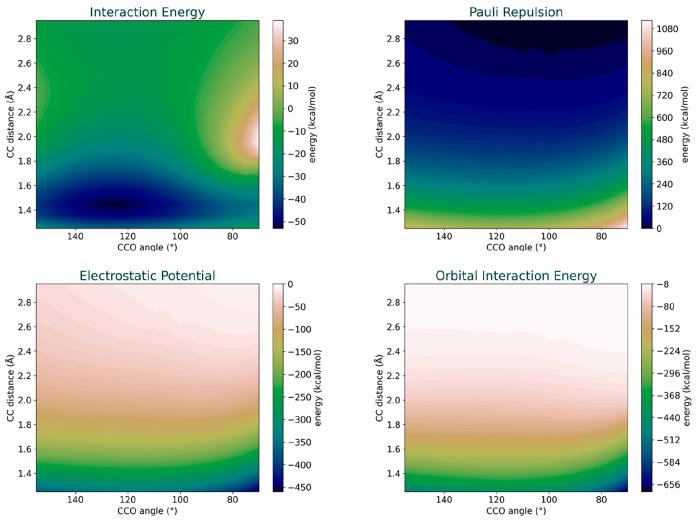
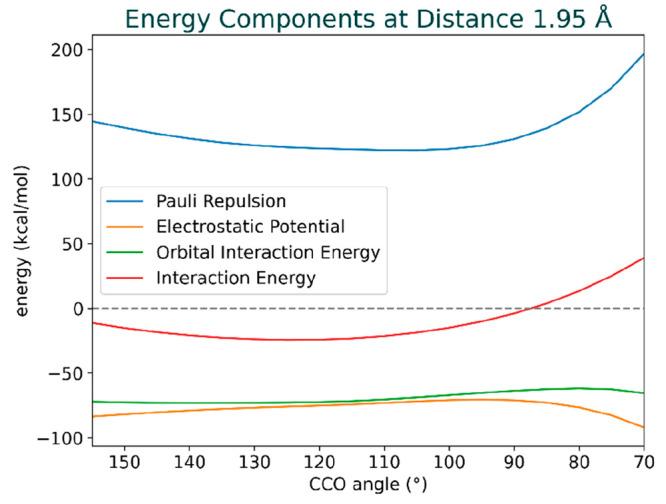
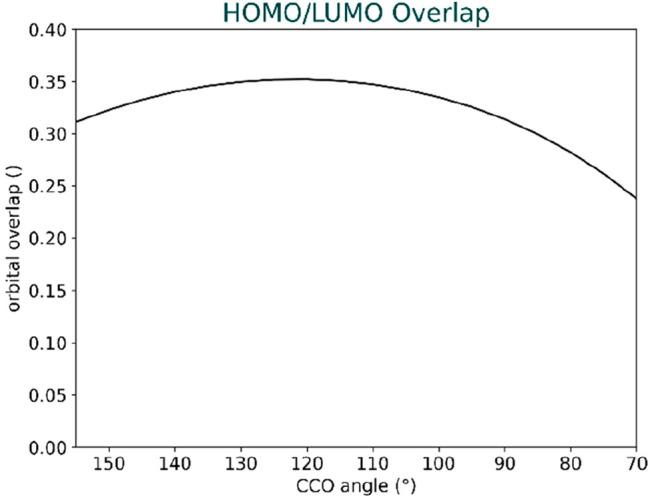
Understanding the geometrical preferences in chemical reactions is crucial for advancing the field of organic chemistry and improving synthetic strategies. One such preference, the Bürgi-Dunitz angle, is central to nucleophilic addition reactions involving carbonyl groups. This study successfully employs a novel two-dimensional Distortion-Interaction/Activation-Strain Model in combination with a two-dimensional Energy Decomposition Analysis to investigate the origins of the Bürgi-Dunitz angle in the addition reaction of CN to (CH)C═O. We constructed a 2D potential energy surface defined by the distance between the nucleophile and carbonylic carbon atom and by the attack angle, followed by an in-depth exploration of energy components, including strain and interaction energy. Our analysis reveals that the Bürgi-Dunitz angle emerges from a delicate balance between two key factors: strain energy and interaction energy. High strain energy, as a result of the carbonyl compound distorting to avoid Pauli repulsion, is encountered at high angles, thus setting the upper bound. On the other hand, interaction energy is shaped by a dominant Pauli repulsion when the angles are lower. This work emphasizes the value of the 2D Energy Decomposition Analysis as a refined tool, offering both quantitative and qualitative insights into chemical reactivity and selectivity.
理解化学反应中的几何偏好对于推动有机化学领域的发展和改进合成策略至关重要。其中一种偏好,即 Bürgi-Dunitz 角,是涉及羰基的亲核加成反应的核心。本研究成功地采用了一种新颖的二维畸变-相互作用/活化应变模型,并结合二维能量分解分析,来研究 CN 与(CH)C═O 加成反应中 Bürgi-Dunitz 角的起源。我们构建了一个由亲核试剂与羰基碳原子之间的距离和进攻角度定义的二维势能面,随后深入探究了包括应变能和相互作用能在内的能量成分。我们的分析表明,Bürgi-Dunitz 角源自两个关键因素之间的微妙平衡:应变能和相互作用能。由于羰基化合物为避免泡利排斥而发生畸变,在大角度时会遇到高应变能,从而设定了上限。另一方面,当角度较小时,相互作用能由占主导的泡利排斥作用塑造。这项工作强调了二维能量分解分析作为一种精细工具的价值,它为化学反应性和选择性提供了定量和定性的见解。



 Zotero 插件